Choosing between them comes down to how often you fly United, whether you’re working toward elite status and how easily you can use each card’s credits and features.
United℠ Explorer Card
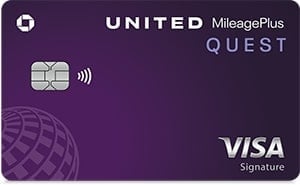
United Quest℠ Card
United℠ Explorer Card
$0 intro for the first year, then $150
United℠ Explorer Card
Earn up to 80,000 United MileagePlus bonus miles after spending $3,000 on qualifying purchases in the first 3 months of opening an account (70K + 10K more miles with an authorized user).
United Quest℠ Card
Earn up to 100,000 United MileagePlus bonus miles and 3,000 PQP after spending $4,000 on qualifying purchases in the first 3 months of opening an account (90K + 10K more miles with an authorized user).
United℠ Explorer Card
3 miles per $1 spent on United purchases.
2 miles per $1 spent on hotels booked direct and restaurant purchases, including takeout.
1 mile per $1 spent on all other purchases.
United Quest℠ Card
4 miles per $1 spent on United purchases.
5 miles per $1 spent on prepaid hotel stays booked through Chase’s “Renowned Hotels and Resorts” collection.
2 miles per $1 spent on all other travel, dining (including takeout) and select streaming services.
1 mile per $1 spent on all other purchases.
Annual credits & other perks
United℠ Explorer Card
Up to $430 in annual statement credits.
Up to $120 statement credit every four years for Global Entry, TSA PreCheck or NEXUS.
2 United Club lounge passes.
Travel insurance, no foreign transaction fees and one free checked bag for the traveler and a companion.
United Quest℠ Card
Up to $860 in annual statement credits.
Up to $120 statement credit every four years for Global Entry, TSA PreCheck or NEXUS.
Travel insurance, no foreign transaction fees and two free checked bags for the traveler and a companion.
United Explorer vs. United Quest: Important factors
Here’s how the annual fees of the two cards compare:
United℠ Explorer Card annual fee: $0 intro for the first year, then $150.
United Quest℠ Card annual fee: $350.
While the United℠ Explorer Card may seem like the obvious choice due to its lower fee, the value of each card depends on how well you can use its features, particularly the annual credits that can help offset the cost.
The usefulness of these annual credits depends on how easily you can use them. Some require enrollment, and others are issued in smaller increments throughout the year, so you may need to use them consistently to get the full value. For example, a $60 rideshare credit may be issued as $5 monthly credits, so you’d need to use it each month to get the full value.
United℠ Explorer Card ($430 in annual credits)
$60 in statement credits on rideshare purchases ($5 monthly).
$100 in statement credits on prepaid stays at United Hotels ($50 on your first and second booking).
$50 in United TravelBank cash for Avis or Budget car rentals ($25 on your first and second booking).
$120 in Instacart credits ($10 monthly; benefit ends 12/31/27).
$100 statement credit on JSX flights.
United Quest℠ Card ($860 in annual credits)
$200 in United TravelBank cash.
$150 in statement credits on prepaid stays booked through Renowned Hotels and Resorts.
$100 in statement credits on rideshare purchases ($8 January through November; $12 in December).
$80 in United TravelBank cash for Avis or Budget car rentals ($40 on your first and second booking).
$150 in statement credit on JSX flights.
$180 in annual Instacart credits ($15 monthly; benefit ends 12/31/27).
At first glance, these credits can make both cards seem like they more than pay for themselves. In practice, their value depends on how easily you can use each benefit. Some credits are tied to specific merchants or issued in small increments, which can make them harder to fully use.
From there, the decision comes down to the other benefits and earning rates.
Checked bags and flight benefits
The United Quest℠ Card also includes access to Renowned Hotels and Resorts benefits, such as a $100 property credit and perks like breakfast and room upgrades on eligible stays, which can pair nicely with the $150 annual statement credit on these reservations.
Beyond that, the cards are otherwise largely aligned. Both offer priority boarding, a Global Entry, TSA PreCheck or NEXUS fee credit every four years, 25% back on inflight purchases, no foreign transaction fees and travel insurance.
Each card has additional spending-based perks, but these require relatively high minimums and may not factor into the decision for most travelers.
When it comes to redeeming miles, the United Quest℠ Card offers a clear advantage. Cardholders receive a 10,000-mile discount on an eligible award flight each year starting on their first anniversary, with the opportunity to earn an additional 10,000-mile discount after meeting an annual spending threshold. This can provide meaningful savings for those who regularly book award flights with United miles.
The United℠ Explorer Card does not offer a comparable benefit. Both cards do, however, allow eligible MileagePlus Premier members to access complimentary upgrades on award tickets when flying on select United-operated flights, subject to availability.
The United℠ Explorer Card earns 3 miles per dollar on United purchases, while the United Quest℠ Card earns 4 miles per dollar. However, the deciding factor isn’t the 1-mile difference between the two cards, but rather how United awards miles to travelers without a co-branded credit card.
For tickets issued starting April 2, 2026, general MileagePlus members without an eligible United credit card won’t earn any miles on basic economy fares and will earn only 3 miles per dollar on all other fares. In contrast, cardholders earn 3 miles per dollar on basic economy and 6 miles per dollar on all other fares. When you combine the cardholder rate with each card’s bonus, the difference between holding a United credit card and not becomes more apparent:
Scenario
Non-basic economy
Basic economy
No United credit card
3 miles per $1
0 miles per $1
Flight booked with United Explorer Card
9 miles per $1
3 miles per $1
Flight booked with United Quest Card
10 miles per $1
3 miles per $1
The bigger takeaway is that holding an eligible United credit card significantly increases your earn rate compared to flying without one. If you frequently fly United and want to earn miles on your travels, there’s a compelling reason to have one of these cards, as United is clearly trying to incentivize travelers to hold one of its cards.
Elite status consideration (PQP earning)
If you’re working toward United elite status, the United Quest℠ Card is the clear winner. It comes with 1,000 bonus Premier Qualifying Points (PQP) each year and allows you to earn 1 PQP for every $20 spent, up to 18,000 PQP annually. In contrast, the United Explorer Card earns PQP at the same rate but caps out at just 1,000 PQP per year.
This means that with enough spending, the Quest Card can meaningfully contribute toward earning Premier status.
Elite status tier
2026 requirements
Premier Silver
5,000 PQP and 15 PQFOr6,000 PQP.
Premier Gold
10,000 PQP and 30 PQFOr12,000 PQP.
Premier Platinum
15,000 PQP and 45 PQFOr18,000 PQP.
Premier 1K
22,000 PQP and 60 PQFOr28,000 PQP.
United Explorer vs. United Quest: Minor features to consider
Both cards also come with a similar set of travel and purchase protections. These include trip cancellation and interruption insurance, trip delay reimbursement, baggage delay insurance, lost luggage reimbursement and primary car rental coverage. Cardholders also get purchase protection and extended warranty coverage, along with access to Visa concierge services.
Each card also offers modest bonus categories on non-United spend, but you could likely earn more with other credit cards.
Which card should you get?
Choose the United℠ Explorer Card if:
The United℠ Explorer Card is a better fit if you fly United occasionally and want to save on checked bag fees, which start at $45 per person on domestic flights. It also makes sense if you value United Club access and can use the two United Club passes each year. If you prefer a lower annual fee and can get some value from the card’s statement credits, it may be the more practical choice.
Choose the United Quest℠ Card if:
The United Quest℠ Card is a better option if you’re working toward United elite status and want to earn PQP through spending. It also makes sense if you fly United more frequently and want a higher checked baggage allowance.
There’s no clear winner between the United℠ Explorer Card and the United Quest℠ Card, as they’re designed for different types of travelers. However, for the occasional United flyer who isn’t focused on Premier elite status, the United℠ Explorer Card is the better fit.
It offers key perks like free checked bags and travel protections, along with higher mileage earning rates on United flights compared to not having a card, all while maintaining a relatively modest annual fee. Compared to the United Quest℠ Card, which comes with a hefty annual fee, the United℠ Explorer Card makes it easier for occasional United travelers to extract value without needing to fully maximize every credit.
How to maximize your rewards
About the author

Elina Geller is a contributing NerdWallet travel writer specializing in airline and hotel loyalty programs and travel insurance. In 2019, Elina founded TheMissMiles, a travel rewards coaching business. Her work has been featured by Forbes and AwardWallet. She is a certified public accountant with degrees from the London School of Economics and Fordham University.