
No Result
View All Result
  • Login
Thursday, August 27, 2026
FeeOnlyNews.com
  • Home
  • Business
  • Financial Planning
  • Personal Finance
  • Investing
  • Money
  • Economy
  • Markets
  • Stocks
  • Trading
  • Home
  • Business
  • Financial Planning
  • Personal Finance
  • Investing
  • Money
  • Economy
  • Markets
  • Stocks
  • Trading
No Result
View All Result
FeeOnlyNews.com
No Result
View All Result
Home Cryptocurrency

How institutions made Bitcoin a weekday market so retail takes on all the weekend risk

by FeeOnlyNews.com
5 months ago
in Cryptocurrency
Reading Time: 6 mins read
A A
0
How institutions made Bitcoin a weekday market so retail takes on all the weekend risk
Share on FacebookShare on TwitterShare on LInkedIn


Make CryptoSlate preferred on

Bitcoin might trade around the clock, but its liquidity doesn’t anymore. The asset that was supposed to become more resilient after absorbing billions in institutional capital through ETFs has instead developed a split personality, one that looks deep and orderly during New York trading hours and considerably more fragile once Wall Street’s desks go dark.

Fresh data from Kaiko published this week quantifies what many traders have felt for a while: the same ETF-driven maturation that deepened Bitcoin’s weekday market has hollowed out its weekend trading, creating a two-tier trading environment where smaller participants absorb a disproportionate share of risk.

Since spot Bitcoin ETFs launched in January 2024, institutional participation has concentrated during US weekday sessions, pushing the share of trading volume occurring in those hours to roughly 47%, according to Kaiko’s analysis.

Weekday volumes now consistently run at double weekend levels, a gap that has widened throughout 2025 and into 2026 as institutional allocations have grown. The promise of a uniform 24/7 market, the feature that was supposed to distinguish crypto from everything else in finance, is weakening in practice because Bitcoin is still open every Saturday and Sunday, while the capital that provides its depth isn’t.

BTC still trades 24/7, but serious liquidity is becoming more selective

The shift is seen in what traders call orderbook depth, the total dollar value of buy and sell orders sitting within a given distance of the current price. It’s an important measure of liquidity, as it functions as a rough measure of how much selling or buying a market can absorb before the price starts moving against you.

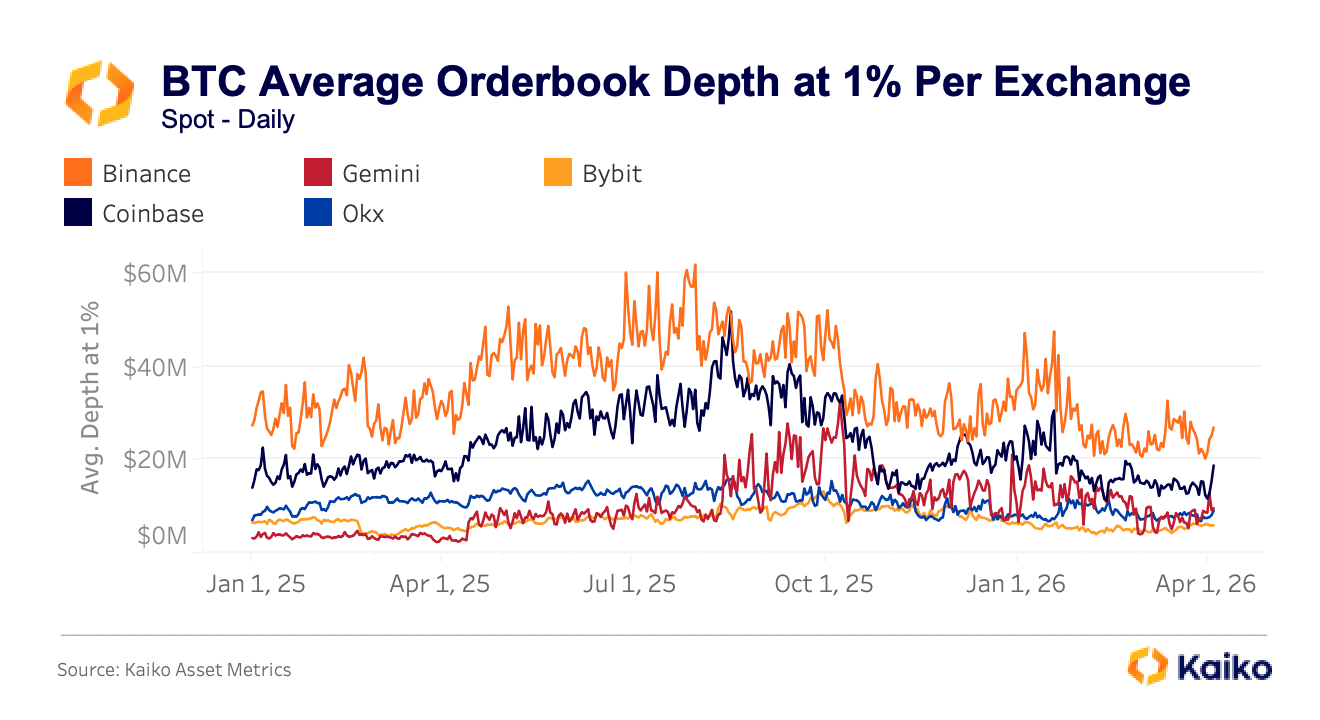
Kaiko tracks depth at 1% from the midpoint, meaning all the resting orders within one percent above and below the current Bitcoin price, and that figure varies enormously depending on where you trade. Binance consistently provides around $30 million in depth at that level, while Coinbase ranges between $16 million and $20 million.
bitcoin exchange orderbook 1% depthbitcoin exchange orderbook 1% depth
Graph showing Bitcoin’s average orderbook depth at 1% across exchanges from Jan. 1, 2025, to Apr. 1, 2026 (Source: Kaiko)

Secondary exchanges, including Gemini, Bybit, and OKX, typically show $10 million to $15 million in volume, producing a two-to-three-times differential that translates directly into worse prices for anyone placing a meaningful order on the wrong platform.

That differential doesn’t remain stable under stress, and in fact, it tends to blow out almost exactly when it would be most costly. During the tariff-driven sell-off last October, BTC spot prices diverged materially across venues within minutes, with Binance quoting $102,318, OKX showing $102,142, and Bybit lagging at $101,675, a $643 spread that persisted for several minutes rather than the seconds one would expect if the usual automated arbitrage mechanisms were closing gaps efficiently.

The pattern repeated during March 2026’s geopolitical escalation in the Middle East, when the cost of trading BTC-USDT on Bybit surged 230% from its normal level, with similar spikes on OKX and Binance. Both episodes began on weekends, when institutional participants had already stepped away, and order books were at their thinnest.

Bitcoin’s rebound looks like a trap as real Hormuz threat may not be overBitcoin’s rebound looks like a trap as real Hormuz threat may not be over
Related Reading

Bitcoin’s rebound looks like a trap as real Hormuz threat may not be over

Banks and energy forecasters see a slower repair in oil flows, keeping inflation and Fed risk alive for Bitcoin.

Apr 8, 2026 · Gino Matos

When Wall Street closes, the gap between “the price” and your price can widen fast

This has some very real and tangible consequences. On Feb. 1, Bitcoin price plunged below $78,000 on a Saturday afternoon, triggering roughly $2.2 billion in liquidations across more than 335,000 traders within 24 hours.

The drawdown was amplified by structurally thin weekend liquidity rather than by any crypto-specific fundamental breakdown, meaning the market wasn’t responding to bad news about Bitcoin so much as to the mechanical reality that fewer participants were present to absorb selling pressure.

A subsequent VanEck analysis of the broader February sell-off found that Bitcoin’s single-day price move on Feb. 5 ranked among the fastest crashes in the asset’s recorded history by statistical measures of speed and magnitude, the kind of extreme event that probability models would predict almost never occurs, yet has now surfaced twice in five months.

A trader buying or selling on a Saturday evening, or on any secondary venue during elevated volatility, may not receive anything close to the consensus Bitcoin price they believe they’re transacting at.

The gap between the quoted price and the executed price tends to widen when the consequences of a bad fill are most severe, and that asymmetry falls hardest on the participants who lack the institutional infrastructure to wait for better conditions.

CryptoSlate Daily Brief

Daily signals, zero noise.

Market-moving headlines and context delivered every morning in one tight read.

5-minute digest 100k+ readers

Free. No spam. Unsubscribe any time.

Whoops, looks like there was a problem. Please try again.

You’re subscribed. Welcome aboard.

Bitcoin whales are dumping massive amounts of supply on exchanges as liquidations mirror the 2022 FTX market collapseBitcoin whales are dumping massive amounts of supply on exchanges as liquidations mirror the 2022 FTX market collapse
Related Reading

Bitcoin whales are dumping massive amounts of supply on exchanges as liquidations mirror the 2022 FTX market collapse

Traders scramble for “smoking gun” as rumors fly, but ETF outflows and whale deposits offer clearer clues to Bitcoin’s steep decline.

Feb 6, 2026 · Oluwapelumi Adejumo

While retail traders clearly still participate in crypto, Kaiko’s research suggests they’ve been pushed into the thinner, less protected parts of it. In terms of time, retail is more exposed during off-hours and weekends, the periods when ETF flows are inactive and institutional market-making retreats.

In terms of geography, retail remains dominant in markets that don’t resemble the US ETF-driven Bitcoin trade at all, with South Korea continuing to run heavily on retail participation and altcoin volume while Turkey’s crypto activity reflects macro-stress hedging and stablecoin demand rather than the institutional activity we’ve seen surge in the US.

There’s also an asset dimension to the split.

Institutional capital, channeled through ETFs and prime brokerage arrangements, has standardized Bitcoin trading more than anything else in crypto, concentrating sophisticated market-making and deep liquidity around BTC, leaving the rest of the landscape (altcoins, local-currency pairs, smaller platforms) with thinner coverage and less professional support. Speculative and fragmented activity persists in abundance across the broader market, just not in the same exchanges and hours that institutions have colonized.

Same Bitcoin, different market quality

What emerges from this data is something that’s increasingly difficult to deny: there may now be two Bitcoin markets running in parallel. A deeper, more efficient, institution-shaped weekday market accessible through ETFs and prime venues, and a thinner, more volatile off-hours market where smaller traders are more likely to be present and more likely to bear the cost of poor execution.

In theory, Bitcoin is the same asset for everyone, but in practice, the quality of the market you encounter depends heavily on when you trade and where you trade.

None of this is an argument that ETFs broke Bitcoin. Institutional participation has brought real benefits, including deeper aggregate liquidity, tighter average spreads during normal conditions, and a degree of legitimacy that none of the previous cycles had.

Cumulative net inflows into US spot Bitcoin ETFs still sit around $53 to $54 billion since launch, even after heavy outflows in early 2026, and they’ve absorbed enormous capital and survived genuine volatility without collapsing.

But the same forces that improved Bitcoin’s best hours appear to have exposed how uneven the market becomes when that participation recedes, delivering maturity for some sessions while leaving fragility in others.


Source link

Tags: BitcoinInstitutionsmarketRetailRiskTakesWeekdayWeekend
ShareTweetShare
Previous Post

There’s a kind of exhaustion specific to people who grew up in the 1960s and 70s — not physical tiredness but the cumulative weight of having been reliable for so long, for so many people, with so little reciprocity, that they genuinely cannot remember what it felt like to be the one who was taken care of

Next Post

How market’s private credit crisis fears are spreading to bond ETFs

Related Posts

EU to Advance MiCA Review, Targeting Non-EU Stablecoin Rules

EU to Advance MiCA Review, Targeting Non-EU Stablecoin Rules

by FeeOnlyNews.com
August 8, 2026
0

Key TakeawaysThe EU is set to revise the MiCA framework to allow excluded foreign stablecoins like Tether to operate.This regulatory...

Coinbase CEO Brian Armstrong Says Crypto Progress Continues Despite CLARITY Act Delay

Coinbase CEO Brian Armstrong Says Crypto Progress Continues Despite CLARITY Act Delay

by FeeOnlyNews.com
August 7, 2026
0

Coinbase CEO Brian Armstrong said crypto adoption continues despite the delayed CLARITY Act, pointing to growing stablecoin use, tokenization, and...

Bybit Uses Tokenised Equities as Underlyings for Structured Yield

Bybit Uses Tokenised Equities as Underlyings for Structured Yield

by FeeOnlyNews.com
August 7, 2026
0

Bybit is expanding the role of tokenised equities on its platform by using more xStocks as underlyings for its Dual...

Senate abandons August CLARITY Act vote

Senate abandons August CLARITY Act vote

by FeeOnlyNews.com
August 7, 2026
0

The US Senate has abandoned plans to vote on the landmark CLARITY Act legislation before its August break.On Aug. 6,...

Reform UK Chair Calls for Probe into SBF-Linked Donation: Report

Reform UK Chair Calls for Probe into SBF-Linked Donation: Report

by FeeOnlyNews.com
August 7, 2026
0

The chairman of the UK’s Reform party has called for an investigation following reports of a $50,000 political donation linked...

MARA Reports 1M Loss While Miners Deposit 581 BTC to NYDIG

MARA Reports $611M Loss While Miners Deposit 581 BTC to NYDIG

by FeeOnlyNews.com
August 7, 2026
0

Key TakeawaysMARA’s Q2 revenue fell 27% to $174.9 million, missing Wall Street estimates by more than 16%.Riot Platforms and MARA...

Next Post
How market’s private credit crisis fears are spreading to bond ETFs

How market's private credit crisis fears are spreading to bond ETFs

Foundayo, Wegovy and How GLP-1 Weight-Loss Pills Compare to Shots

Foundayo, Wegovy and How GLP-1 Weight-Loss Pills Compare to Shots

  • Trending
  • Comments
  • Latest
Bitcoin and ethereum prices today, Friday, August 7, 2026: Crypto prices moving higher following July jobs report

Bitcoin and ethereum prices today, Friday, August 7, 2026: Crypto prices moving higher following July jobs report

August 7, 2026
MEXC Lists Ondo Yield Asset As Tokenized Treasury Demand Grows

MEXC Lists Ondo Yield Asset As Tokenized Treasury Demand Grows

July 3, 2026
Why did a 4 billion CEO just endorse stripping most Americans of voting rights?

Why did a $154 billion CEO just endorse stripping most Americans of voting rights?

July 27, 2026
Yahoo Finance Plus Review – Is the Premium Service Worth It?

Yahoo Finance Plus Review – Is the Premium Service Worth It?

May 20, 2026
11 Remote Jobs You Can Start Today With Zero Experience

11 Remote Jobs You Can Start Today With Zero Experience

March 27, 2026
Simple Rules That Helped Mariana Reach  Million

Simple Rules That Helped Mariana Reach $1 Million

March 26, 2026
Advanced Micro Devices (AMD) Price Prediction: How Much a ,000 Investment Could Be Worth by 2031

Advanced Micro Devices (AMD) Price Prediction: How Much a $5,000 Investment Could Be Worth by 2031

0
Cities holding up to 3 million people found under Amazon rain forest

Cities holding up to 3 million people found under Amazon rain forest

0
Republican Party Displacement | Mises Institute

Republican Party Displacement | Mises Institute

0
Bybit Uses Tokenised Equities as Underlyings for Structured Yield

Bybit Uses Tokenised Equities as Underlyings for Structured Yield

0
Explained: How BSE traded fewer contracts after CAS but premiums rose 75% in first week

Explained: How BSE traded fewer contracts after CAS but premiums rose 75% in first week

0
Vaxart outlines Phase IIb COVID-19 top line data in first half of 2027 backed by BARDA funding (OTCMKTS:VXRT)

Vaxart outlines Phase IIb COVID-19 top line data in first half of 2027 backed by BARDA funding (OTCMKTS:VXRT)

0
Advanced Micro Devices (AMD) Price Prediction: How Much a ,000 Investment Could Be Worth by 2031

Advanced Micro Devices (AMD) Price Prediction: How Much a $5,000 Investment Could Be Worth by 2031

August 8, 2026
Republican Party Displacement | Mises Institute

Republican Party Displacement | Mises Institute

August 8, 2026
Vanguard Chief Economist: AI and jobs, still in an ATM phase

Vanguard Chief Economist: AI and jobs, still in an ATM phase

August 8, 2026
Explained: How BSE traded fewer contracts after CAS but premiums rose 75% in first week

Explained: How BSE traded fewer contracts after CAS but premiums rose 75% in first week

August 8, 2026
Democrats’ Affordability Message Misses a Key Expense—Student Debt

Democrats’ Affordability Message Misses a Key Expense—Student Debt

August 8, 2026
Banks or NBFCs? DSP’s Preethi R S explains where she sees the best opportunities

Banks or NBFCs? DSP’s Preethi R S explains where she sees the best opportunities

August 8, 2026
FeeOnlyNews.com

Get the latest news and follow the coverage of Business & Financial News, Stock Market Updates, Analysis, and more from the trusted sources.

CATEGORIES

  • Business
  • Cryptocurrency
  • Economy
  • Financial Planning
  • Investing
  • Market Analysis
  • Markets
  • Money
  • Personal Finance
  • Startups
  • Stock Market
  • Trading

LATEST UPDATES

  • Advanced Micro Devices (AMD) Price Prediction: How Much a $5,000 Investment Could Be Worth by 2031
  • Republican Party Displacement | Mises Institute
  • Vanguard Chief Economist: AI and jobs, still in an ATM phase
  • Our Great Privacy Policy
  • Terms of Use, Legal Notices & Disclaimers
  • About Us
  • Contact Us

Copyright © 2022-2024 All Rights Reserved
See articles for original source and related links to external sites.

Welcome Back!

Sign In with Facebook
Sign In with Google
Sign In with Linked In
OR

Login to your account below

Forgotten Password?

Retrieve your password

Please enter your username or email address to reset your password.

Log In
No Result
View All Result
  • Home
  • Business
  • Financial Planning
  • Personal Finance
  • Investing
  • Money
  • Economy
  • Markets
  • Stocks
  • Trading

Copyright © 2022-2024 All Rights Reserved
See articles for original source and related links to external sites.