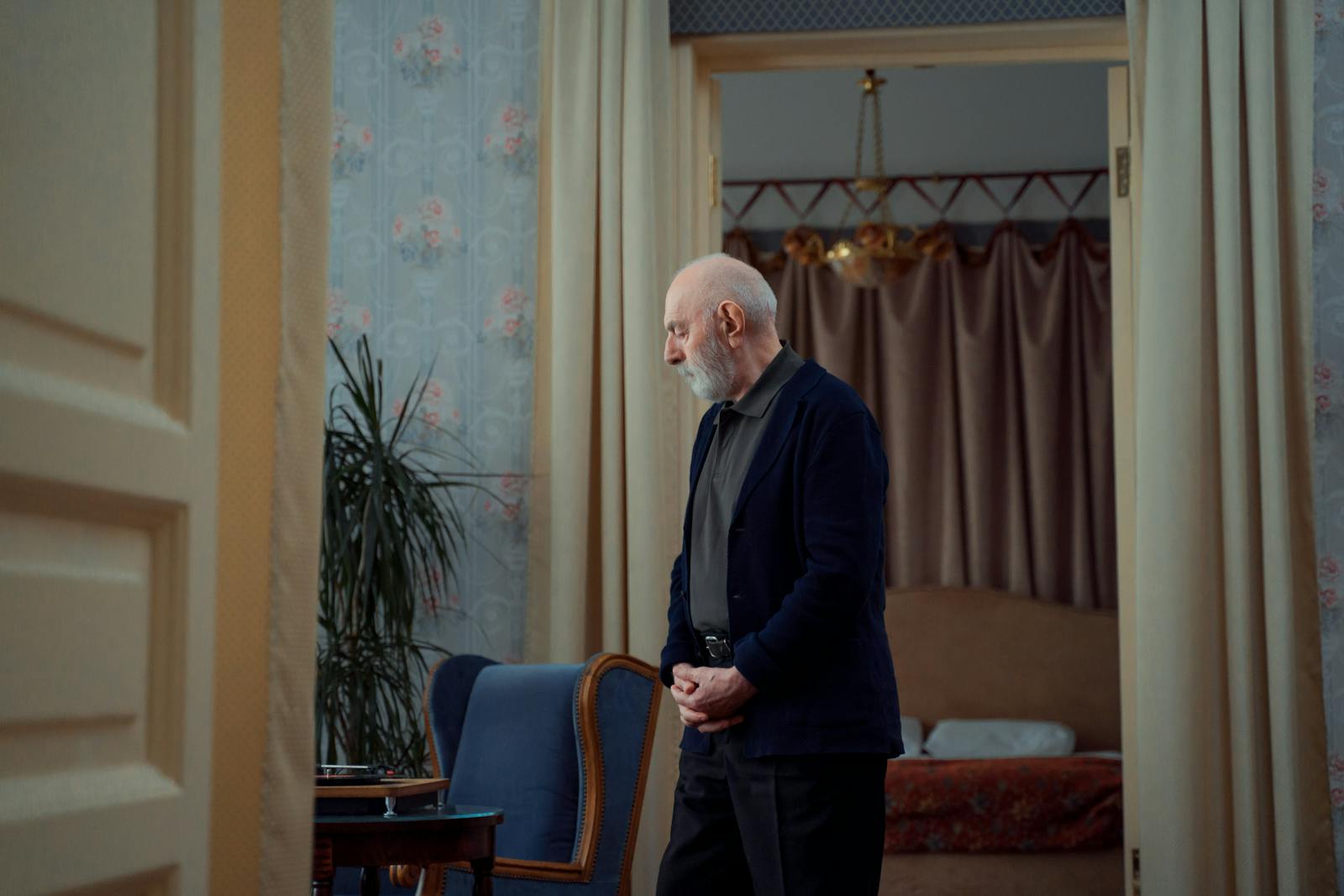
Everyone celebrates the friend who checks in. Social media loves them. “Protect the friend who remembers everything.” “Cherish the one who always asks how you’re doing.” Here’s what nobody wants to say: that friend’s caretaking is not always generosity. Sometimes it’s a control strategy. Sometimes the person who tracks everyone else’s pain is running the most sophisticated avoidance operation you’ve ever seen, and the thing they’re avoiding is the terrifying possibility that they themselves might need something.
I know this because I was that person for about thirty years.
And if you recognized yourself in that title before you even clicked, I already know a few things about you. You’re tired in a way that doesn’t show up on your face. You’ve rehearsed saying “I’m actually not doing great” and then abandoned it mid-conversation more times than you can count. And somewhere along the way, you stopped being hurt that nobody noticed and started being confirmed by it. Like the absence of being seen was just evidence of something you already suspected about your own visibility in the world.
Let me be direct: that belief is understandable, it’s deeply rooted, and it’s wrong.
Where the Pattern Starts
I’ve talked to enough people — in conversations, through reader emails, through the brutally honest exchanges that happen in my own life — to see a common thread. The person who becomes the perpetual caretaker in their friendships almost always learned early that their emotional needs were either too much, poorly timed, or simply uninteresting to the people who were supposed to notice.
Maybe you had a parent who was dealing with their own depression and you learned, at seven or eight years old, that the household couldn’t hold your sadness and theirs. Maybe you had a sibling with greater needs: medical, behavioral, academic. And you became “the easy one.” Maybe nobody was cruel about it at all. Maybe you were just quietly overlooked by people who loved you but didn’t have the bandwidth to see you, and you adapted the way kids do: by becoming useful instead of needy.
That adaptation is brilliant, honestly. A kid who learns to monitor the emotional states of everyone around them, who learns to provide comfort and anticipate needs: that kid survives. That kid gets praised. Teachers like that kid. Friends are drawn to that kid. It works.
The problem is that it works so well, you never stop doing it. And by adulthood, you’ve built an entire identity around being the person who gives care, and you’ve simultaneously built an invisible wall that makes receiving care feel somewhere between uncomfortable and impossible.
What It Actually Looks Like
Let me give you some concrete examples, because I think a lot of people live inside this pattern without recognizing it.
You’re going through something: a health scare, a financial crisis, a stretch of depression that’s been sitting on your chest for weeks. A friend asks how you’re doing. You say, “Good! Hey, how did that thing with your landlord work out?” You redirect so fast it’s almost a reflex. The conversation moves on. Later, you feel a dull ache about it, but you’re not even sure what you’d have said if you’d been honest.
Or this one: you finally do tell someone you’re struggling. You pick your words carefully. You minimize. You say “it’s not a big deal” at least twice. The friend offers some comfort, and within about ninety seconds you’re reassuring them: “Honestly, I’m fine, I don’t even know why I brought it up.” Because the experience of being held in someone else’s concern feels like standing in a room with the lights too bright.
Or maybe the most painful version: you do open up, and the response is underwhelming. The friend half-listens, or pivots to their own story, or offers a platitude. And instead of thinking “that person didn’t show up for me the way I show up for them,” you think, “See? This is why I don’t tell people things.” You use one data point to confirm a lifetime of avoidance.
I did all three of these. Regularly. For decades.
The Myth of Being “Spontaneously Seen”
Here’s the part of the title I want to dig into: the idea that being spontaneously seen starts to feel like something that happens to other people.
There’s a fantasy that a lot of chronic caretakers carry, even if they won’t admit it. The fantasy is that someday, someone will just know. They’ll look at you and see through the competence and the check-ins and the “I’m fine” and they’ll say, “No, really — what’s going on with you?” And they won’t accept the deflection. They’ll sit with you the way you’ve sat with everyone else.
Some people do experience this. But here’s what I had to learn the hard way: most of the time, those people experienced it because at some point, they let themselves be partially visible. They cracked the door open, even just a little. They gave someone something to notice.
When you’ve spent years perfecting the appearance of someone who has it together, you don’t get to be angry that people believe you. You built that facade. It’s good work. People bought it because you sold it. And the cruel irony is that the better you are at taking care of others, the more people assume you don’t need taking care of. Your competence becomes your camouflage.
I remember a specific night — it must have been 2014 or so — when Donna and I were lying in bed and she said, “You know you haven’t told me anything real about how you’re feeling in about six months, right?” And my first reaction wasn’t gratitude that she noticed. It was defensiveness. I said something like, “I’m fine, I just don’t have anything to report.” As if my inner life was a quarterly earnings call.
She didn’t push it that night. But the fact that she said it at all haunted me, because she was right. I had been going through one of the hardest stretches of my professional life, and I had told exactly no one. Not her. Not my closest friends. I was just handling it, the way I always handled things. Which meant I was barely sleeping and white-knuckling my way through each day while sending thoughtful check-in texts to other people.
Why It’s Not Just About Vulnerability
I know the standard advice here. “Be vulnerable.” “Let people in.” “Ask for help.” I’m not dismissing that advice: it’s correct, as far as it goes. But it doesn’t go far enough, because it treats this as a courage problem. Like you just need to be braver.
For the person who’s been the caretaker their entire life, this is not primarily a courage problem. It’s an identity problem. You have genuinely come to believe that your role in relationships is to be the strong one, the steady one, the one who holds space. And the terror isn’t just that you’ll be rejected if you show need. It’s that you’ll lose the thing that makes you valuable. If you’re not the one who checks in, who are you? If you need as much as everyone else, what’s your purpose in the friendship?
This is why “just be vulnerable” doesn’t work as advice for these people. You’re not asking them to share a feeling. You’re asking them to dismantle a load-bearing wall in their psychological architecture. The wall that says: I am loved because I am useful. Take away the usefulness, and what’s left?
The answer, obviously, is you. But that answer doesn’t mean anything until you’ve tested it. And testing it is terrifying.
What Actually Helped Me
I’m not going to give you a five-step program for this. It doesn’t work that way. But I can tell you what shifted things for me, and maybe some of it applies.
I started small and specific. I didn’t try to pour my heart out. I just started answering “how are you?” honestly, in low-stakes moments. “Actually, I’m kind of worn down this week.” That’s it. No drama. No lengthy confession. Just a true sentence instead of a reflexive “good.” You’d be amazed how much changes when you swap one word.
I noticed my own deflections. Once I started watching for it, I realized I redirected conversations away from myself constantly. Like a conversational pickpocket: by the time anyone realized it, we were already talking about them. Just noticing it, without even changing it right away, started to loosen its grip.
I let some responses be disappointing. This was big. I told a friend I was struggling, and he gave me a pretty surface-level response. Old me would have sealed the vault shut and never tried again. Instead, I tried a different friend. She showed up beautifully. The lesson wasn’t “people will always come through.” The lesson was: some people won’t, and that doesn’t mean the project of being known is a failure.
I stopped treating my own needs as an imposition. This one took years. I had to actively push back against the voice that said “they don’t want to hear about your stuff.” Because here’s the thing: when a friend opens up to me, I don’t experience it as a burden. I experience it as trust. I experience it as closeness. Why would I assume everyone else experiences it as a burden when I do it? That double standard was running my life, and I hadn’t even identified it.
A Word About the People Around You
If you’re reading this and you recognize someone else in it — a friend, a partner, a family member who’s always the caretaker and never the one being cared for — I want to say something to you directly.
Don’t wait for them to ask. They probably won’t. Not because they don’t need anything, but because the asking mechanism is broken, or was never installed in the first place. You have to go first. And you might have to go first repeatedly, because the first few times you try, they’re going to deflect, and you’re going to think that means they’re fine. They’re not fine. They’re just good at the deflection.
Try something like: “I notice you always ask about me, and I realize I don’t ask about you enough. What’s actually going on in your life right now?” And then — this is the important part — sit in the silence if they don’t answer right away. Don’t fill it. Don’t let them redirect. Just wait. Give them a moment to realize you’re serious.
You might not get anything the first time. That’s okay. You’re planting a seed that says: I see you. Not because you told me to look, but because I chose to. For someone who’s never experienced that, it’s a kind of revolution.
The Part Nobody Talks About
Here’s what I didn’t expect when I started letting people in: grief. Not relief, though that came too. A deep, disorienting grief for all the years I’d spent invisible by my own design. For all the moments I was drowning and smiling. For the friendships that could have been deeper if I’d let them. For the version of me that decided, probably around age nine, that his feelings were a problem to be managed rather than an experience to be shared.
I think that grief is important. I think you have to let it move through you. Because on the other side of it is something I didn’t have for most of my life: the experience of being known. Not the version of you that shows up to help. Not the curated, capable, always-available version. The real one. The one who’s sometimes a mess. The one who needs things.
Donna passed away a few years ago, and I wish I could tell you that in the last years of our marriage, I finally cracked the whole thing open. That I became a person who could fully receive love. The truth is messier. I got better. I let her see more of me than I’d let anyone see before. But I also wonder sometimes whether I actually changed, or whether I just found one person patient enough to do my emotional tracking back at me. Whether Donna’s willingness to push past my deflections became its own kind of crutch: a way to feel known without ever really learning how to ask for it myself.
I don’t have a clean answer. And that’s the question I want to leave you with. If you’re the friend who always checks in on everyone: do you actually want to be seen? Or have you built something out of not being seen, something that feels like identity now, something you’d miss if it were gone? Is the invisibility still a wound? Or has it become a home?
Because those are two very different problems. And only one of them gets solved by someone finally noticing.
Feature image by cottonbro studio on Pexels