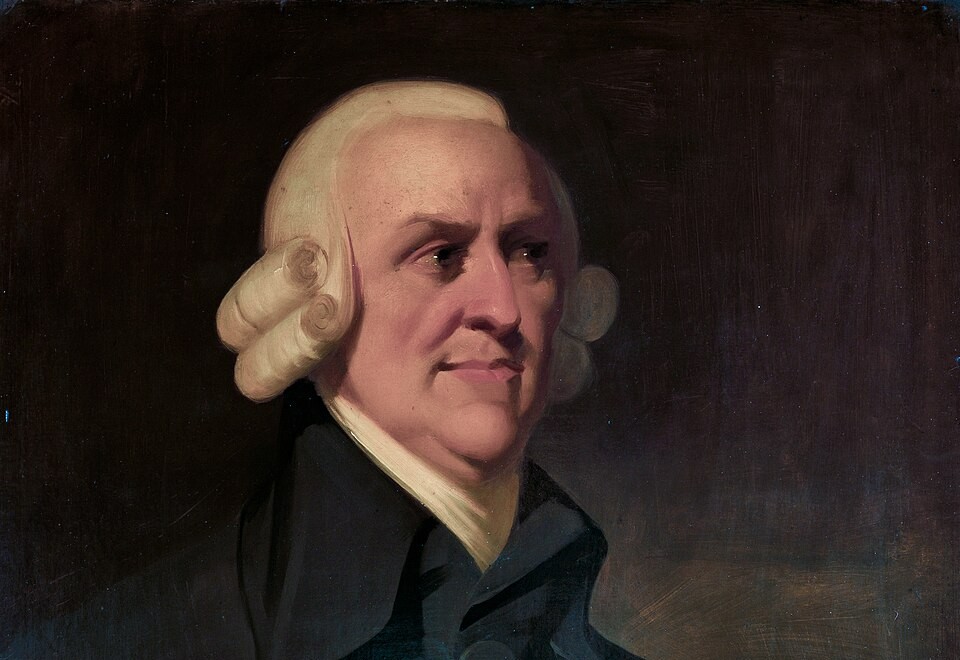
Yet the argument of Book V of Wealth of Nations is something quite different. Over hundreds of pages, Smith patiently shows why both peace and a tolerable administration of justice are historically rare, and continually fragile. To the extent that some society or other happens to have them, it seems to be neither the natural course of things nor the result of wise and judicious statesmanship but rather barely better than luck.
“Little else is requisite to carry a state to the highest degree of opulence from the lowest barbarism, but peace, easy taxes, and a tolerable administration of justice; all the rest being brought about by the natural course of things. All governments which thwart this natural course, which force things into another channel, or which endeavour to arrest the progress of society at a particular point, are unnatural, and to support themselves are obliged to be oppressive and tyrannical.”
The passage, attributed to Adam Smith posthumously by Dugald Stewart, is a popular one in some circles and not only (though certainly in part) for its appeal to low taxes. It seems to offer a comforting assurance about politics. The “natural course of things” will mean that politics will tend to work out reasonably well. Governing well is not difficult, as it mostly consists of not doing things: not going to war, not raising taxes. To the modern economists who think that they are the true intellectual heirs of WN, the implication that political science isn’t that difficult might be an added bonus.
Yet the argument of Book V of The Wealth of Nations is something quite different. Over hundreds of pages, Smith patiently shows why both peace and a tolerable administration of justice are historically rare, and continually fragile. To the extent that some society or other happens to have them, it seems to be neither the natural course of things nor the result of wise and judicious statesmanship but rather barely better than luck.
Smith was not an esoteric writer, but he was a patient one. He laid out arguments and counterarguments at narrative length and expected readers to follow along with him. Book V requires particularly patient reading, not least because so many different topics are packed into what is officially a section on state budgets. The headline organization of the book into the sovereign’s expenses, revenues, and debts belies subject matter that ranges across the state of English universities, the stadial theory of social organization, church-state relations, the problems of corporate governance, the operation of toll roads, and the organizational consequences of gunpowder. I don’t claim that Smith treats these topics reductively in terms of a single overarching thesis. But, taken together, his sophisticated accounts of all of them point to the tremendous difficulty of attaining and sustaining government that is not “oppressive and tyrannical.”
“In commercial society, the sovereign will pay a unified army and will supply them with their matériel including expensive, capital-intensive artillery and ships. The sovereign may not own the means of military organization in the same personal way that Genghis Khan did, but the distinction is a fine one.”
Peace
Book V begins with an extended account of the political and organizational history of warfare. Its most politically pointed conclusion was the inevitability and superiority of a standing army under modern conditions, and the attendant need for a permanent public fisc to pay for and supply that army. This necessity is not only due to the advantages of specialization and the division of labor, though it is also not a coincidence that the argument appears in a work whose first chapter was about those advantages. Those engaged in commerce and manufacture, unlike herders or yeoman farmers, bear a constant opportunity cost for time spent in military service. Herding peoples like the Mongols bring their animal wealth with them to war. Farmers have seasonal free time, between the planting and the harvest. But those of us in commercial society can’t easily get away without damage to our own livelihood— which is to say, to the wealth of the nation. A commercial society can’t rely on citizens training, marching, and fighting in the off-season; it must pay to staff a full-time professional army.
There are two key things to note for our purposes. One is that the history of government, for Smith, in crucial part just is the history of warfare and military organization. Here, as in Theory of Moral Sentiments (TMS), he gives an account of the moral psychology of obedience that leads us to be willing to be led and governed at all, but the shape of government at any given time is crucially about the shape of the armed forces under the particular economic and technological conditions.
The other is that in modern conditions, the circumstances are particularly ripe for a return to the despotism that Smith associates with the hordes of the herding peoples. The era of the feudal dispersal of military power, we learned in Book III, was dead and gone, undermined by the commercial development of the medieval cities and by the desire of the nobility for luxuries and baubles. The era of the citizen militia celebrated by Machiavelli and the civic republican tradition was always ephemeral. In commercial society, the sovereign will pay a unified army and will supply them with their matériel including expensive, capital-intensive artillery and ships. The sovereign may not own the means of military organization in the same personal way that Genghis Khan did, but the distinction is a fine one.
V.i.a is not the only account of warfare in Book V. The topic returns in V.i.g, the chapter on religion. Smith does not blame religious fervor as such for the wars of religion, but rather the entanglement of church and state. “If politicks had never called in the aid of religion, had the conquering party never adopted the tenets of one sect more than another,” he suggests, denominations and sects could have proliferated and competed freely and peacefully (V.i.g.8, emphasis added). But as Ryan Griffiths has carefully shown, matters are different in societies where politics has already done so, which at the time meant all societies except the United States. Where the entanglement is already an established fact, the risk of cycles of persecution and retribution is an ongoing one, and damage control for the history of persecution is complicated. Moreover, there’s standard, predictable, permanent reason for political actors to call in the aid of religion, and to set their polities on the path to religious conflict. “[E]ach political party has either found it, or imagined it, for its interest, to league itself with some or other of the contending religious sects” (Vi.g.7). The sound policy of liberal religious freedom is one that “positive law has perhaps never yet established, and probably will never establish in any country” (Vi.g.8).
The language here recalls that in Book IV, saying that the establishment of real free trade is a utopian project, and that the sound policy of letting America go peacefully is “such a measure as never was, and never will be adopted, by any nation in the world.” In all these cases, Smith is happy to describe the desired political outcomes, but is far too aware of the mechanisms of politics to think that they are ever attainable.
“Without what we would now call a robust separation of powers, we should not expect “a tolerable administration of justice.” But this passage comes at the end of a history of judicial power that argues such a separation is a late, rare, and lucky development.”
Tolerable administration of justice
The passage with which I started the essay is one of the most famous of Smith’s commentaries on politics, widely quoted on the right. Perhaps the most widely-known section of Book V is a paragraph on the mentally and politically stunting effects of the division of labor, celebrated on the left. (V.i.f.50) But neither really gets at the core political teaching of Book V, which is better represented by this:
“When the judicial is united to the executive power, it is scarce possible that justice should not be frequently sacrificed to, what is vulgarly called, politics. The persons entrusted with the great interests of the state may, even without any corrupt views, sometimes imagine it necessary to sacrifice to those interests the rights of a private man. But upon the impartial administration of justice depends the liberty of every individual, the opinion which he has of his own security. In order to make every individual feel himself perfectly secure in the possession of every right which belongs to him, it is not only necessary that the judicial should be separated from the executive power, but that it should be rendered as much as possible independent of that power.” (V.i.b.24)
Without what we would now call a robust separation of powers, we should not expect “a tolerable administration of justice.” But this passage comes at the end of a history of judicial power that argues such a separation is a late, rare, and lucky development. Indeed it seems quite impossible that it can have been in place early enough to lift any society “from the lowest barbarism,” since in the hunting and herding stages of political economy, Smith says that adjudication was standardly joined to the power of command. This remained true into the era of monarchical rule over agricultural peoples. The history of maladministration of justice ran long and deep in part because the ruler passed judgment in private cases as a source of revenue, “which could scarce fail to be productive of several very gross abuses… That such abuses were far from being uncommon, the antient history of every country in Europe bears witness.” (Vi.i.b.14) Since judgment was for sale as the normal fact of legal organization, “the administration of justice appears for a long time to have been extremely corrupt; far from being quite equal and impartial even under the best monarchs, and altogether profligate under the worst” (V.i.b.15).
How did this seemingly intractable condition end? There were two causes, one general and one local to England. The general one was simply that rulers became too busy, or thought themselves too grand, or both, to continue passing judgments personally. Roman consuls and European kings alike eventually delegated the task to subordinates. Once this had been done, a person who thought themselves victim of a gross injustice at least might in principle appeal from the subordinate to the superior. That mitigated some abuses: the king might frown on a judge or bailiff taking bribes, at least if he did not share them upward. But as long as the judges and bailiffs were genuinely dependent on the king, the sacrifice of justice “to what is vulgarly called, politics” continued unabated. The corruption of judgments, moreover, was at best lightly held in check by vague royal oversight.
“[T]he discussion of taxes in Book V continues to undermine the happy vision of “peace, easy taxes, and a tolerable administration of justice.””
The local explanation was the highly contingent development of multiple judicial systems whose jurisdictions overlapped enough that they might compete to attract cases, and filing fees. Under the salutary pressure from this competition, courts developed reputations for fairness, impartiality, and incorruptibility. They competed on the quality of the procedures they offered to litigants. Unlike most of the rest of the chapter, the discussion of this development is restricted to England, notably the development of the equity-based court of exchequer. Whether that means Smith thinks this only happened in England isn’t clear. It’s a fortunate example of invisible hand processes: judges seeking only the financial advantage of their courts promoted an end which was no part of their intention, the rule of law. But there doesn’t seem to be anything at all inevitable about it; the development requires the combination of fee-based courts separate from direct royal control, a plurality of judicial systems, and enough concurrency of jurisdiction that they can actually compete for the same cases. Smith does think that post-Glorious Revolution, post-Act of Union Britain has attained a ”tolerable administration of justice.” But, like his friend and mentor David Hume, Smith doubts that the reasonably happy political condition of late 18th-century Britain was inevitable, or is somehow a natural state of affairs that can now be taken for granted.
Taxes
The bulk of Smith’s argument that political actors face constant incentives to increase burdensome tariffs and taxes on commerce happens in Books II and IV. But the discussion of taxes in Book V continues to undermine the happy vision of “peace, easy taxes, and a tolerable administration of justice.” Some of the pressure to keep taxes high will, of course, arise out of warfare itself. But at any given level of overall taxation, it is difficult to make its burden more “easy” by a fair sharing across a broader base. In the context of 1776 this would mean a confederal union spreading taxation and representation across “all the different provinces of the empire inhabited by people of either British or European extraction.” If Ireland, the North American colonies, and the settler plantations of the West Indies were brought into such shared governance, the tax base would broaden, and so the burden would ease. But “the private interest of many powerful individuals, the confirmed prejudices of great bodies of people” provide opposition “as it may be very difficult, perhaps altogether impossible, to surmount.” He continues on with the “speculative” task of offering a vision for such a multinational confederation.” The vision, he drily and darkly jokes, “can at worst be regarded but as a new Utopia, less amusing certainly, but not more useless and chimerical than the old one” (V.iii.68).
Conclusion
Adam Smith did more than any other single thinker to create political economy, and we should take both of the words there seriously. His intellectual contributions to what would later be called political science are of the same serious intellectual caliber as those to what would later be called economics. In my view Smith is the first major social theorist to see the modern state in full. Book V of WN shows a deep understanding, in a way that Locke or even Montesquieu does not, of the political forms then coming into being. That understanding includes a realistic vision of particular political actors— judges, kings, priests, parliamentarians— as well as of organizations like armies, churches, parties, and bureaucracies. The political lessons he draws from that understanding are never simple ones. The vision of a free society he offers might seem like one characterized by inaction: don’t interfere with trade, don’t interfere with religion. But inaction, on his account, will never get us there. Executive domination, corruption of justice, the fusion of military and political power, imperialism and mercantilism motivated by nationalist pride, and religious state persecution of dissidents and nonbelievers: these are what he shows to be the normal course of things. Governments that are “oppressive and tyrannical” are the rule, and he maps out the challenges of finding our way to the occasional exception.
This article has been cross-posted from Liberty Matters, part of the Liberty Fund network. It is part of the series “Compounding Interest: Revisiting the Wealth of Nations at 250“.
Endnotes
[1] Smith presciently noted that the American militias of 1775–76 would have to develop into such an army if the war that had recently broken out lasted for a few years, which of course they did, under Washington’s leadership and Lafayette’s training.
*Jacob T. Levy is Tomlinson Professor of Political Theory and associated faculty in the Department of Philosophy at McGill University. He is the coordinator of McGill’s Research Group on Constitutional Studies and was the founding director of McGill’s Yan P. Lin Centre for the Study of Freedom and Global Orders in the Ancient and Modern Worlds. He is a Senior Fellow at the Niskanen Center, and has been a Distinguished Fellow for the Study of Liberalism and the Free Society of the Institute for Humane Studies and a Templeton Adam Smith Tercentenary Fellow at The University of Glasgow.
Read more by Jacob T. Levy.