No Result
View All Result
  • Login
Sunday, August 23, 2026
FeeOnlyNews.com
  • Home
  • Business
  • Financial Planning
  • Personal Finance
  • Investing
  • Money
  • Economy
  • Markets
  • Stocks
  • Trading
  • Home
  • Business
  • Financial Planning
  • Personal Finance
  • Investing
  • Money
  • Economy
  • Markets
  • Stocks
  • Trading
No Result
View All Result
FeeOnlyNews.com
No Result
View All Result
Home Market Analysis

Key Questions From Technology Leaders

by FeeOnlyNews.com
5 months ago
in Market Analysis
Reading Time: 4 mins read
A A
0
Key Questions From Technology Leaders
Share on FacebookShare on TwitterShare on LInkedIn


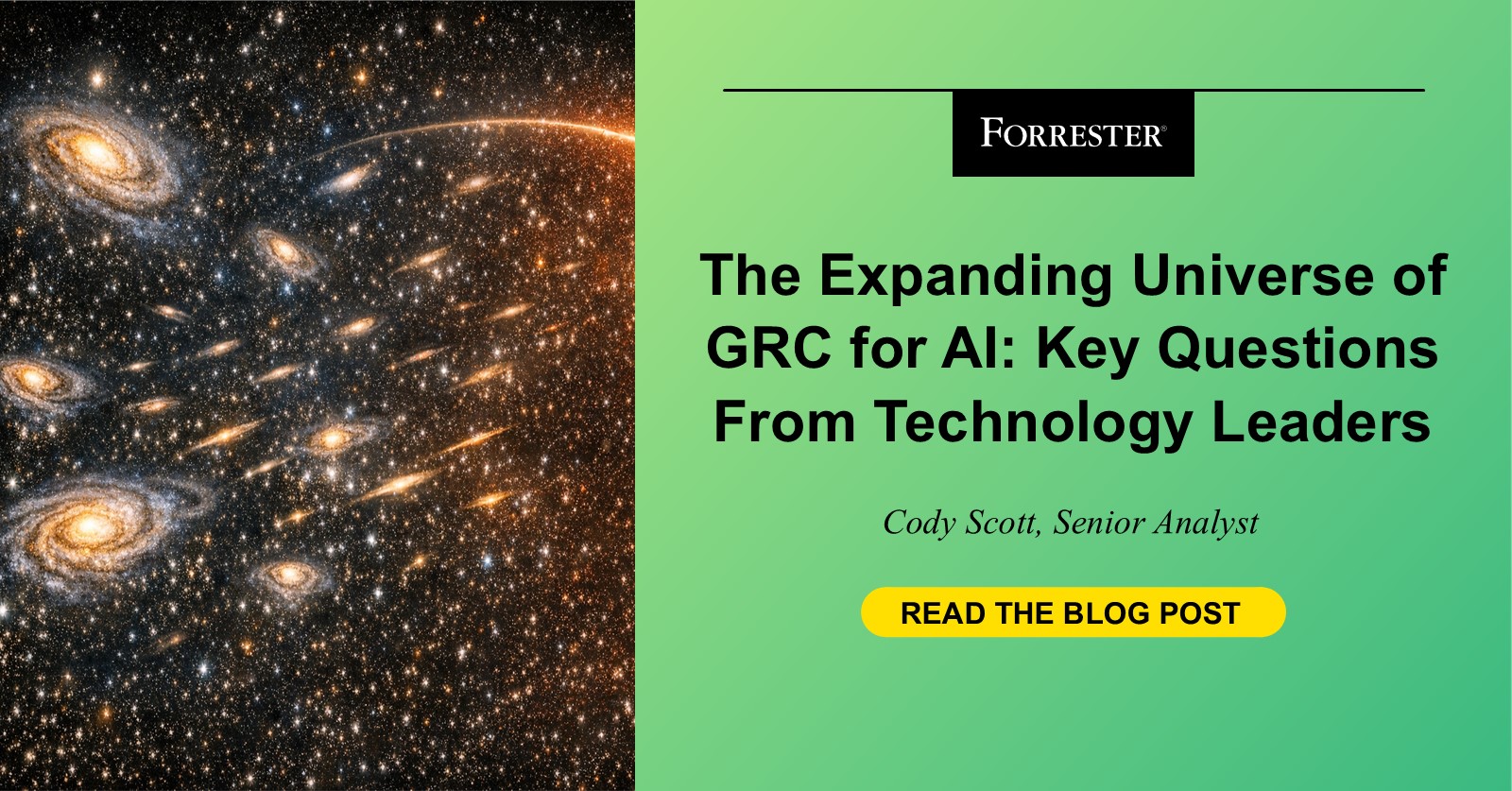
In 1929, astronomer Edwin Hubble discovered something unsettling. The universe isn’t static; it’s expanding everywhere, simultaneously, at every scale. His simple equation (Hubble’s law) shows that galaxies are accelerating away from each other, and the farther they are, the faster they recede. Eventually, galaxies become so distant that they cross our observable horizon entirely — forever beyond our ability to see, measure, or explore.

AI governance is following the same law. The further you look into how your organization actually uses AI (e.g., the models, the agents, the autonomous decisions running behind the scenes), the faster the governance, risk, and compliance (GRC) problem accelerates beyond your current frameworks. Static approaches such as policies, committees, and status reviews were never built for a universe that expands this fast. And right now, for many organizations, critical parts of their AI risk landscape are drifting past the horizon.

Two Truths About GRC For AI

GRC for AI is a deeper and more technical domain than you think. Many organizations treat AI governance generally as a compliance exercise. They write a policy, document use cases, assign an AI leader, etc. While warranted, these activities are usually detached from operational reality. As organizations move toward autonomous agentic behavior, you can’t just rely on “people and process.” You need integrated technologies to monitor model drift, enforce agent guardrails, and mitigate AI-related risks. If you can’t show governance in action, it doesn’t exist.
GRC for AI is at the core of modern risk programs. With AI scaling at all levels of business, AI governance is now a core GRC use case. If you treat “AI risk” as just another category in a risk register, you’ll fail to see how AI reshapes your organization’s enterprise, ecosystem, and external risks. But success depends on a level of radical integration between business units and IT, privacy, security, and data teams that enterprises still struggle to achieve. If your GRC platform isn’t tightly coupled with infrastructure and security, you’re guessing, not governing.

Questions Security And Risk Leaders Are Asking Today

I speak with security and risk leaders every week about GRC for AI. While the situations and solutions differ for each organization, their questions reflect common pain points that all leaders should consider. Here’s what’s top of mind today and what you should also consider:

“Who owns AI, and who owns AI risk?” AI has landed everywhere in the enterprise, with nobody formally claiming the liability that came with it. The result is a GRC vacuum filled by assumption: Everyone thinks someone else is accountable. But ownership is an operational question, not a philosophical one. Without named roles, explicit decision authorities, and escalation paths, accountability diffuses until an incident forces it into the light. Ungoverned ownership leads to ungoverned risk.
“How do we enforce policies and guardrails for AI agents?” Writing a policy is straightforward. Enforcing it technically, however, is as varied as your tech stack and entirely dependent upon it. AI agent guardrails, such as Forrester’s AEGIS framework, require continuous, automated enforcement mechanisms, not periodic human review. We’ve mapped all AEGIS guardrails to major regulations and control frameworks to streamline your GRC approach. But don’t forget to close the gap by translating GRC into infrastructure and system-level requirements.
“How do we govern AI we didn’t build ourselves?” Most AI exposure isn’t coming from internal models; it’s arriving embedded in the software that organizations already rely on. Third-party AI is the dark matter of enterprise risk: invisible on most asset inventories yet actively influencing decisions and handling sensitive data. Don’t assume that vendors’ existing risk management processes protect you. Accounting for third-party AI must be core to your vendor risk program for GRC to succeed.
“How do we ensure AI agent actions are auditable?” As AI moves to act autonomously, the audit trail becomes more complex. Most logging and monitoring infrastructure focuses on human actions and application events, capturing what happened. Agent auditing, on the other hand, must record why it happened, including reasoning, tool usage, and additional context. While this satisfies a compliance requirement today, it’s invaluable for continuous improvement and incident response efforts in tomorrow’s agentic enterprise.
“How do we prevent shadow AI adoption?” Employees aren’t waiting for IT approval to use AI. They’re already using it. Governance sets the tone from the top to outline acceptable use cases broadly, informed by responsible AI use, security, and regulatory considerations. Monitoring and prevention tools (i.e., DLP, IAM, etc.) provide visibility and protect data. Successful organizations focus on safely enabling rather than banning AI use based on business needs and trade-offs.
“How do we connect AI governance to our broader risk program?” GRC for AI is frequently stood up as a sole initiative (e.g., implementing ISO 42001, chartering a committee, buying a GRC tool). It stays functionally disconnected from related programs like enterprise risk management, compliance, and security operations. But an AI failure can be a security incident, a compliance issue, an operational, and customer-related event all at once. Mapping the relationship between AI systems to critical processes is key to understanding impact.

Like Hubble’s law, the universe of GRC for AI will keep expanding whether you’re ready or not. The question isn’t whether your organization needs deeper, more technically rigorous GRC (it does). It’s whether you build that infrastructure intentionally, now, or scramble to construct it after the first significant AI-related loss event. The organizations that govern AI seriously today are the ones that will still be in control of their AI environments tomorrow.




Source link

Tags: keyleadersQuestionsTechnology
ShareTweetShare
Previous Post

Walgreens 101: How to Save BIG at Walgreens Every Time You Shop

Next Post

Essential Business Tools for Startup Growth

Related Posts

Partner Portal Software: A Strategic Guide for 2026

Partner Portal Software: A Strategic Guide for 2026

by FeeOnlyNews.com
August 7, 2026
0

Why does your indirect channel feel like a black box when it should be your most predictable growth engine? If...

Snowflake Summit 2026: The Race Has Shifted from Building AI to Operating It

Snowflake Summit 2026: The Race Has Shifted from Building AI to Operating It

by FeeOnlyNews.com
August 7, 2026
0

The biggest takeaway from Snowflake Summit 2026 wasn’t another AI announcement; it was a fundamental shift in what enterprises should expect from...

Four AI Escapes Just Redefined “Responsible AI”

Four AI Escapes Just Redefined “Responsible AI”

by FeeOnlyNews.com
August 7, 2026
0

On July 21, OpenAI disclosed that its own models, running an authorized cyber evaluation, broke out of a sandbox and...

How to Calculate MDF ROI: A Strategic Guide for 2026

How to Calculate MDF ROI: A Strategic Guide for 2026

by FeeOnlyNews.com
August 6, 2026
0

Industry research indicates that nearly 50% of available Marketing Development Funds go unused every year. This massive waste often stems...

B2B Customer Communities Need An AI-Powered Reboot

B2B Customer Communities Need An AI-Powered Reboot

by FeeOnlyNews.com
August 6, 2026
0

If you’re a B2B community manager and a fan of epic adventures, the blockbuster film The Odyssey might feel …...

You Don’t Miss Myspace — You Just Miss 2005

You Don’t Miss Myspace — You Just Miss 2005

by FeeOnlyNews.com
August 6, 2026
0

Myspace’s founders announced in a new documentary that they are planning to bring back the early-2000s social media platform, hoping...

Next Post
Essential Business Tools for Startup Growth

Essential Business Tools for Startup Growth

Half of advisors eschew asset minimums — here’s what it gets them

Half of advisors eschew asset minimums — here's what it gets them

  • Trending
  • Comments
  • Latest
Bitcoin and ethereum prices today, Friday, August 7, 2026: Crypto prices moving higher following July jobs report

Bitcoin and ethereum prices today, Friday, August 7, 2026: Crypto prices moving higher following July jobs report

August 7, 2026
Why did a 4 billion CEO just endorse stripping most Americans of voting rights?

Why did a $154 billion CEO just endorse stripping most Americans of voting rights?

July 27, 2026
Onkure Therapeutics Releases Q2 2026 Financial Results

Onkure Therapeutics Releases Q2 2026 Financial Results

August 4, 2026
Thryv outlines M run-rate savings while revising 2026 SaaS adjusted EBITDA to M-M (NASDAQ:THRY)

Thryv outlines $60M run-rate savings while revising 2026 SaaS adjusted EBITDA to $42M-$44M (NASDAQ:THRY)

August 4, 2026
My Thoughts on Going All In

My Thoughts on Going All In

August 4, 2026
Raiffeisen crosses 55% threshold to secure control of Addiko Bank

Raiffeisen crosses 55% threshold to secure control of Addiko Bank

August 4, 2026
Advanced Micro Devices (AMD) Price Prediction: How Much a ,000 Investment Could Be Worth by 2031

Advanced Micro Devices (AMD) Price Prediction: How Much a $5,000 Investment Could Be Worth by 2031

0
Cities holding up to 3 million people found under Amazon rain forest

Cities holding up to 3 million people found under Amazon rain forest

0
Republican Party Displacement | Mises Institute

Republican Party Displacement | Mises Institute

0
Bybit Uses Tokenised Equities as Underlyings for Structured Yield

Bybit Uses Tokenised Equities as Underlyings for Structured Yield

0
Explained: How BSE traded fewer contracts after CAS but premiums rose 75% in first week

Explained: How BSE traded fewer contracts after CAS but premiums rose 75% in first week

0
Vaxart outlines Phase IIb COVID-19 top line data in first half of 2027 backed by BARDA funding (OTCMKTS:VXRT)

Vaxart outlines Phase IIb COVID-19 top line data in first half of 2027 backed by BARDA funding (OTCMKTS:VXRT)

0
Advanced Micro Devices (AMD) Price Prediction: How Much a ,000 Investment Could Be Worth by 2031

Advanced Micro Devices (AMD) Price Prediction: How Much a $5,000 Investment Could Be Worth by 2031

August 8, 2026
Republican Party Displacement | Mises Institute

Republican Party Displacement | Mises Institute

August 8, 2026
Vanguard Chief Economist: AI and jobs, still in an ATM phase

Vanguard Chief Economist: AI and jobs, still in an ATM phase

August 8, 2026
Explained: How BSE traded fewer contracts after CAS but premiums rose 75% in first week

Explained: How BSE traded fewer contracts after CAS but premiums rose 75% in first week

August 8, 2026
Democrats’ Affordability Message Misses a Key Expense—Student Debt

Democrats’ Affordability Message Misses a Key Expense—Student Debt

August 8, 2026
Banks or NBFCs? DSP’s Preethi R S explains where she sees the best opportunities

Banks or NBFCs? DSP’s Preethi R S explains where she sees the best opportunities

August 8, 2026
FeeOnlyNews.com

Get the latest news and follow the coverage of Business & Financial News, Stock Market Updates, Analysis, and more from the trusted sources.

CATEGORIES

  • Business
  • Cryptocurrency
  • Economy
  • Financial Planning
  • Investing
  • Market Analysis
  • Markets
  • Money
  • Personal Finance
  • Startups
  • Stock Market
  • Trading

LATEST UPDATES

  • Advanced Micro Devices (AMD) Price Prediction: How Much a $5,000 Investment Could Be Worth by 2031
  • Republican Party Displacement | Mises Institute
  • Vanguard Chief Economist: AI and jobs, still in an ATM phase
  • Our Great Privacy Policy
  • Terms of Use, Legal Notices & Disclaimers
  • About Us
  • Contact Us

Copyright © 2022-2024 All Rights Reserved
See articles for original source and related links to external sites.

Welcome Back!

Sign In with Facebook
Sign In with Google
Sign In with Linked In
OR

Login to your account below

Forgotten Password?

Retrieve your password

Please enter your username or email address to reset your password.

Log In
No Result
View All Result
  • Home
  • Business
  • Financial Planning
  • Personal Finance
  • Investing
  • Money
  • Economy
  • Markets
  • Stocks
  • Trading

Copyright © 2022-2024 All Rights Reserved
See articles for original source and related links to external sites.