No Result
View All Result
  • Login
Monday, August 17, 2026
FeeOnlyNews.com
  • Home
  • Business
  • Financial Planning
  • Personal Finance
  • Investing
  • Money
  • Economy
  • Markets
  • Stocks
  • Trading
  • Home
  • Business
  • Financial Planning
  • Personal Finance
  • Investing
  • Money
  • Economy
  • Markets
  • Stocks
  • Trading
No Result
View All Result
FeeOnlyNews.com
No Result
View All Result
Home Market Analysis

Rising Infrastructure Costs Aren’t A Blip — They’re A Reset

by FeeOnlyNews.com
5 months ago
in Market Analysis
Reading Time: 3 mins read
A A
0
Rising Infrastructure Costs Aren’t A Blip — They’re A Reset
Share on FacebookShare on TwitterShare on LInkedIn


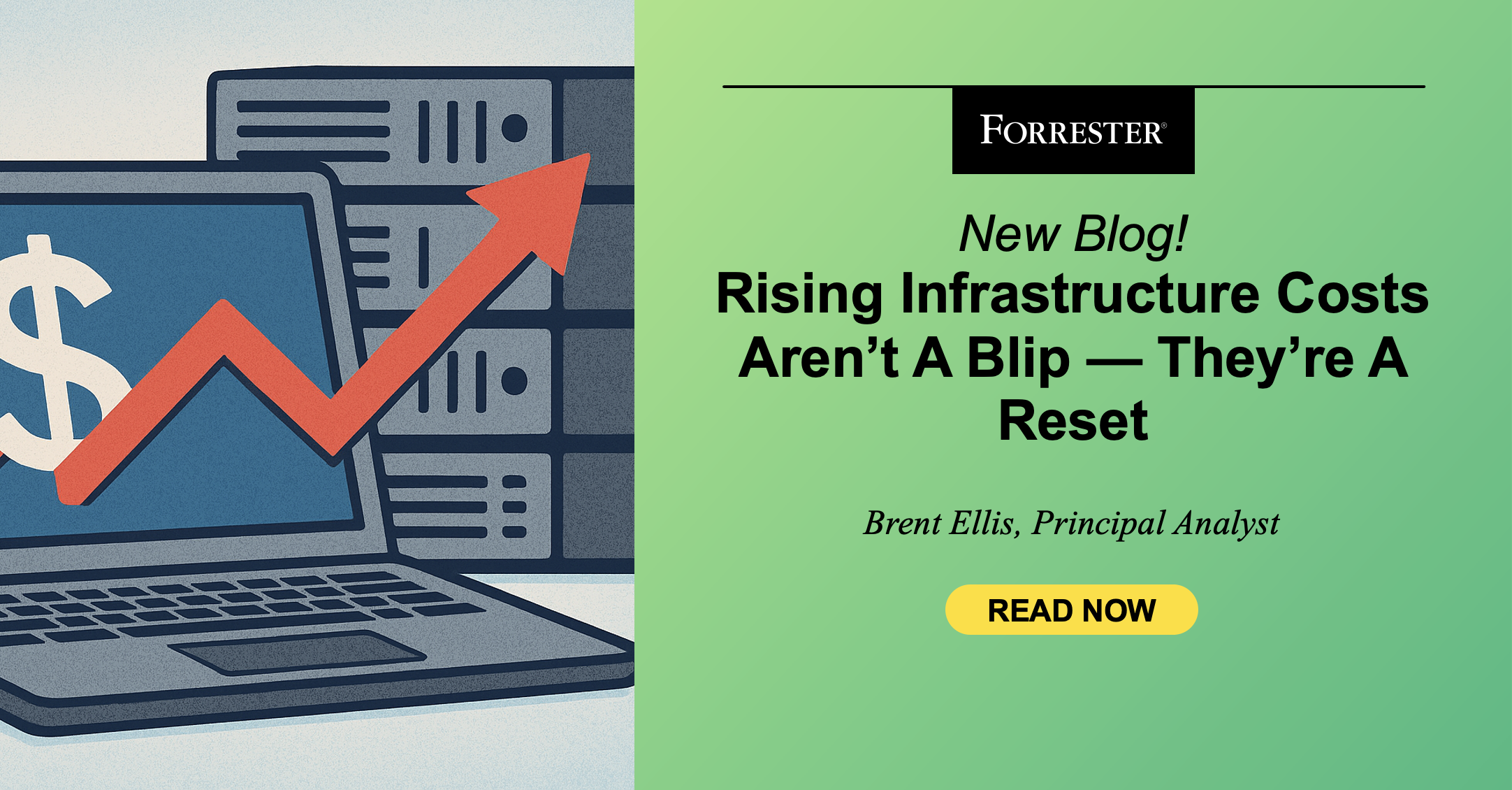
Over the past several months, I’ve gotten a sharp uptick in questions from infrastructure leaders trying to make sense of rising infrastructure costs. The questions are all variations of the same theme: What’s actually driving this? Is it temporary? And what — realistically — can we do about it?

The short answer is that this isn’t a cyclical blip or a transient supply issue. It’s a structural shift in how compute, memory, and storage capacity are produced, allocated, and priced — and it has durable implications for enterprise infrastructure planning.

What’s changed is not just cost. It’s access.

What’s Happening — And Why This Isn’t A Temporary Reset

Enterprise infrastructure markets are being reshaped by an AI‑driven realignment in how capacity is built and allocated. Manufacturing resources, both for the production facilities and for the raw inputs for compute, memory, and storage, are being prioritized for higher-margin AI‑optimized components — GPUs, high‑bandwidth memory, high‑density dynamic random-access memory, and high-performance flash — reducing effective supply for traditional enterprise configurations.

Because these components share underlying fabrication capacity, the supply chain effects stack up. Lower-margin commodity memory and conventional flash storage have been casualties of this compounding, while the shrinking hard disk drive market no longer provides a reliable low-cost fallback for storage. Long-term contracts from hyperscalers and AI infrastructure vendors leave fewer production resources for the conventional compute market, whether it is enterprise servers or end-user laptops and desktops.

The most visible impact is cost. Many enterprise customers are seeing their infrastructure refresh quotes 10–20% above the prices they were getting at the end of last year. This is coupled with a very short-term quote validity window and longer delivery lead times, especially with custom configurations. But the more important story is how long this price hike may endure. Flash memory manufacturers, specifically, have shifted toward margin discipline, passing on higher prices to downstream suppliers. While some new fabs were already being built, new capacity takes years, and anything that breaks down today won’t contribute to supply for 18–24 months.

For the demand side, AI infrastructure order pipelines through 2026 remain high, and new use cases such as self-driving cars will require hundreds of gigabytes of RAM per vehicle, signaling a long-term increase in memory demand. When the supply and demand side stabilizes, expect manufacturers to control production to resist flooding the market and crushing profits. Rather than seeing prices fall to historical norms, the baseline will be higher.

The question that enterprises are grappling with, then, isn’t how long this will last — it’s how to plan and operate effectively when prices are rising and there is no end in sight.

Controlling IT Costs In A Structurally Constrained Market

Enterprises can’t control global supply dynamics, but they can reduce exposure to volatility by changing how they plan, buy, and govern infrastructure. In a supply-constrained market, cost control is less about squeezing unit prices and more about making deliberate choices earlier — around commitments, configurations, and expectations. The organizations adapting best are shifting away from just‑in‑time infrastructure decisions, narrowing the set of configurations they rely on, and placing more emphasis on supply reliability and predictability than on headline discounts alone. Negotiations increasingly focus on clarity, protection, and long-term parts availability, not just price.

Just as importantly, refresh planning is changing. Many enterprises are now assuming higher baseline costs and being more selective about where premium infrastructure is justified while looking harder at utilization and lifecycle discipline to avoid unnecessary growth. Some are even turning to the circular economy, with some infrastructure vendors recertifying used parts for use in production.

The net effect is a more intentional approach to where infrastructure spend increases show up — and where they don’t.

The Bottom Line

Rising infrastructure costs aren’t a temporary anomaly. They’re the byproduct of a structural realignment driven by AI, manufacturer and supplier behavior, and long‑term capacity planning. Enterprises that continue to rely on late‑stage negotiation and just‑in‑time purchasing will feel increasingly exposed. Those that shift earlier, simplify configurations, and treat allocation reliability as a first‑order concern will be far better positioned — not just to manage costs but to keep critical programs moving.

The question is no longer how to get infrastructure cheap — it’s how to get it predictably and plan for the best possible utilization.

If you have questions and you’re a Forrester client, reach out to schedule an inquiry or guidance session.




Source link

Tags: arentblipCostsinfrastructureResetRisingtheyre
ShareTweetShare
Previous Post

United-Guardian, Inc. (UG) Reports FY2025 Earnings

Next Post

Carnival Corporation & plc (CCL) Reports Q1 Earnings

Related Posts

Partner Portal Software: A Strategic Guide for 2026

Partner Portal Software: A Strategic Guide for 2026

by FeeOnlyNews.com
August 7, 2026
0

Why does your indirect channel feel like a black box when it should be your most predictable growth engine? If...

Snowflake Summit 2026: The Race Has Shifted from Building AI to Operating It

Snowflake Summit 2026: The Race Has Shifted from Building AI to Operating It

by FeeOnlyNews.com
August 7, 2026
0

The biggest takeaway from Snowflake Summit 2026 wasn’t another AI announcement; it was a fundamental shift in what enterprises should expect from...

Four AI Escapes Just Redefined “Responsible AI”

Four AI Escapes Just Redefined “Responsible AI”

by FeeOnlyNews.com
August 7, 2026
0

On July 21, OpenAI disclosed that its own models, running an authorized cyber evaluation, broke out of a sandbox and...

How to Calculate MDF ROI: A Strategic Guide for 2026

How to Calculate MDF ROI: A Strategic Guide for 2026

by FeeOnlyNews.com
August 6, 2026
0

Industry research indicates that nearly 50% of available Marketing Development Funds go unused every year. This massive waste often stems...

B2B Customer Communities Need An AI-Powered Reboot

B2B Customer Communities Need An AI-Powered Reboot

by FeeOnlyNews.com
August 6, 2026
0

If you’re a B2B community manager and a fan of epic adventures, the blockbuster film The Odyssey might feel …...

You Don’t Miss Myspace — You Just Miss 2005

You Don’t Miss Myspace — You Just Miss 2005

by FeeOnlyNews.com
August 6, 2026
0

Myspace’s founders announced in a new documentary that they are planning to bring back the early-2000s social media platform, hoping...

Next Post
Carnival Corporation & plc (CCL) Reports Q1 Earnings

Carnival Corporation & plc (CCL) Reports Q1 Earnings

15 Cities in America Where Homebuyers Compete for Aging Fixer-Uppers

15 Cities in America Where Homebuyers Compete for Aging Fixer-Uppers

  • Trending
  • Comments
  • Latest
Coffee Break: Armed Madhouse – From Spy Satellites to Peace Satellites

Coffee Break: Armed Madhouse – From Spy Satellites to Peace Satellites

July 7, 2026
US prosecutors examine LA Dodgers owner Mark Walter-linked insurers – report

US prosecutors examine LA Dodgers owner Mark Walter-linked insurers – report

July 21, 2026
Teachers’ Unions Shell Out More Than  Billion on Politics

Teachers’ Unions Shell Out More Than $1 Billion on Politics

May 14, 2026
Why did a 4 billion CEO just endorse stripping most Americans of voting rights?

Why did a $154 billion CEO just endorse stripping most Americans of voting rights?

July 27, 2026
Product-Market Fit Expires Every 90 Days. Here’s What to Do About It.

Product-Market Fit Expires Every 90 Days. Here’s What to Do About It.

July 15, 2026
Bond Vet and Small Door Merge to Form One of the Nation’s Largest Premium Veterinary Networks – AlleyWatch

Bond Vet and Small Door Merge to Form One of the Nation’s Largest Premium Veterinary Networks – AlleyWatch

July 9, 2026
Advanced Micro Devices (AMD) Price Prediction: How Much a ,000 Investment Could Be Worth by 2031

Advanced Micro Devices (AMD) Price Prediction: How Much a $5,000 Investment Could Be Worth by 2031

0
Cities holding up to 3 million people found under Amazon rain forest

Cities holding up to 3 million people found under Amazon rain forest

0
Republican Party Displacement | Mises Institute

Republican Party Displacement | Mises Institute

0
Bybit Uses Tokenised Equities as Underlyings for Structured Yield

Bybit Uses Tokenised Equities as Underlyings for Structured Yield

0
Explained: How BSE traded fewer contracts after CAS but premiums rose 75% in first week

Explained: How BSE traded fewer contracts after CAS but premiums rose 75% in first week

0
Vaxart outlines Phase IIb COVID-19 top line data in first half of 2027 backed by BARDA funding (OTCMKTS:VXRT)

Vaxart outlines Phase IIb COVID-19 top line data in first half of 2027 backed by BARDA funding (OTCMKTS:VXRT)

0
Advanced Micro Devices (AMD) Price Prediction: How Much a ,000 Investment Could Be Worth by 2031

Advanced Micro Devices (AMD) Price Prediction: How Much a $5,000 Investment Could Be Worth by 2031

August 8, 2026
Republican Party Displacement | Mises Institute

Republican Party Displacement | Mises Institute

August 8, 2026
Vanguard Chief Economist: AI and jobs, still in an ATM phase

Vanguard Chief Economist: AI and jobs, still in an ATM phase

August 8, 2026
Explained: How BSE traded fewer contracts after CAS but premiums rose 75% in first week

Explained: How BSE traded fewer contracts after CAS but premiums rose 75% in first week

August 8, 2026
Democrats’ Affordability Message Misses a Key Expense—Student Debt

Democrats’ Affordability Message Misses a Key Expense—Student Debt

August 8, 2026
Banks or NBFCs? DSP’s Preethi R S explains where she sees the best opportunities

Banks or NBFCs? DSP’s Preethi R S explains where she sees the best opportunities

August 8, 2026
FeeOnlyNews.com

Get the latest news and follow the coverage of Business & Financial News, Stock Market Updates, Analysis, and more from the trusted sources.

CATEGORIES

  • Business
  • Cryptocurrency
  • Economy
  • Financial Planning
  • Investing
  • Market Analysis
  • Markets
  • Money
  • Personal Finance
  • Startups
  • Stock Market
  • Trading

LATEST UPDATES

  • Advanced Micro Devices (AMD) Price Prediction: How Much a $5,000 Investment Could Be Worth by 2031
  • Republican Party Displacement | Mises Institute
  • Vanguard Chief Economist: AI and jobs, still in an ATM phase
  • Our Great Privacy Policy
  • Terms of Use, Legal Notices & Disclaimers
  • About Us
  • Contact Us

Copyright © 2022-2024 All Rights Reserved
See articles for original source and related links to external sites.

Welcome Back!

Sign In with Facebook
Sign In with Google
Sign In with Linked In
OR

Login to your account below

Forgotten Password?

Retrieve your password

Please enter your username or email address to reset your password.

Log In
No Result
View All Result
  • Home
  • Business
  • Financial Planning
  • Personal Finance
  • Investing
  • Money
  • Economy
  • Markets
  • Stocks
  • Trading

Copyright © 2022-2024 All Rights Reserved
See articles for original source and related links to external sites.