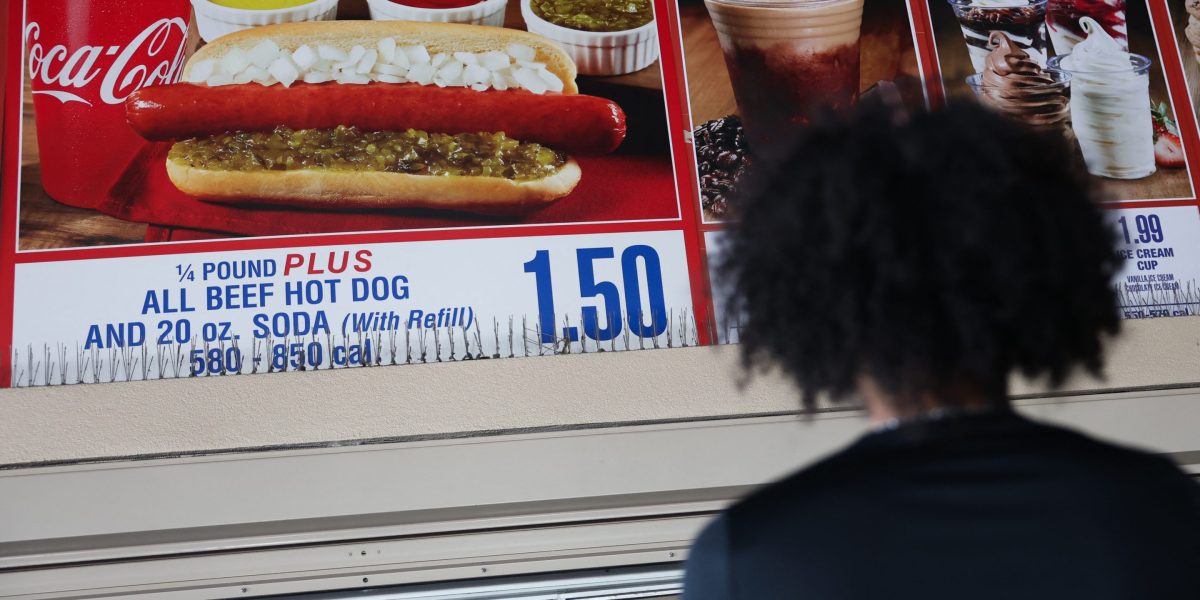
There’s no better way to fuel up for traipsing the Costco aisles for hours than a $1.50 hot dog and a soda.
It’s been a staple of the bargain shopping club for four decades, and Costco’s president and CEO, Ron Vachris, recently confirmed it’s a deal that’s never going away, at least under his watch.
“The hot dog price will not change as long as I’m around,” Vachris said in an Instagram video posted this week.
Costco executives have long assured customers the bargain won’t go away, but they’ve ramped up that messaging in the past couple of years as consumers continue to be strained by tariffs, inflation, and a high cost of living.
Richard Galanti, who stepped down in 2024 as chief financial officer, told Fortune’s Phil Wahba that deals as well as Costco’s $5 rotisserie chicken are “foundational” to the warehouse chain’s success—and even told The Wall Street Journal in 2022 the $1.50 hot dog was “sacrosanct,” and its price would stay fixed “forever.” In 2024, Galanti’s successor, Gary Millerchip, said, “I also want to confirm the $1.50 hot dog price is safe.”
And as Irina Ivanova reported for Fortune, Costco is also committed to keeping the soda part of the combo cheap. When Costco’s contract with Coca-Cola was up for renewal a decade ago, the company switched to Pepsi to save on prices, although they’re back to serving Coke products now.
K-shaped economy food prices
The timing of Vachris’s reassurance isn’t coincidental, could be seen as strategic. American consumers face mounting financial pressure, so even a modest, decades-old hot dog deal has become a symbol of economic stability in an otherwise turbulent economy.
“Food away from home” prices rose about 4.1% from December 2024 to December 2025, according to the U.S. Consumer Price Index. That means a budget staple like Costco’s $1.50 combo, which has been unchanged since 1985, represents something increasingly rare: a price point that hasn’t budged while nearly everything else has.
The broader backdrop is a K-shaped economy that has split American consumers into two diverging realities. According to a Moody’s analysis of Federal Reserve data, lower-income earners have spent only in line with inflation since the pandemic, with all real spending growth coming from the top 20%.
“Looking at the data, it’s not a mystery why most Americans feel like the economy isn’t working for them,” Moody’s chief economist Mark Zandi wrote in a 2025 report. “For those in the bottom 80% of the income distribution, those making less than approximately $175,000 a year, their spending has simply kept pace with inflation since the pandemic.”
“The 20% of households that make more have done much better,” he continued, “and those in the top 3.3% of the distribution have done much, much, much better.”
Spending among top-income consumers grew 4% in November 2025 year-over-year—nearly four times the pace of the lowest-income bracket, according to the Bank of America Institute. For the consumers trending downward on the K-curve, every dollar counts.
This phenomenon has triggered other food-industry companies to create deals for consumers. McDonald’s extended its meal deal well beyond its original run and launched a “McValue” menu with buy-one-get-one-for-$1 offers. Wendy’s rolled out $4, $6, and $8 mix-and-match value tiers; KFC introduced a $5 offering; and Taco Bell launched Cravings Boxes starting at $5. Even Sweetgreen, a notoriously expensive fast-casual chain, began offering $10 loyalty-member bowls, a roughly $6 discount, to stay competitive.
But Costco doesn’t need a limited-time promotion to signal it’s on the consumer’s side. It’s been doing that for 40 years by consistently selling $1.50 hot dogs, so customers know what to expect.