Updated on March 20th, 2026 by Bob Ciura
As a business owner, selling products that have high profit margins along with strong brand awareness and an exceptionally loyal customer base is strongly desirable.
This allows for predictable revenue and high levels of profits over time.
The tobacco industry fits this model, despite declines over time in the number of customers that use its products.
Tobacco stocks are particularly attractive to income investors thanks to their generous dividends and defensive characteristics during economic downturns.
Tobacco stocks produce a lot of cash flow, but have very little capital expenditure needs, creating what could be considered perfect income stocks.
You can download a spreadsheet with all our tobacco stocks (along with important financial metrics such as dividend yields and price-to-earnings ratios) using the link below:

Tobacco stocks are widely prized by income investors thanks to their high dividend yields, stable payouts and dividend increase streaks. However, declining customer counts and usage rates are weighing on the group.
This article will analyze the prospects of 5 of the largest tobacco stocks that we cover in the Sure Analysis Research Database.
Rankings are in order of projected total returns from lowest to highest.
Table of Contents
You can instantly jump to any individual stock analysis by clicking on the links below:
But first, we’ll take a look at the tobacco industry’s primary concern, which is declining tobacco usage.
Industry Overview: Declining Smoking Rates
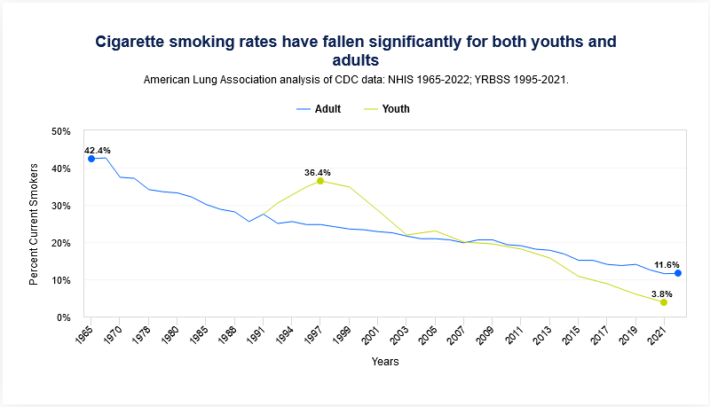
The percent of the U.S. population that smokes is in a continuous decline, and has been for decades.
Source: American Lung Association
The percent of the U.S. smoking adult population has steadily declined from 42% in 1965, to just 11.6% as of 2021. The declines among the youth population have been even bigger.
Young people now have a smoking rate of about one in 25. This sort of decline in an industry’s customer group generally spells trouble for the companies that operate within it.
Other forms of tobacco usage have seen similar rates of decline, including smokeless tobacco. This has been the case with every demographic group, so it is widespread among all of the companies’ potential customers.
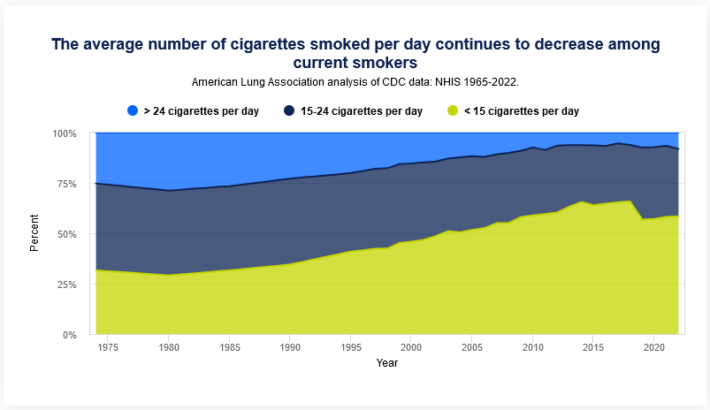
Not only are fewer people smoking, but the ones that do are smoking less than they used to.
Source: American Lung Association
The number of people smoking at least 15 cigarettes a day has plummeted in the past few decades. Today, the overwhelming majority of smokers use fewer than 15 cigarettes daily.
In other words, there are fewer customers for the industry. And, the ones that remain are using fewer products. This has negatively impacted demand from two directions.
This has led to much lower volumes of total cigarettes sold, producing a declining total to be split up among the various companies selling cigarettes.
An increasing number of U.S. states have significantly raised the tax on cigarettes to reduce their budget deficits, and to reduce the potential appeal of smoking for consumers.
Given the propensity of localities to use tax increases on cigarettes, the situation will likely only get worse for tobacco stocks.
In addition, pricing increases have the impact of reducing usage further. Demand will almost certainly continue to decline as taxes and prices rise.
Indeed, health organizations like the American Lung Association actively encourage localities to raise taxes on cigarettes and other tobacco products to discourage usage.
To make matters worse for tobacco companies, most of the world’s smoking population rate looks much the same as the above chart. It has become abundantly clear that consumers around the world are eschewing tobacco products for health concerns.
These negative trends have kept many investors away from tobacco stocks. However, tobacco stocks can still generate solid total returns given that they tend to offer high dividend yields.
The key behind an investment in tobacco stocks is the inelastic demand for cigarettes relative to their price due to the addictive nature of these products.
Tobacco companies have been able to raise their prices to help offset declining smoking rates. As a result, they have exceptional growth records.
In addition, population growth partly offsets the effect of the declining percent of smokers.
However, investors must keep in mind that the total volumes for the industry are in fairly steep decline, and all indications are that this is irreversible.
Tobacco Stock #5: Altria Group (MO)
5-year expected returns: 5.1%
Altria is a tobacco stock that sells cigarettes, chewing tobacco, cigars, e-cigarettes, and more under a variety of brands, including Marlboro, Skoal, and Copenhagen, among others.
This is a period of transition for Altria. The decline in the U.S. smoking rate continues. In response, Altria has invested heavily in new products that appeal to changing consumer preferences, as the smoke-free category continues to grow.
The company also has a 35% investment stake in e-cigarette maker JUUL, and a 45% stake in the Canadian cannabis producer Cronos Group (CRON).
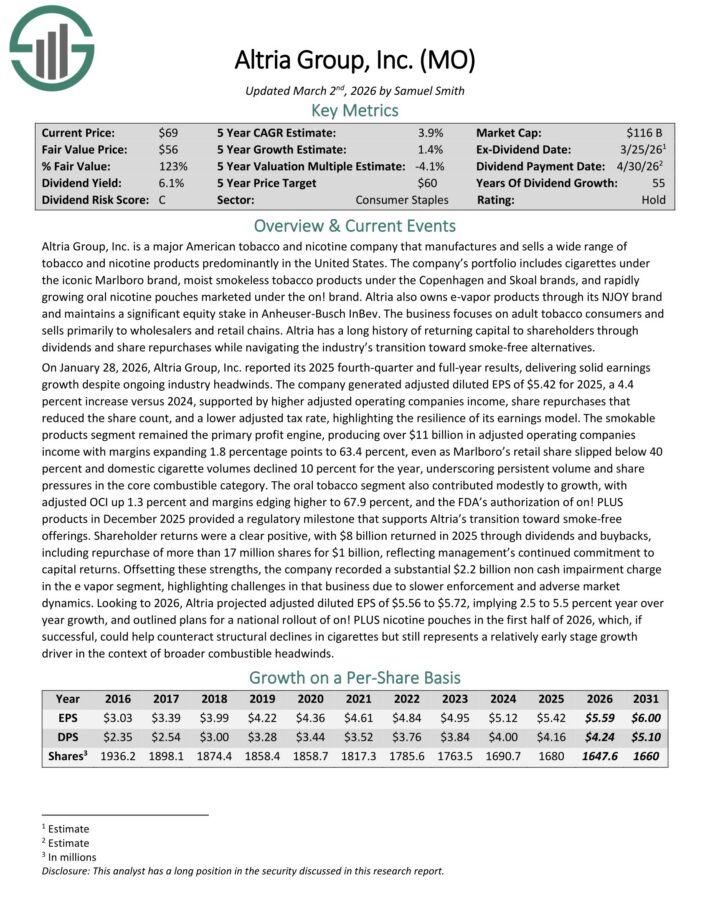
On January 28, 2026, Altria Group, Inc. reported its 2025 fourth-quarter and full-year results. The company generated adjusted diluted EPS of $5.42 for 2025, a 4.4% increase versus 2024.
EPS growth was supported by higher adjusted operating companies income, share repurchases that reduced the share count, and a lower adjusted tax rate.
The smokable products segment remained the primary profit engine, producing over $11 billion in adjusted operating companies income with margins expanding 1.8 percentage points to 63.4%.
Margin expansion occurred even as Marlboro’s retail share slipped below 40% and domestic cigarette volumes declined 10% for the year. The oral tobacco segment also contributed modestly to growth, with adjusted OCI up 1.3%.
Looking to 2026, Altria projected adjusted diluted EPS of $5.56 to $5.72, implying 2.5% to 5.5% year-over-year growth.
Click here to download our most recent Sure Analysis report on Altria (preview of page 1 of 3 shown below):
Tobacco Stock #4: Imperial Brands (IMBBY)
5-year expected returns: 5.5%
Imperial Brands is a tobacco company that was founded in 1901. Today, it is headquartered in the United Kingdom. The company manufactures and sells a variety of tobacco products, including cigarettes, tobaccos, cigars, rolling papers, and tubes.
Some of its core brands include Winston, Davidoff, Gauloises, L&B, Bastos, Fine, Gitanes, Kool, Jade, and many more.
The company is organized into two operating segments, tobacco and logistics. The tobacco segment includes the manufacture and sale of its various tobacco products, while the logistics segment distributes tobacco to product manufacturers.
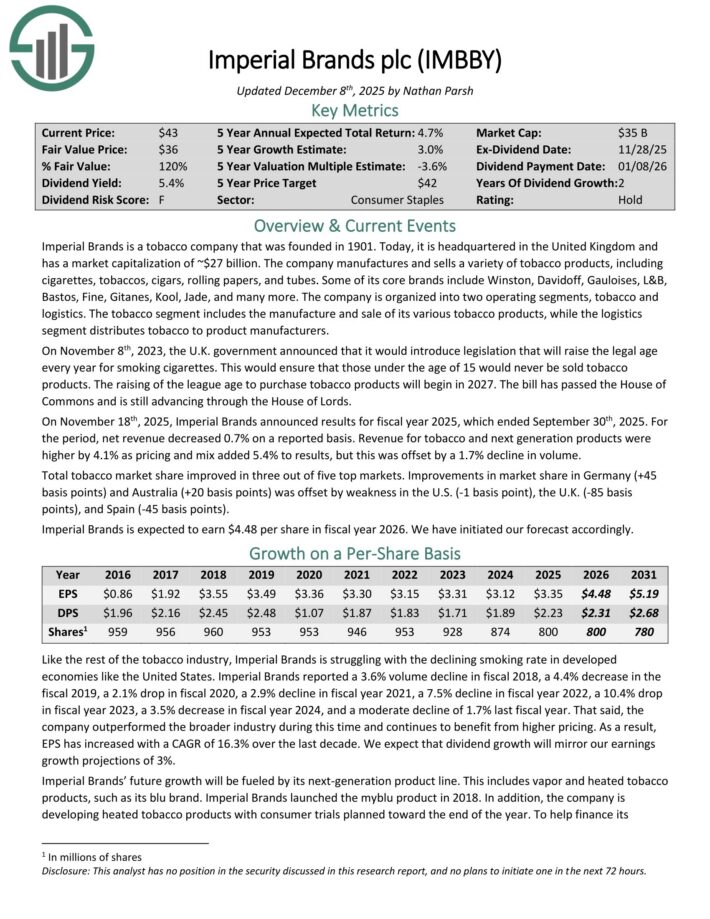
On November 18th, 2025, Imperial Brands announced results for fiscal year 2025, which ended September 30th, 2025. For the period, net revenue decreased 0.7% on a reported basis.
Revenue for tobacco and next generation products were higher by 4.1% as pricing and mix added 5.4% to results, but this was offset by a 1.7% decline in volume.
Total tobacco market share improved in three out of five top markets. Improvements in market share in Germany (+45 basis points) and Australia (+20 basis points) was offset by weakness in the U.S. (-1 basis point), the U.K. (-85 basis points), and Spain (-45 basis points).
Imperial Brands is expected to earn $4.48 per share in fiscal year 2026.
Click here to download our most recent Sure Analysis report on IMBBY (preview of page 1 of 3 shown below):
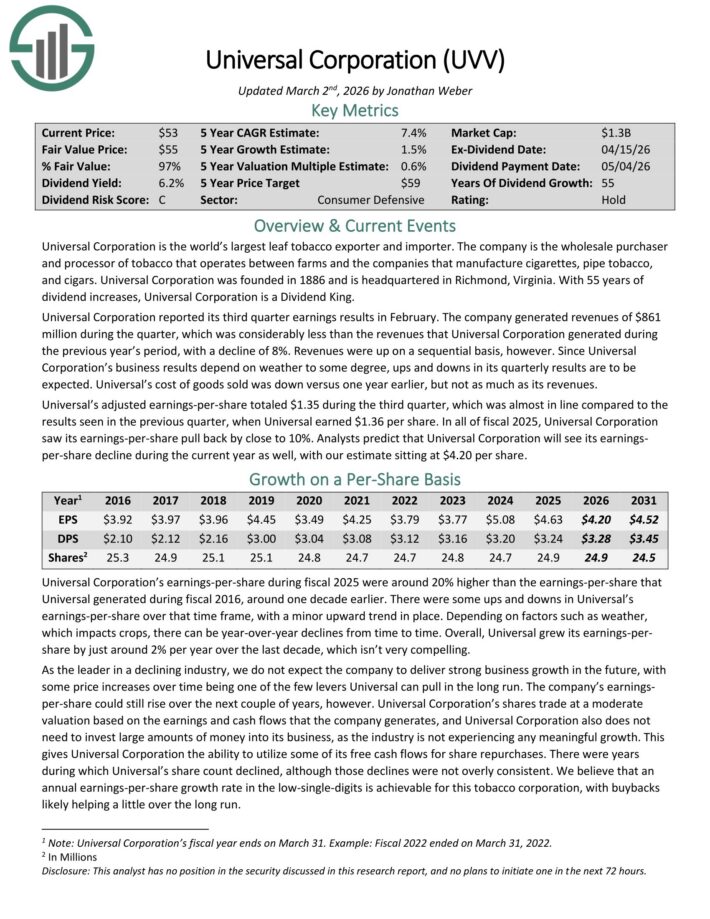
Tobacco Stock #3: Universal Corporation (UVV)
5-year expected returns: 8.0%
Universal Corporation is a market leader in supplying leaf tobacco and other plant-based inputs to consumer product manufacturers.
The Tobacco Operations segment buys and sells tobacco used to make cigarettes, cigars, pipe tobacco, and smokeless products. Universal buys tobacco from its suppliers, processes it, and sells it to large tobacco companies in the US and internationally.
The Ingredient Operations deal mainly with vegetables and fruits but is significantly smaller than the tobacco operations.
Universal Corporation reported its third quarter earnings results in February. The company generated revenues of $861 million during the quarter, a year-over-year decline of 8%. Revenues were up on a sequential basis, however.
Since Universal Corporation’s business results depend on weather to some degree, ups and downs in its quarterly results are to be expected. Cost of goods sold was down versus one year earlier, but not as much as its revenues.
Universal’s adjusted earnings-per-share totaled $1.35 during the third quarter, which was almost in line compared to the results seen in the previous quarter, when Universal earned $1.36 per share.
In all of fiscal 2025, Universal Corporation saw its earnings-per-share pull back by close to 10%..
Click here to download our most recent Sure Analysis report on UVV (preview of page 1 of 3 shown below):
Tobacco Stock #2: Philip Morris International (PM)
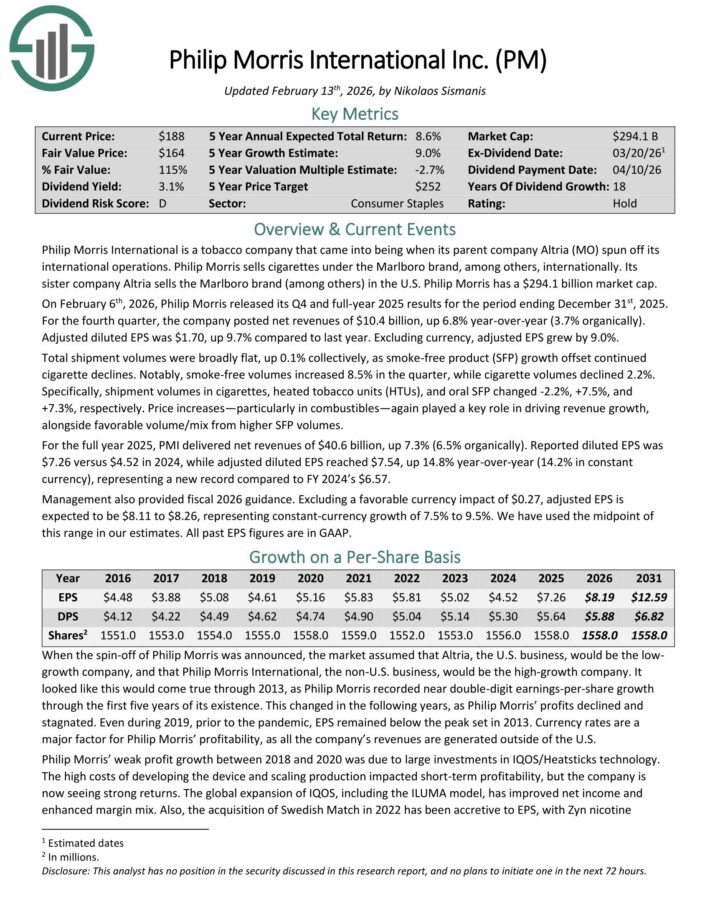
5-year expected returns: 11.7%
Philip Morris International was spun off from Altria in 2008, and is charged with the production and distribution of Altria’s products outside of the United States. This distribution includes the Marlboro brand.
On February 6th, 2026, Philip Morris released its Q4 and full-year 2025 results. For the fourth quarter, the company posted net revenues of $10.4 billion, up 6.8% year-over-year (3.7% organically).
Adjusted diluted EPS was $1.70, up 9.7% compared to last year. Excluding currency, adjusted EPS grew by 9.0%.
Total shipment volumes were broadly flat, up 0.1% collectively, as smoke-free product (SFP) growth offset continued cigarette declines.
Notably, smoke-free volumes increased 8.5% in the quarter, while cigarette volumes declined 2.2%. Specifically, shipment volumes in cigarettes, heated tobacco units (HTUs), and oral SFP changed -2.2%, +7.5%, and +7.3%, respectively.
Price increases—particularly in combustibles—again played a key role in driving revenue growth, alongside favorable volume/mix from higher SFP volumes.
For the full year 2025, PMI delivered net revenues of $40.6 billion, up 7.3% (6.5% organically). Adjusted diluted EPS reached $7.54, up 14.8% year-over-year (14.2% in constant currency), representing a new record compared to FY 2024’s $6.57.
Click here to download our most recent Sure Analysis report on Philip Morris International (PM) (preview of page 1 of 3 shown below):
Tobacco Stock #1: Turning Point Brands (TPB)
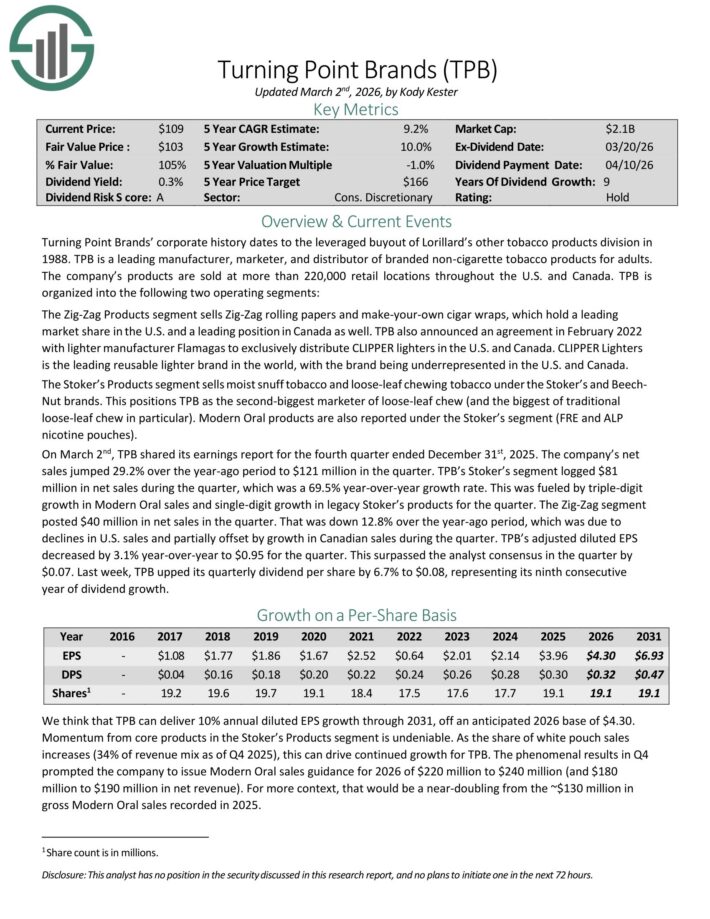
5-year expected returns: 14.5%
Turning Point Brands is a leading manufacturer, marketer, and distributor of branded non-cigarette tobacco products for adults. The company’s products are sold at more than 220,000 retail locations throughout the U.S. and Canada.
The Zig-Zag Products segment sells Zig-Zag rolling papers and make-your-own cigar wraps, which hold a leading market share in the U.S. and a leading position in Canada as well.
The Stoker’s Products segment sells moist snuff tobacco and loose-leaf chewing tobacco under the Stoker’s and Beech Nut brands. This positions TPB as the second-biggest marketer of loose-leaf chew (and the biggest of traditional loose-leaf chew in particular).
Modern Oral products are also reported under the Stoker’s segment (FRE and ALP nicotine pouches).
On March 2nd, TPB shared its earnings report for the fourth quarter ended December 31st, 2025. Net sales jumped 29.2% over the year-ago period to $121 million in the quarter.
The Stoker’s segment logged $81 million in net sales during the quarter, which was a 69.5% year-over-year growth rate. This was fueled by triple-digit growth in Modern Oral sales and single-digit growth in legacy Stoker’s products for the quarter.
The Zig-Zag segment posted $40 million in net sales in the quarter. That was down 12.8% over the year-ago period, which was due to declines in U.S. sales and partially offset by growth in Canadian sales during the quarter.
Adjusted diluted EPS decreased by 3.1% year-over-year to $0.95 for the quarter. This surpassed the analyst consensus in the quarter by $0.07.
TPB upped its quarterly dividend per share by 6.7% to $0.08, representing its ninth consecutive year of dividend growth.
Click here to download our most recent Sure Analysis report on TPB (preview of page 1 of 3 shown below):
Final Thoughts
Tobacco stocks as a group have had a difficult time in the past couple of years. Regulatory and consumer preference changes continue to plague the group.
But valuations are relatively low, dividend yields are high, and most companies are diversifying away from tobacco.
We see PM, UVV, and MO currently offering the highest expected total returns. And, all offer sizable dividend yields.
Dividend sustainability varies by stock in this group, but overall, there is a lot for income investors to like when it comes to these 5 tobacco stocks.
Further Reading
If you are interested in finding high-quality dividend growth stocks suitable for long-term investment, the following Sure Dividend databases will be useful:
Thanks for reading this article. Please send any feedback, corrections, or questions to [email protected].