The March 2026 joint framework from the Securities and Exchange Commission and the Commodity Futures Trading Commission represents the most significant regulatory development in U.S. crypto history. While most of my peers see this as “good”, I view this moment with cautious optimism.
The classification of 16 major digital assets, including Bitcoin, Ethereum, Solana, and XRP, as digital commodities under primary CFTC jurisdiction finally provides the legal certainty that institutional capital has demanded.
Clarity, however welcome, does not equate to perfection. The framework’s very structure reveals tensions that could undermine its stated goal of fostering innovation while protecting investors.
After more than a decade of uncertainty, this interpretation will provide market participants with a clear understanding of how the SEC treats crypto assets under federal securities laws.
This is what regulatory agencies are supposed to do: draw clear lines in clear terms. https://t.co/wij5cA7N2i
— Paul Atkins (@SECPaulSAtkins) March 17, 2026
The 5-category taxonomy, covering Digital Commodities, Digital Securities, Digital Collectibles, Digital Tools, and regulated Payment Stablecoins under the GENIUS Act, offers a pragmatic scaffold for a market that has operated in a regulatory gray zone for too long.
Join the inaugural Finance Magnates Singapore Summit 2026, which will bring together brokers, fintechs, banks, EMIs, wealth managers, and hedge funds across APAC.
By acknowledging that assets can transition from securities to commodities as decentralization deepens, the agencies have embraced a dynamic view of technological evolution that the static Howey test never accommodated. This is progress.
Related: SEC Clarifies Crypto Rules, Shifting Responsibility to Brokers
The practical implications of shifting oversight from the SEC’s disclosure-heavy regime to the CFTC ‘s market-conduct focus raise legitimate questions about investor safeguards.
Commodities regulation simply does not mandate the same level of financial transparency, audit requirements, or fiduciary obligations that securities law imposes.
For retail participants who have grown accustomed to the SEC’s investor-first posture, this represents a tangible reduction in recourse should manipulation or fraud occur. The data bears this out. While the CFTC has expanded its enforcement capabilities, its budget and staffing remain a fraction of the SEC’s, limiting its capacity to police a market now valued in the trillions.
The GENIUS Act’s Safeguards Could Backfire
The GENIUS Act’s treatment of stablecoins illustrates another layer of complexity. While the legislation rightly mandates one-to-one reserve backing, monthly attestations, and segregation of customer funds, it explicitly prohibits issuers from paying yield on stablecoin holdings.
TRUMP: 🇺🇸 “The Golden Age of America is upon us, with today’s signing.”
President Trumps signs the Genius Act signaling the first of Stablecoin legislation. pic.twitter.com/JD2TtV0p9b
— CoinDesk (@CoinDesk) July 18, 2025
This well-intentioned guardrail against shadow banking risks inadvertently pushes yield-seeking users toward unregulated offshore platforms or riskier DeFi protocols, potentially increasing systemic fragility rather than reducing it.
Furthermore, the Act’s bankruptcy provisions, while granting stablecoin holders super-priority status in theory, leave unresolved questions about the practical enforceability of those claims across fragmented custody arrangements.
Read more: Trump Signs GENIUS Act Into Law, Setting Stage for Wider Crypto Oversight
If a major issuer were to fail, the FDIC’s $250,000 insurance limit applies to the corporate account holding reserves, not to individual token holders. This gap could leave millions of users exposed despite the framework’s consumer-protection rhetoric.
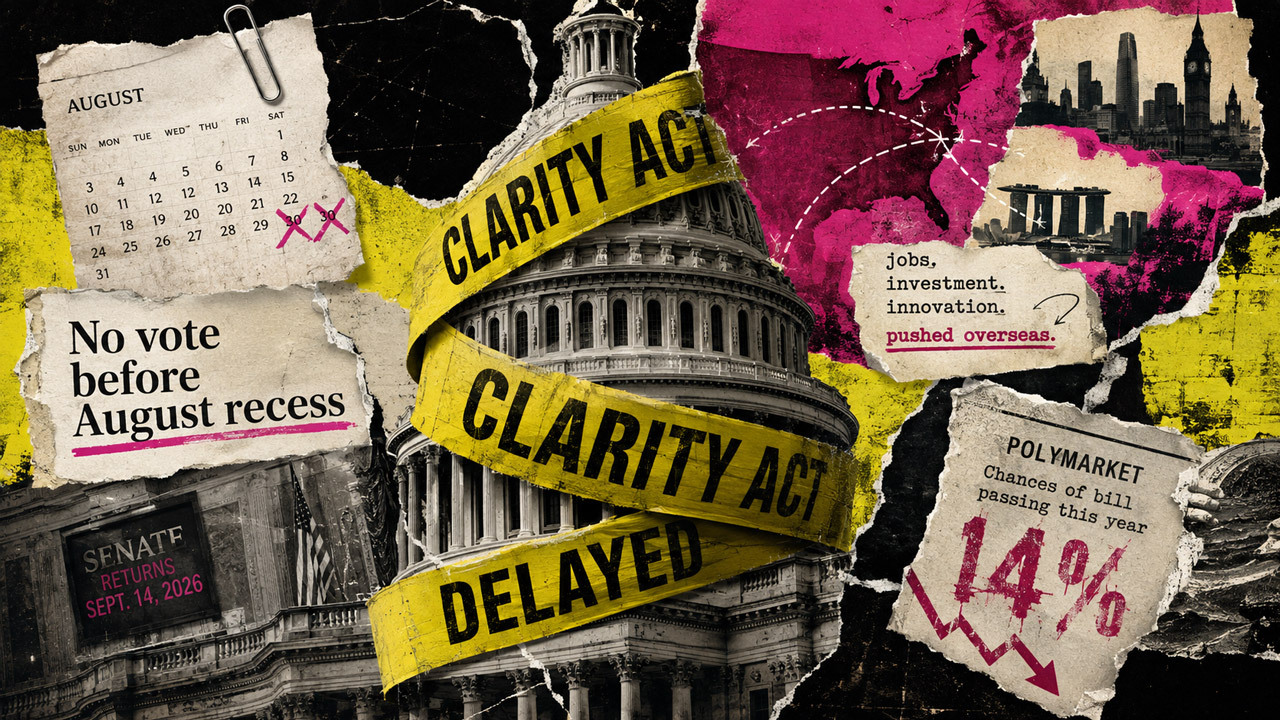
Perhaps the most pressing concern is the framework’s non-binding status. The SEC and CFTC do not legislate. Congress does. What we have today is an interpretive memorandum, not codified law, and as such, it remains vulnerable to shifts in agency leadership, judicial challenge, or superseding legislation like the pending Clarity Act.
JUST IN: 📜 The CLARITY Act could see a markup before Easter, according to Senator Kevin Cramer.
🇺🇸 Cramer advocates for “U.S. guardrails” between traditional and non-traditional banking, warning the U.S. could lose its “innovative edge” if digital assets move overseas. pic.twitter.com/2cWRw6SsXy
— Bitcoin.com News (@BitcoinNews) March 17, 2026
Policy Without Law Leaves Investors Exposed
This uncertainty is compounded by the grey period inherent in the transition mechanism. Projects must now navigate costly legal analyses to determine precisely when they have achieved sufficient decentralization to shed their securities classification. For early-stage teams operating on lean budgets, this ambiguity could stifle the very innovation the framework purports to enable.
Moreover, national security experts at institutions like CSIS have warned that the GENIUS Act’s focus on centralized issuers may leave decentralized protocols and privacy-enhancing technologies outside the regulatory perimeter, creating vectors for sanctions evasion that adversaries could exploit.
Continue reading: SEC and CFTC Finally Align on Crypto: “Most Assets Aren’t Securities”
From my vantage point, having engaged with both regulators and builders, I see this framework not as an endpoint but as a foundation on which more durable, adaptive regulation must be built. The harmonization of SEC and CFTC authority through Project Crypto is a historic step toward ending the jurisdictional turf wars that have long paralyzed U.S. crypto policy.
The Real Test Will Be in How Regulators Apply
Still, true regulatory maturity requires more than asset classification. It demands ongoing dialogue with technologists, economists, and civil society to ensure that rules evolve alongside the systems they govern. The inclusion of on-chain activities like staking, mining, and wrapping within the framework’s analytical scope is encouraging.
The devil will be in the implementation details that regulators now must develop through notice-and-comment rulemaking. The market has responded positively to the clarity, with institutional interest in the newly designated digital commodities rising measurably since the announcement. But we must resist the temptation to declare victory prematurely.
After months of hard work, we have bipartisan text ready for Thursday’s markup. I urge my Democrat colleagues: don’t retreat from our progress. The Digital Asset Market Clarity Act will provide the clarity needed to keep innovation in the U.S. & protect consumers. Let’s do this! pic.twitter.com/fuu5CIQa8X
— Senator Cynthia Lummis (@SenLummis) January 13, 2026
The framework’s success will ultimately be judged not by the elegance of its taxonomy but by its real-world outcomes. Does it reduce fraud without stifling experimentation? Does it protect consumers without cementing incumbent advantages?
Does it position the United States as a leader in responsible digital asset innovation, or merely as a jurisdiction that has replaced one set of uncertainties with another?
Prioritize Transparency and User Protection
As we await Congressional action to codify these principles into law, the industry must remain engaged, constructive, and vigilant. Builders should leverage the newfound clarity to prioritize transparency and user protection, not as a regulatory checkbox but as a competitive advantage.
BREAKING: The SEC has formally classified SOL as a digital commodity in its new crypto asset taxonomy, alongside BTC, ETH, and 14 other assets.
SOL is not a security. pic.twitter.com/PnqpT46NdT
— Solana (@solana) March 17, 2026
Investors must recognize that commodity classification does not eliminate risk and should conduct due diligence accordingly. Policymakers must continue to listen to the diverse voices shaping this ecosystem, from developers in decentralized autonomous organizations to consumer advocates demanding accountability.
Do not get me wrong. The March 2026 framework is a big plus for the industry, yes, but it is a plus that comes with asterisks. It is a map, not the territory. It is a starting gun, not a finish line. Those of us who have championed decentralization, privacy, and financial inclusion for over a decade understand that regulatory clarity is necessary but insufficient.
Classification to Cultivation
The work now shifts from classification to cultivation. We must build the institutions, standards, and cultural norms that will allow digital assets to fulfill their promise without repeating the excesses of traditional finance.
If we approach this moment with both appreciation for the progress made and humility about the challenges ahead, the United States can yet lead the world into a more open, equitable, and innovative financial future. The framework gives us the rules of the road. It is up to all of us to ensure the journey delivers on its destination.
The March 2026 joint framework from the Securities and Exchange Commission and the Commodity Futures Trading Commission represents the most significant regulatory development in U.S. crypto history. While most of my peers see this as “good”, I view this moment with cautious optimism.
The classification of 16 major digital assets, including Bitcoin, Ethereum, Solana, and XRP, as digital commodities under primary CFTC jurisdiction finally provides the legal certainty that institutional capital has demanded.
Clarity, however welcome, does not equate to perfection. The framework’s very structure reveals tensions that could undermine its stated goal of fostering innovation while protecting investors.
After more than a decade of uncertainty, this interpretation will provide market participants with a clear understanding of how the SEC treats crypto assets under federal securities laws.
This is what regulatory agencies are supposed to do: draw clear lines in clear terms. https://t.co/wij5cA7N2i
— Paul Atkins (@SECPaulSAtkins) March 17, 2026
The 5-category taxonomy, covering Digital Commodities, Digital Securities, Digital Collectibles, Digital Tools, and regulated Payment Stablecoins under the GENIUS Act, offers a pragmatic scaffold for a market that has operated in a regulatory gray zone for too long.
Join the inaugural Finance Magnates Singapore Summit 2026, which will bring together brokers, fintechs, banks, EMIs, wealth managers, and hedge funds across APAC.
By acknowledging that assets can transition from securities to commodities as decentralization deepens, the agencies have embraced a dynamic view of technological evolution that the static Howey test never accommodated. This is progress.
Related: SEC Clarifies Crypto Rules, Shifting Responsibility to Brokers
The practical implications of shifting oversight from the SEC’s disclosure-heavy regime to the CFTC ‘s market-conduct focus raise legitimate questions about investor safeguards.
Commodities regulation simply does not mandate the same level of financial transparency, audit requirements, or fiduciary obligations that securities law imposes.
For retail participants who have grown accustomed to the SEC’s investor-first posture, this represents a tangible reduction in recourse should manipulation or fraud occur. The data bears this out. While the CFTC has expanded its enforcement capabilities, its budget and staffing remain a fraction of the SEC’s, limiting its capacity to police a market now valued in the trillions.
The GENIUS Act’s Safeguards Could Backfire
The GENIUS Act’s treatment of stablecoins illustrates another layer of complexity. While the legislation rightly mandates one-to-one reserve backing, monthly attestations, and segregation of customer funds, it explicitly prohibits issuers from paying yield on stablecoin holdings.
TRUMP: 🇺🇸 “The Golden Age of America is upon us, with today’s signing.”
President Trumps signs the Genius Act signaling the first of Stablecoin legislation. pic.twitter.com/JD2TtV0p9b
— CoinDesk (@CoinDesk) July 18, 2025
This well-intentioned guardrail against shadow banking risks inadvertently pushes yield-seeking users toward unregulated offshore platforms or riskier DeFi protocols, potentially increasing systemic fragility rather than reducing it.
Furthermore, the Act’s bankruptcy provisions, while granting stablecoin holders super-priority status in theory, leave unresolved questions about the practical enforceability of those claims across fragmented custody arrangements.
Read more: Trump Signs GENIUS Act Into Law, Setting Stage for Wider Crypto Oversight
If a major issuer were to fail, the FDIC’s $250,000 insurance limit applies to the corporate account holding reserves, not to individual token holders. This gap could leave millions of users exposed despite the framework’s consumer-protection rhetoric.
Perhaps the most pressing concern is the framework’s non-binding status. The SEC and CFTC do not legislate. Congress does. What we have today is an interpretive memorandum, not codified law, and as such, it remains vulnerable to shifts in agency leadership, judicial challenge, or superseding legislation like the pending Clarity Act.
JUST IN: 📜 The CLARITY Act could see a markup before Easter, according to Senator Kevin Cramer.
🇺🇸 Cramer advocates for “U.S. guardrails” between traditional and non-traditional banking, warning the U.S. could lose its “innovative edge” if digital assets move overseas. pic.twitter.com/2cWRw6SsXy
— Bitcoin.com News (@BitcoinNews) March 17, 2026
Policy Without Law Leaves Investors Exposed
This uncertainty is compounded by the grey period inherent in the transition mechanism. Projects must now navigate costly legal analyses to determine precisely when they have achieved sufficient decentralization to shed their securities classification. For early-stage teams operating on lean budgets, this ambiguity could stifle the very innovation the framework purports to enable.
Moreover, national security experts at institutions like CSIS have warned that the GENIUS Act’s focus on centralized issuers may leave decentralized protocols and privacy-enhancing technologies outside the regulatory perimeter, creating vectors for sanctions evasion that adversaries could exploit.
Continue reading: SEC and CFTC Finally Align on Crypto: “Most Assets Aren’t Securities”
From my vantage point, having engaged with both regulators and builders, I see this framework not as an endpoint but as a foundation on which more durable, adaptive regulation must be built. The harmonization of SEC and CFTC authority through Project Crypto is a historic step toward ending the jurisdictional turf wars that have long paralyzed U.S. crypto policy.
The Real Test Will Be in How Regulators Apply
Still, true regulatory maturity requires more than asset classification. It demands ongoing dialogue with technologists, economists, and civil society to ensure that rules evolve alongside the systems they govern. The inclusion of on-chain activities like staking, mining, and wrapping within the framework’s analytical scope is encouraging.
The devil will be in the implementation details that regulators now must develop through notice-and-comment rulemaking. The market has responded positively to the clarity, with institutional interest in the newly designated digital commodities rising measurably since the announcement. But we must resist the temptation to declare victory prematurely.
After months of hard work, we have bipartisan text ready for Thursday’s markup. I urge my Democrat colleagues: don’t retreat from our progress. The Digital Asset Market Clarity Act will provide the clarity needed to keep innovation in the U.S. & protect consumers. Let’s do this! pic.twitter.com/fuu5CIQa8X
— Senator Cynthia Lummis (@SenLummis) January 13, 2026
The framework’s success will ultimately be judged not by the elegance of its taxonomy but by its real-world outcomes. Does it reduce fraud without stifling experimentation? Does it protect consumers without cementing incumbent advantages?
Does it position the United States as a leader in responsible digital asset innovation, or merely as a jurisdiction that has replaced one set of uncertainties with another?
Prioritize Transparency and User Protection
As we await Congressional action to codify these principles into law, the industry must remain engaged, constructive, and vigilant. Builders should leverage the newfound clarity to prioritize transparency and user protection, not as a regulatory checkbox but as a competitive advantage.
BREAKING: The SEC has formally classified SOL as a digital commodity in its new crypto asset taxonomy, alongside BTC, ETH, and 14 other assets.
SOL is not a security. pic.twitter.com/PnqpT46NdT
— Solana (@solana) March 17, 2026
Investors must recognize that commodity classification does not eliminate risk and should conduct due diligence accordingly. Policymakers must continue to listen to the diverse voices shaping this ecosystem, from developers in decentralized autonomous organizations to consumer advocates demanding accountability.
Do not get me wrong. The March 2026 framework is a big plus for the industry, yes, but it is a plus that comes with asterisks. It is a map, not the territory. It is a starting gun, not a finish line. Those of us who have championed decentralization, privacy, and financial inclusion for over a decade understand that regulatory clarity is necessary but insufficient.
Classification to Cultivation
The work now shifts from classification to cultivation. We must build the institutions, standards, and cultural norms that will allow digital assets to fulfill their promise without repeating the excesses of traditional finance.
If we approach this moment with both appreciation for the progress made and humility about the challenges ahead, the United States can yet lead the world into a more open, equitable, and innovative financial future. The framework gives us the rules of the road. It is up to all of us to ensure the journey delivers on its destination.