
Bitcoin has stalled below $70,000 recently after fresh profit-taking capped gains, according to Glassnode. The firm said every recovery attempt since early February has met demand exhaustion near $70K. Thin liquidity and steady realized profits have repeatedly blocked sustained upside.
Bitcoin’s Price Liquidity Strain
As per Glassnode data, even net realized profit above $5 million per hour has led to rejection near $70K. That contrasts with Q3 2025, when profit realization reached $200 million to $350 million per hour. However, current liquidity is thin, which makes the $70,000 to $80,000 range structurally difficult.
On Feb. 25 at 18:00 UTC, smoothed net realized P&L again exceeded $5 million per hour. Price peaked at $69,400 before stalling. Glassnode said modest realization events now suppress recovery attempts under this regime.
Liquidity concerns extend beyond price action. According to CryptoQuant’s outlook, Tether reserves on exchanges dropped from $60 billion to $51.1 billion in two months. This $9 billion decline has coincided with weak January and February performance.
CryptoQuant identified $50 billion in USDT reserves as a critical threshold. If reserves fall below that level, the next structural support is at $44 billion. The firm noted that breaking $44 billion could intensify selling across Bitcoin, Ethereum, and XRP.
Meanwhile, on-chain participation has slowed. Active addresses fell from 376,000 to 263,000. CryptoQuant said the decline in unique senders and receivers confirms reduced retail and institutional activity.
Nexo Sees Defensive but Stable On-Chain Structure
While liquidity thins, Nexo described the current Bitcoin structure as compressed but orderly. Bitcoin trades below its true market mean of about $79,000. However, it is well above its realized price near $54,900.
Nexo pointed to a Bitcoin demand cluster between $60,000 and $69,000. That zone continues to absorb pressure despite repeated tests. The firm added that the environment appears defensive yet stable.
Macro conditions also weigh on liquidity. January FOMC minutes showed the Federal Reserve in no rush to cut rates. With the next cut priced around mid-year, elevated real yields limit liquidity expansion.
ETF flows have moderated as well. Five straight weeks of net outflows removed about $3.8 billion since late January. Although cumulative inflows remain sizable, institutional demand no longer offers consistent support.
Bitcoin Price Outlook and Analyst Views
At press time, the BTC price was trading at $67,021. The price fell by 2.4% in the past 24 hours and 23.83% over the past month. Earlier, Bitcoin dropped from $68,000 to near $63,000 in a sharp bearish move.
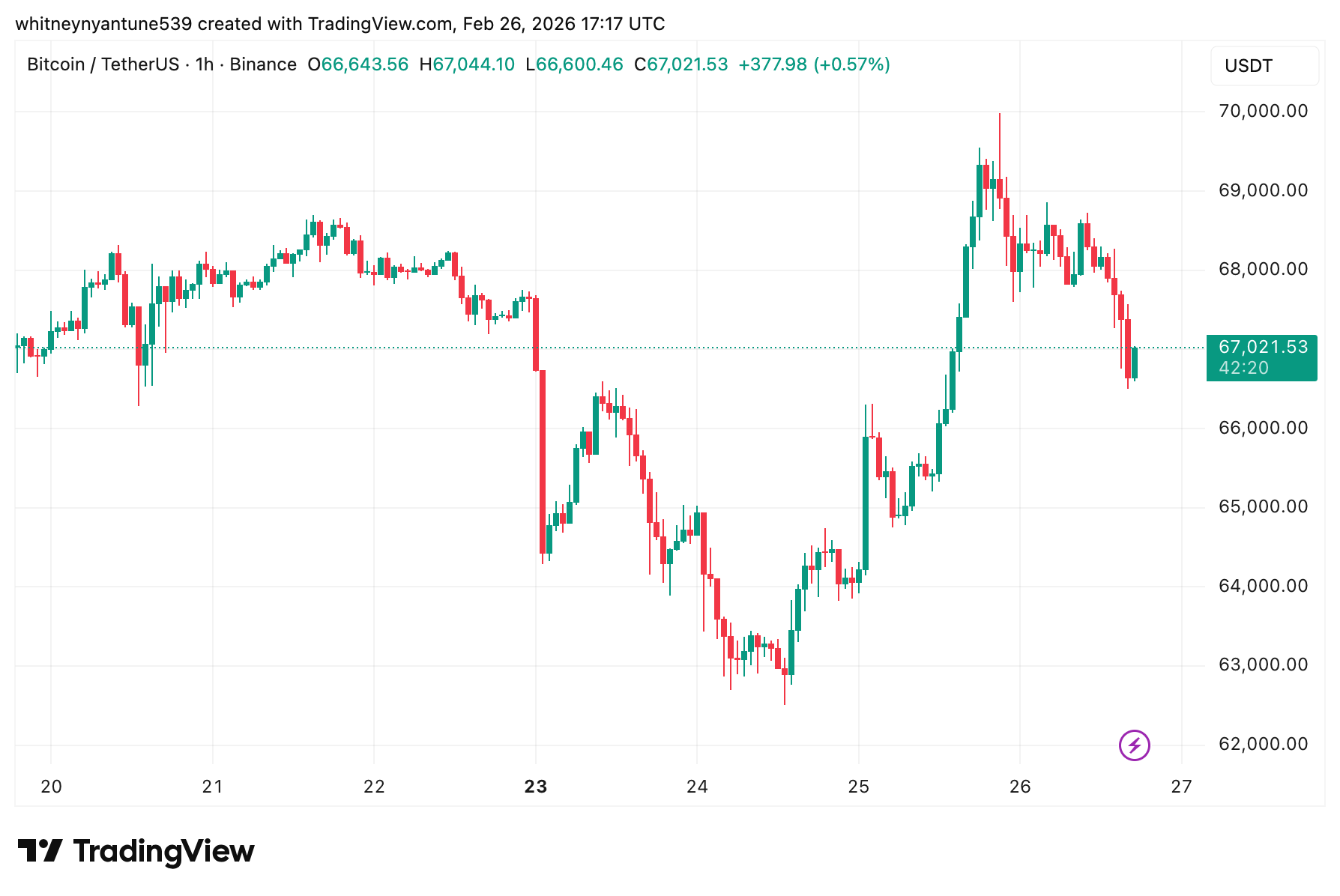 Source: TradingView
As a result, the Bitcoin price rebounded toward $69,500 to $70,000 resistance before facing rejection. It now stabilizes near $67,000, with stronger demand around $65,000. Resistance is between $68,500 and $69,500.
According to analyst Ted, recent Bitcoin gains came mainly from spot demand. However, U.S. buyers have not yet returned in force. Ted said he remains short-term bullish while spot demand holds, but he would reduce exposure if perpetual-driven activity dominates.