Updated on February 20th, 2026 by Bob Ciura
Return on invested capital, or ROIC, is a valuable financial ratio that investors can add to their research process.
Understanding ROIC and using it to screen for high ROIC stocks is a good way to focus on the highest-quality businesses.
With this in mind, we ran a stock screen to focus on the highest ROIC stocks in the S&P 500.
You can download a free copy of the top 100 stocks with the highest ROIC (along with important financial metrics like dividend yields and price-to-earnings ratio) by clicking on the link below:

Using ROIC allows investors to filter out the highest-quality businesses that are effectively generating a return on capital.
This article will explain ROIC and its usefulness for investors. It will also list the top 10 highest ROIC stocks right now.
Table Of Contents
You can use the links below to instantly jump to an individual section of the article:
What Is ROIC?
Put simply, return on invested capital (ROIC) is a financial ratio that shows a company’s ability to allocate capital. The common formula to calculate ROIC is to divide a company’s after-tax net operating profit, by the sum of its debt and equity capital.
Once the ROIC is calculated, it is evaluated against a company’s weighted average cost of capital, commonly referred to as WACC.
If a company’s WACC is not immediately available, it can be calculated by taking a weighted average of the cost of a company’s debt and equity.
Cost of debt is calculated by averaging the yield to maturity for a company’s outstanding debt. This is fairly easy to find, as a publicly-traded company must report its debt obligations.
Cost of equity is typically calculated by using the capital asset pricing model, otherwise known as CAPM.
Once the WACC is calculated, it can be compared with the ROIC. Investors want to see a company’s ROIC exceed its WACC.
This indicates the underlying business is successfully investing its capital to generate a profitable return. In this way, the company is creating economic value.
Generally, stocks generating the highest ROIC are doing the best job of allocating their investors’ capital. With this in mind, the following section ranks the 10 stocks with the highest ROIC.
The Top 10 Highest ROIC Stocks
The following 10 stocks have the highest ROIC in the Sure Analysis Research Database. Stocks are listed by ROIC, from lowest to highest.
High ROIC Stock #10: Yum Brands Inc. (YUM)
Return on invested capital: 44.6%
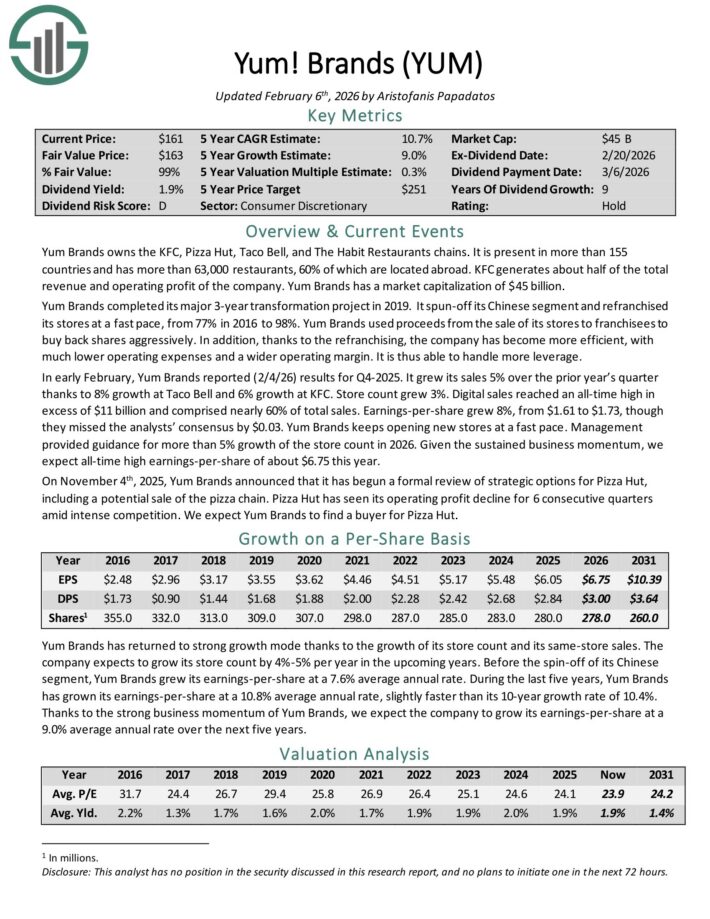
Yum Brands owns the KFC, Pizza Hut, Taco Bell, and The Habit Restaurants chains. It is present in more than 155 countries and has more than 59,000 restaurants, 60% of which are located abroad.
KFC generates about half of the total revenue and operating profit of the company.
In early February, Yum Brands reported (2/4/26) results for Q4-2025. It grew its sales 5% over the prior year’s quarter thanks to 8% growth at Taco Bell and 6% growth at KFC. Store count grew 3%.
Digital sales reached an all-time high in excess of $11 billion and comprised nearly 60% of total sales. Earnings-per-share grew 8%, from $1.61 to $1.73, though they missed the analysts’ consensus by $0.03. Yum Brands keeps opening new stores at a fast pace.
Management provided guidance for more than 5% growth of the store count in 2026. Given the sustained business momentum, we expect all-time high earnings-per-share of about $6.75 this year.
Click here to download our most recent Sure Analysis report on YUM (preview of page 1 of 3 shown below):
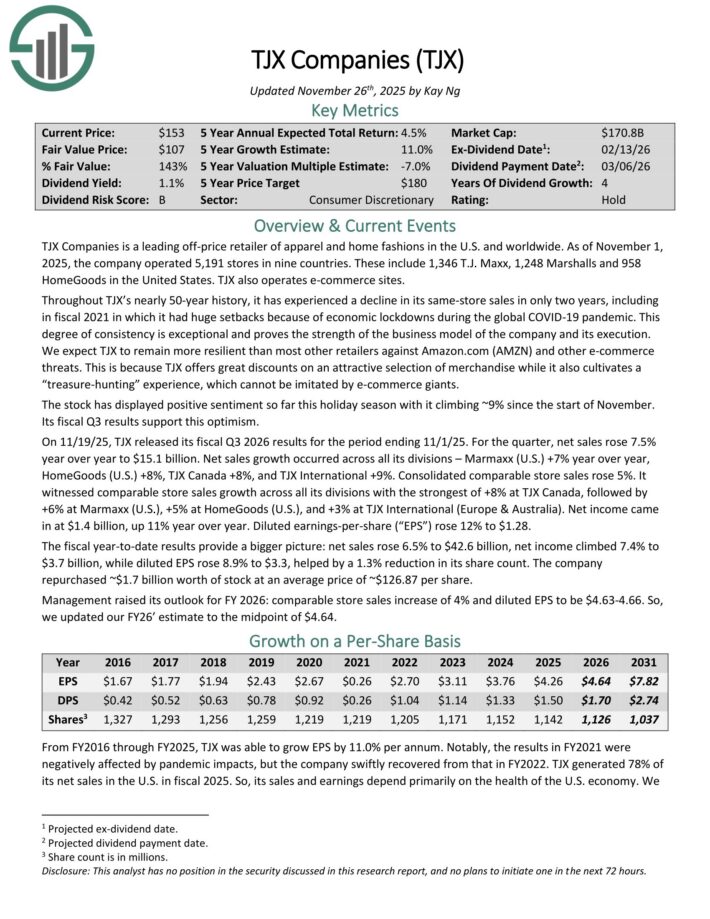
High ROIC Stock #9: TJX Companies (TJX)
Return on invested capital: 46.9%
TJX Companies is a leading off-price retailer of apparel and home fashions in the U.S. and worldwide. As of November 2, 2024, the company operated 5,057 stores in nine countries.
These include 1,331 T.J. Maxx (26% of total), 1,219 Marshalls (24%) and 941 HomeGoods (19%) in the United States. TJX also operates e-commerce sites. In a normal year, the company generates ~$50 billion in annual revenue and ~$4 billion in net profit.
On 11/19/25, TJX released its fiscal Q3 2026 results for the period ending 11/1/25. For the quarter, net sales rose 7.5% year over year to $15.1 billion. Net sales growth occurred across all its divisions – Marmaxx (U.S.) +7% year over year, HomeGoods (U.S.) +8%, TJX Canada +8%, and TJX International +9%.
Consolidated comparable store sales rose 5%. It witnessed comparable store sales growth across all its divisions with the strongest of +8% at TJX Canada, followed by +6% at Marmaxx (U.S.), +5% at HomeGoods (U.S.), and +3% at TJX International (Europe & Australia).
Net income came in at $1.4 billion, up 11% year over year. Diluted earnings-per-share rose 12% to $1.28.
The company repurchased ~$1.7 billion worth of stock at an average price of ~$126.87 per share.
Click here to download our most recent Sure Analysis report on TJX (preview of page 1 of 3 shown below):
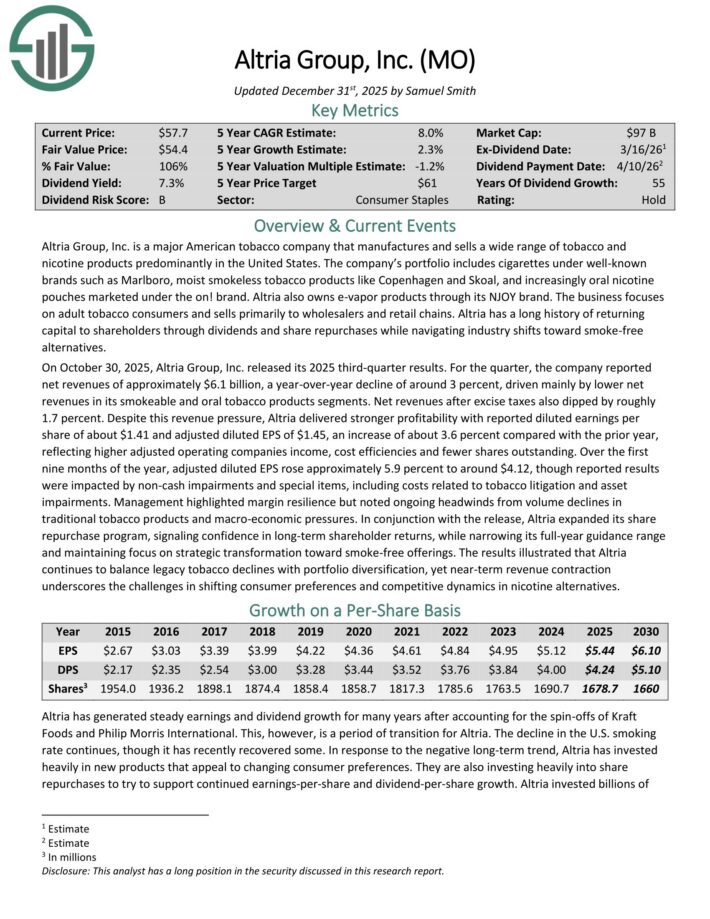
High ROIC Stock #8: Altria Group (MO)
Return on invested capital: 47.5%
Altria is a tobacco stock that sells cigarettes, chewing tobacco, cigars, e-cigarettes, and more under a variety of brands, including Marlboro, Skoal, and Copenhagen, among others.
The decline in the U.S. smoking rate continues, though it has recently recovered some. In response to the negative long-term trend, Altria has invested heavily in new products that appeal to changing consumer preferences.
On October 30, 2025, Altria Group, Inc. released its 2025 third-quarter results. For the quarter, the company reported net revenues of approximately $6.1 billion, a year-over-year decline of around 3%, driven mainly by lower net revenues in its smokeable and oral tobacco products segments.
Net revenues after excise taxes also dipped by roughly 1.7%. Despite this revenue pressure, Altria delivered stronger profitability with reported diluted earnings per share of about $1.41 and adjusted diluted EPS of $1.45, an increase of about 3.6% compared with the prior year, reflecting higher adjusted operating companies income, cost efficiencies and fewer shares outstanding.
Click here to download our most recent Sure Analysis report on Altria (preview of page 1 of 3 shown below):
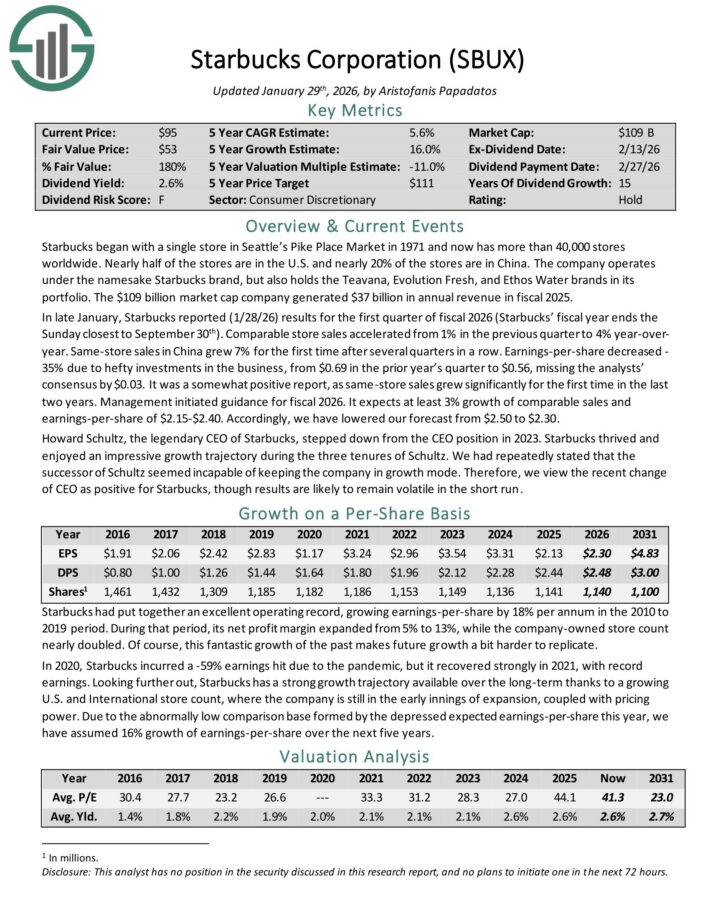
High ROIC Stock #7: Starbucks Corporation (SBUX)
Return on invested capital: 51.2%
Starbucks began with a single store in Seattle’s Pike Place Market in 1971 and now has more than 39,000 stores worldwide. Nearly half of the stores are in the U.S. and nearly 20% of the stores are in China.
The company operates under the Starbucks brand, but also holds the Teavana, Evolution Fresh, and Ethos Water brands in its portfolio. The company generated $36 billion in annual revenue in fiscal 2024.
In late January, Starbucks reported (1/28/26) results for the first quarter of fiscal 2026. Comparable store sales accelerated from 1% in the previous quarter to 4% year-over-year.
Same-store sales in China grew 7% for the first time after several quarters in a row. Earnings-per-share decreased 35% due to hefty investments in the business, from $0.69 in the prior year’s quarter to $0.56, missing the analysts’ consensus by $0.03.
It was a somewhat positive report, as same-store sales grew significantly for the first time in the last two years. Management initiated guidance for fiscal 2026. It expects at least 3% growth of comparable sales and earnings-per-share of $2.15-$2.40. Accordingly, we have lowered our forecast from $2.50 to $2.30.
Click here to download our most recent Sure Analysis report on SBUX (preview of page 1 of 3 shown below):
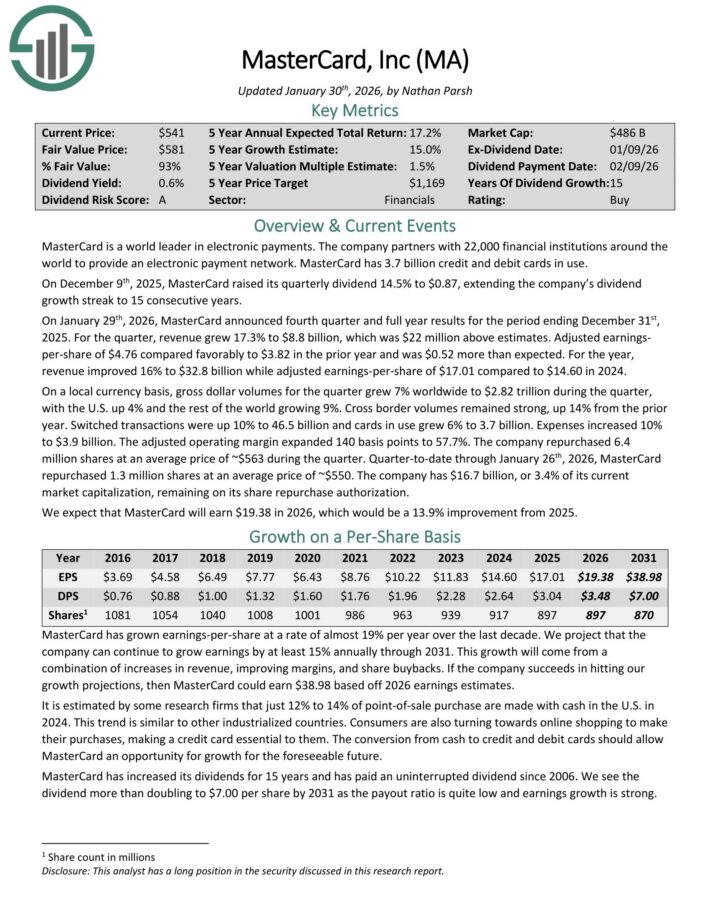
High ROIC Stock #6: Mastercard Inc. (MA)
Return on invested capital: 52.9%
MasterCard is a world leader in electronic payments. The company partners with 25,000 financial institutions around the world to provide an electronic payment network. MasterCard has more than 3.1 billion credit and debit cards in use.
On January 29th, 2026, MasterCard announced fourth quarter and full year results for the period ending December 31st, 2025. For the quarter, revenue grew 17.3% to $8.8 billion, which was $22 million above estimates.
Adjusted earnings-per-share of $4.76 compared favorably to $3.82 in the prior year and was $0.52 more than expected.
For the year, revenue improved 16% to $32.8 billion while adjusted earnings-per-share of $17.01 compared to $14.60 in 2024.
On a local currency basis, gross dollar volumes for the quarter grew 7% worldwide to $2.82 trillion during the quarter, with the U.S. up 4% and the rest of the world growing 9%. Cross border volumes remained strong, up 14% from the prior year.
Quarter-to-date through January 26th, 2026, MasterCard repurchased 1.3 million shares at an average price of ~$550. The company has $16.7 billion, or 3.4% of its current market capitalization, remaining on its share repurchase authorization.
Click here to download our most recent Sure Analysis report on Mastercard (preview of page 1 of 3 shown below):
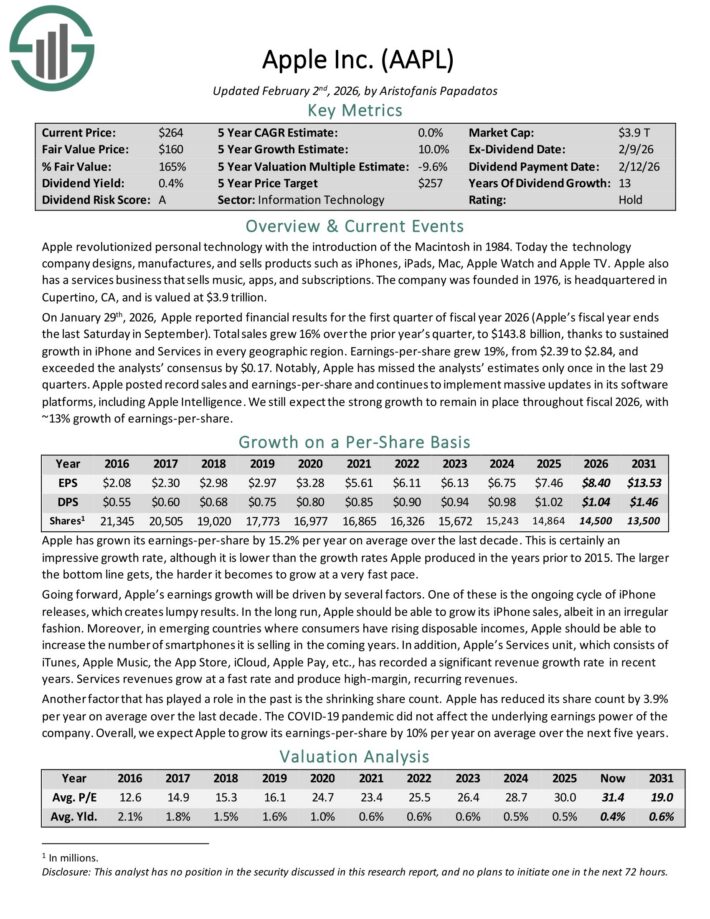
High ROIC Stock #5: Apple, Inc. (AAPL)
Return on invested capital: 54.1%
Apple is a technology company that designs, manufactures, and sells products such as iPhones, iPads, Mac, Apple Watch and Apple TV. Apple also has a services business that sells music, apps, and subscriptions.
On January 29th, 2026, Apple reported financial results for the first quarter of fiscal year 2026 (Apple’s fiscal year ends the last Saturday in September). Total sales grew 16% over the prior year’s quarter, to $143.8 billion, thanks to sustained growth in iPhone and Services in every geographic region.
Earnings-per-share grew 19%, from $2.39 to $2.84, and exceeded the analysts’ consensus by $0.17. Notably, Apple has missed the analysts’ estimates only once in the last 29 quarters.
Apple posted record sales and earnings-per-share and continues to implement massive updates in its software platforms, including Apple Intelligence.
Going forward, Apple’s earnings growth will be driven by several factors. One of these is the ongoing cycle of iPhone releases, which creates lumpy results. In the long run, Apple should be able to grow its iPhone sales, albeit in an irregular fashion.
Moreover, in emerging countries where consumers have rising disposable incomes, Apple should be able to increase the number of smartphones it is selling in the coming years.
In addition, Apple’s Services unit, which consists of iTunes, Apple Music, the App Store, iCloud, Apple Pay, etc., has recorded a significant revenue growth rate in recent years. Services revenues grow at a fast rate and produce high-margin, recurring revenues.
Click here to download our most recent Sure Analysis report on AAPL (preview of page 1 of 3 shown below):
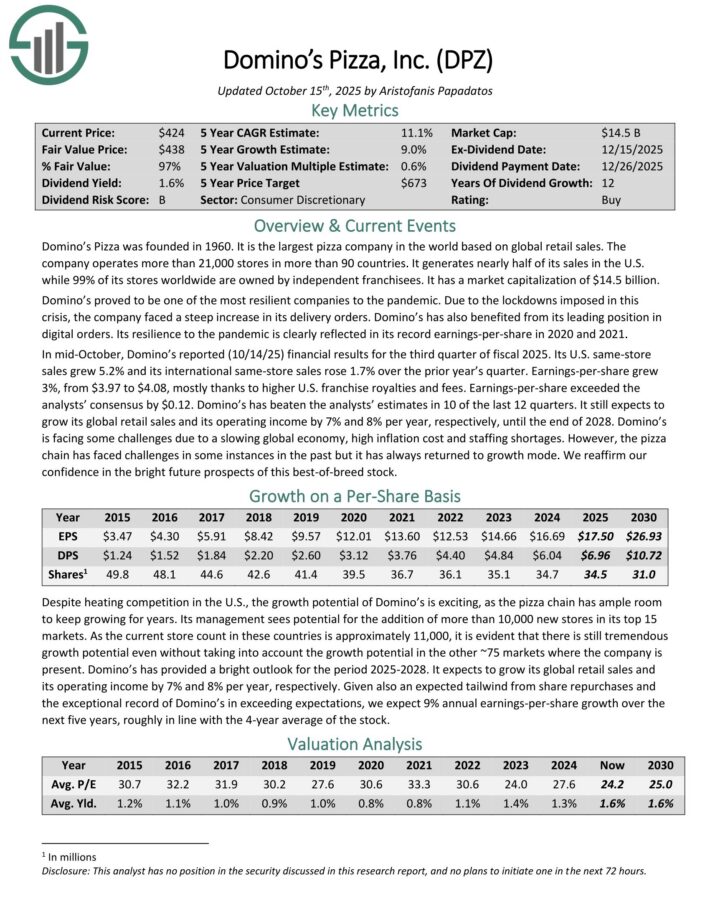
High ROIC Stock #4: Domino’s Pizza Inc. (DPZ)
Return on invested capital: 59.3%
Domino’s Pizza was founded in 1960. It is the largest pizza company in the world based on global retail sales. The company operates more than 21,000 stores in more than 90 countries.
It generates nearly half of its sales in the U.S. while 99% of its stores worldwide are owned by independent franchisees.
In mid-October, Domino’s reported (10/14/25) financial results for the third quarter of fiscal 2025. Its U.S. same-store sales grew 5.2% and its international same-store sales rose 1.7% over the prior year’s quarter.
Earnings-per-share grew 3%, from $3.97 to $4.08, mostly thanks to higher U.S. franchise royalties and fees. Earnings-per-share exceeded the analysts’ consensus by $0.12. Domino’s has beaten the analysts’ estimates in 10 of the last 12 quarters.
It still expects to grow its global retail sales and its operating income by 7% and 8% per year, respectively, until the end of 2028.
Click here to download our most recent Sure Analysis report on DPZ (preview of page 1 of 3 shown below):
High ROIC Stock #3: McKesson Corporation (MCK)
Return on invested capital: 64.3%
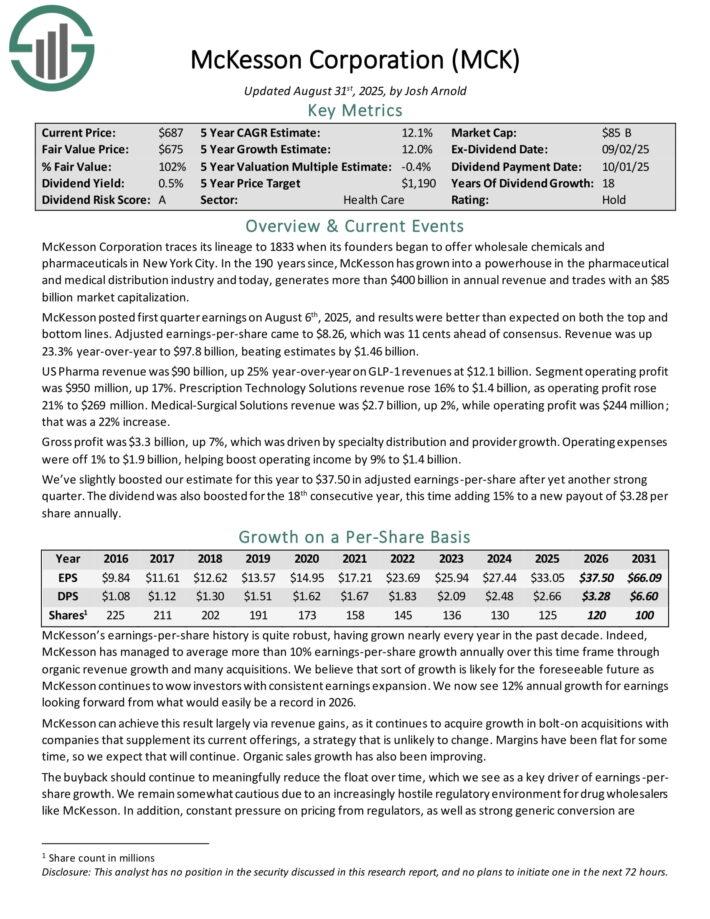
McKesson Corporation traces its lineage to 1833 when its founders began to offer wholesale chemicals and pharmaceuticals in New York City.
In the 190 years since, McKesson has grown into a powerhouse in the pharmaceutical and medical distribution industry and today, generates more than $300 billion in annual revenue.
McKesson posted first quarter earnings on August 6th, 2025, and results were better than expected on both the top and bottom lines.
Adjusted earnings-per-share came to $8.26, which was 11 cents ahead of consensus. Revenue was up 23.3% year-over-year to $97.8 billion, beating estimates by $1.46 billion.
US Pharma revenue was $90 billion, up 25% year-over-year on GLP-1 revenues at $12.1 billion. Segment operating profit was $950 million, up 17%.
Prescription Technology Solutions revenue rose 16% to $1.4 billion, as operating profit rose 21% to $269 million. Medical-Surgical Solutions revenue was $2.7 billion, up 2%, while operating profit was $244 million; that was a 22% increase.
Gross profit was $3.3 billion, up 7%, which was driven by specialty distribution and provider growth. Operating expenses were off 1% to $1.9 billion, helping boost operating income by 9% to $1.4 billion.
Click here to download our most recent Sure Analysis report on MCK (preview of page 1 of 3 shown below):
High ROIC Stock #2: Otis Worldwide (OTIS)
Return on invested capital: 69.0%
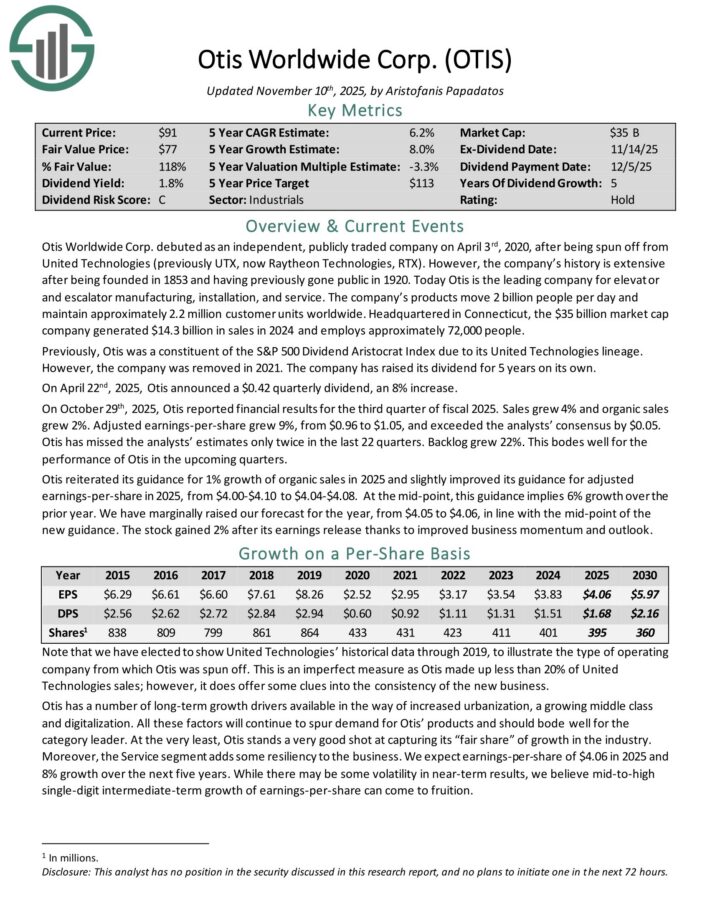
Otis Worldwide Corp. debuted as an independent, publicly traded company on April 3rd, 2020, after being spun off from United Technologies (previously UTX, now Raytheon Technologies, RTX).
Today Otis is the leading company for elevator and escalator manufacturing, installation, and service.
On October 29th, 2025, Otis reported financial results for the third quarter of fiscal 2025. Sales grew 4% and organic sales grew 2%. Adjusted earnings-per-share grew 9%, from $0.96 to $1.05, and exceeded the analysts’ consensus by $0.05.
Otis has missed the analysts’ estimates only twice in the last 22 quarters. Backlog grew 22%. This bodes well for the performance of Otis in the upcoming quarters.
Otis reiterated its guidance for 1% growth of organic sales in 2025 and slightly improved its guidance for adjusted earnings-per-share in 2025, from $4.00-$4.10 to $4.04-$4.08.
At the mid-point, this guidance implies 6% growth over the prior year.
Click here to download our most recent Sure Analysis report on OTIS (preview of page 1 of 3 shown below):
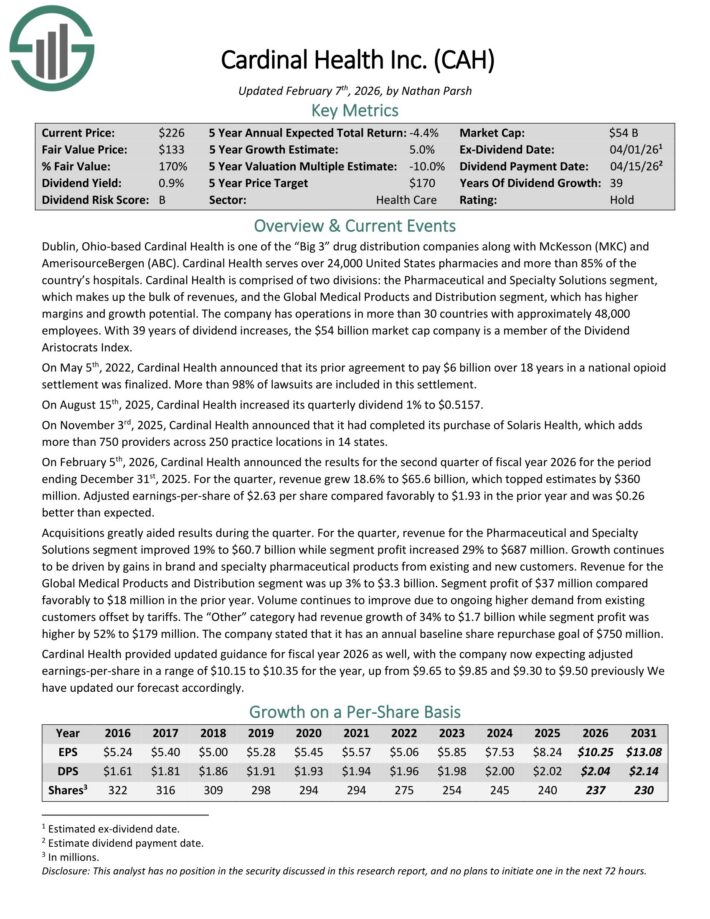
High ROIC Stock #1: Cardinal Health (CAH)
Return on invested capital: 71.6%
Cardinal Health is one of the “Big 3” drug distribution companies along with McKesson (MKC) and AmerisourceBergen (ABC). Cardinal Health serves over 24,000 United States pharmacies and more than 85% of the country’s hospitals.
Over 90% of the company’s revenue comes from the Pharma & Specialty areas.
On February 5th, 2026, Cardinal Health announced the results for the second quarter of fiscal year 2026 for the period ending December 31st, 2025.
For the quarter, revenue grew 18.6% to $65.6 billion, which topped estimates by $360 million. Adjusted earnings-per-share of $2.63 per share compared favorably to $1.93 in the prior year and was $0.26 better than expected.
Acquisitions greatly aided results during the quarter. For the quarter, revenue for the Pharmaceutical and Specialty Solutions segment improved 19% to $60.7 billion while segment profit increased 29% to $687 million.
Growth continues to be driven by gains in brand and specialty pharmaceutical products from existing and new customers. Revenue for the Global Medical Products and Distribution segment was up 3% to $3.3 billion.
Segment profit of $37 million compared favorably to $18 million in the prior year. Volume continues to improve due to ongoing higher demand from existing customers offset by tariffs.
Click here to download our most recent Sure Analysis report on CAH (preview of page 1 of 3 shown below):
Final Thoughts
There are many different ways for investors to value stocks. One popular valuation method is to calculate a company’s return on invested capital.
By doing so, investors can get a better gauge of companies that do the best job of investing their capital.
ROIC is by no means the only metric that investors should use to buy stocks. There are many other worthwhile valuation methods that investors should consider.
That said, the top 10 ROIC stocks on this list have proven the ability to create economic value for shareholders.
Further Reading
If you are interested in finding high-quality dividend growth stocks suitable for long-term investment, the following Sure Dividend databases will be useful:
Thanks for reading this article. Please send any feedback, corrections, or questions to [email protected].