Despite warnings about the dangers of private equity, credit and similar assets, retail investors are piling ever-larger amounts of money into them.
Processing Content
And advisors are becoming more willing to help them do it.
Those are the conclusions suggested by a pair of recent reports, one from the investment banking and private market-tracking firm Robert A. Stanger and the other from asset management giant Blackstone. Stanger, which emails out a weekly “Alt Street Journal” tallying retail investments into private equity, private credit, venture capital, real estate and other alternatives to standard stocks and bonds, reported last month that regular investors plowed $203.7 billion in total into U.S. private markets in 2025.
That was up nearly 36% from the year before and a whopping 122% from 2023. The biggest category of investment, taking in $63 billion, was business development companies, which are set up as conduits for investing in small and medium-size privately held firms.
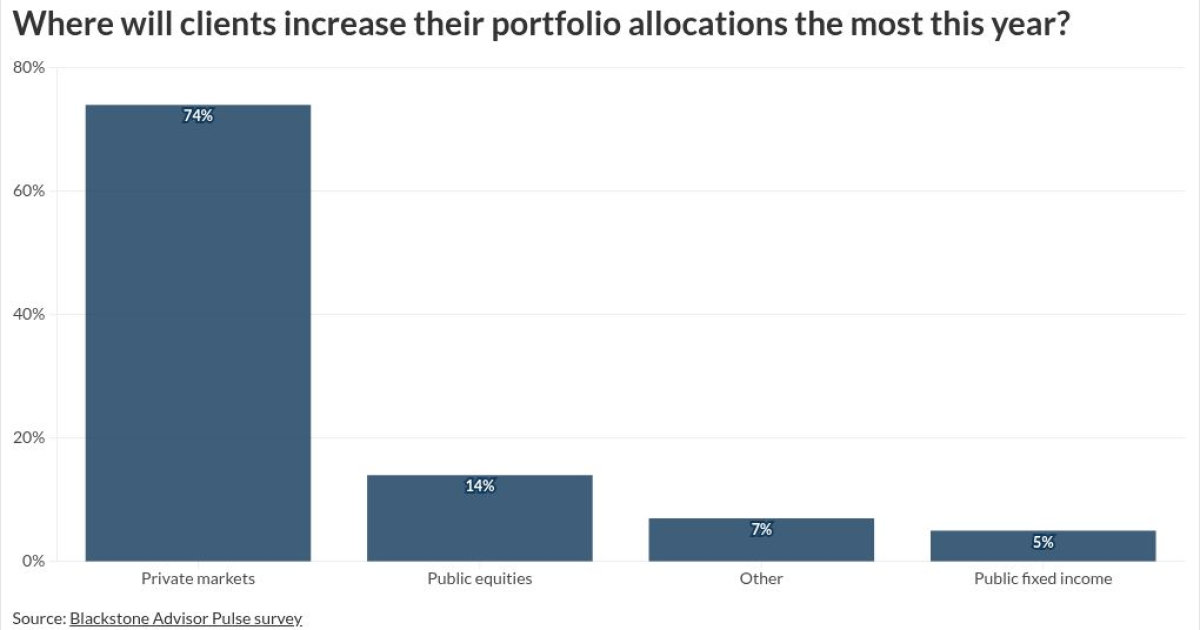
Meanwhile, Blackstone released survey results this week suggesting that nearly three-quarters of advisors expect clients’ private market allocations to increase more this year than investments in public companies’ stock, fixed-income vehicles like bonds or other investments. Blackstone’s report, drawn from global polls of advisors between November and January, cited some of the most commonly perceived benefits of private markets.
“Private assets offer investors unique sources of returns, potential for mitigating downside risks, and access to long-term growth trends that are less influenced by daily market swings,” according to the report.
Despite such assurances, skepticism of private markets abounds. Critics warn private markets are rife with traps for the unwary, including high fees and barriers to pulling money out.
READ MORE: Blackstone again hits brakes on withdrawals from non-traded REIT
Alts appetite remains strong despite cautionary tales
They also point to examples of investors tying up their money longer than planned. Just this week, the private investment firm Blue Owl Capital announced it was restricting investors’ ability to make quarterly withdrawals of money held in three private-credit funds designed for retail investors. Roughly two years ago, Blackstone itself put up similar barriers to retrieving investments in its private real estate fund known as BREIT.
Yet, despite such warning signs, advisor and investor interest in private markets continues unabated. Private investment specialist Hamilton Lane reported last month that 86% of the 390 wealth professionals it surveyed from Oct. 23 to Nov. 4 intend to increase their clients’ allocations to private markets this year.
As in many similar polls, Hamilton Lane found two driving factors behind the plans: a desire to increase portfolio performance and diversification. Nearly 30% of the respondents to the firm’s survey cited both goals.
Jackie Rantanen, a managing director on Hamilton Lane’s evergreen portfolio management team, said a large driver of the surging interest in private investments has been the work Hamilton Lane and other firms have put into making private markets accessible to more investors. The evergreen funds Rantanen works on, for instance, are designed to respond to liquidity concerns by letting investors take their money out at set intervals. Before their introduction, investors often had to wait as long as 10 years before seeing any returns.

Such innovations have helped ensure private equity, private credit and other alternatives are no longer exclusive to large institutional investors.
“We’re in a much better place today with having investors being able to invest through these funds that have lower minimums,” Rantanen said. “They have easier reporting and tax structures and all of that.”
Hamilton Lane is far from the only firm trying to clear retail investors’ path into alternatives.
On Thursday, Morgan Stanley announced it was halving fees (from 5% to 2.5%) that its private marketplace subsidiary EquityZen, which it acquired last year, charges retail investors for most transactions. Morgan Stanley is maintaining its $5,000 investment minimum for private markets.
Speaking at a financial services conference last week, Morgan Stanley wealth head Jed Finn touched on the oft-expressed desire in the industry to “democratize” private markets. He said Morgan Stanley is extending investment opportunities to all investors.
That includes investors using its E-Trade online brokerage, along with often wealthier clients working directly with its financial advisors or family-office specialists.
“EquityZen brings that capability to a more democratized view of clients,” Finn said.
READ MORE: Do ‘modest’ private market returns justify the added complexity?
Lowering regulatory barriers to investing in private markets
Lawmakers and regulators are thinking along similar lines. Many types of private investments are still out of bounds for people who don’t meet the criteria for being an “accredited investor,” defined as someone with at least $1 million in net worth (excluding homes) and an annual income of at least $200,000 for the past two years for single earners and $300,000 for married couples.
In December, the U.S. House passed legislation named the Invest Act calling on the Securities and Exchange Commission to devise an examination that investors could take to qualify as accredited, even if they don’t meet the net worth and income requirements. The Senate is expected to vote on the act this spring.
Separately, the Trump administration last year called on the Department of Labor to reconsider rules discouraging private investments in individual retirement plans like 401(k)s. Such proposals have led to an outcry from investor advocates.
In a response to the Trump proposal, the nonprofit group Better Markets wrote that the only reason private markets are now looking to retail investors is that their traditional sources of financing — endowments and pension funds — have curtailed their contributions.
“The potential for trouble is huge,” according to Better Markets. “The fear is that, rather than retail investors receiving the same opportunities as accredited investors, retail investors will get saddled with the worst private market offerings.”
The push to open private markets comes as the number of companies traded on public exchanges has fallen to less than half what it was 30 years ago, according to the SEC. Meanwhile, prominent firms like SpaceX and Anthropic, the maker of the Claude AI system, remain private.
READ MORE: As SEC leans toward opening up alts access, advisors ring alarm bells
Advisors can get help guiding clients to private markets
Rather than shy away from these opportunities and their attendant risks, many large wealth managers and advisors are now trying to position themselves as experts adept at helping clients distinguish good opportunities from bad. Various firms, in turn, have responded with services to help make this often bewildering task easier.
Simon Tang, the head of U.S. limited partnership (LP) sales at the private investment firm Carta, said one of the chief difficulties with private markets is that issuers of alternative investments don’t have to report financial data to investors in the same standardized manner that public companies do. Carta takes the diverse and vast amount of information coming from private investment issuers and puts it into a format that makes it easier for advisors to comprehend and compare.
Tang said Carta has developed systems that take private firms’ data releases and turn them into easily readable reports or graphic visualizations.
“It’s really enabling the investors, the LPs, to get a handle on transparency and really understand the risk-return characteristics within the portfolio, understand the value drivers, which ones are underperforming, etc. …,” Tang said.
Carta was founded in 2012 to help private companies manage their stock ownership plans and partnered with Morgan Stanley in late 2024 to help employees of private firms take shares in their employers when they go public. Tang acknowledged that investing in private markets has become “cool, it’s sexy, it’s the flavor of the day.”
“But if you’re going to invest into this asset class for the long term, you really need to understand what’s happening within those individual companies and see if that really aligns with the proposition that the [private investment issuers] are putting forward when they’re fundraising and holding them to account,” he said. “So there are a lot of various challenges for LPs once they start dipping their toes into this asset class.”Rather than reasons to stay away, advisors are finding much to recommend private markets.
Blackstone’s survey found that 40% of respondents want to diversify their portfolios, in large part for fear that stocks have become overvalued. Similarly, 32% said concerns about volatility in public markets were driving their desire for diversification.
Hamilton Lane’s survey suggests many investors remain unaware of recent innovations meant to take some of the risk out of private markets. Just over 60% of its respondents, for instance, said their clients don’t know about the sorts of evergreen funds that Rantanen and others at Hamilton Lane manage to help reduce liquidity concerns.
“There’s a lot of education, I think, that still needs to happen about what the private markets are and how investors should think about them,” she said. “They are still long-dated investment opportunities. And so understanding that and helping investors understand how they can fit into a portfolio is really important.”