No Result
View All Result
  • Login
Saturday, May 30, 2026
FeeOnlyNews.com
  • Home
  • Business
  • Financial Planning
  • Personal Finance
  • Investing
  • Money
  • Economy
  • Markets
  • Stocks
  • Trading
  • Home
  • Business
  • Financial Planning
  • Personal Finance
  • Investing
  • Money
  • Economy
  • Markets
  • Stocks
  • Trading
No Result
View All Result
FeeOnlyNews.com
No Result
View All Result
Home Economy

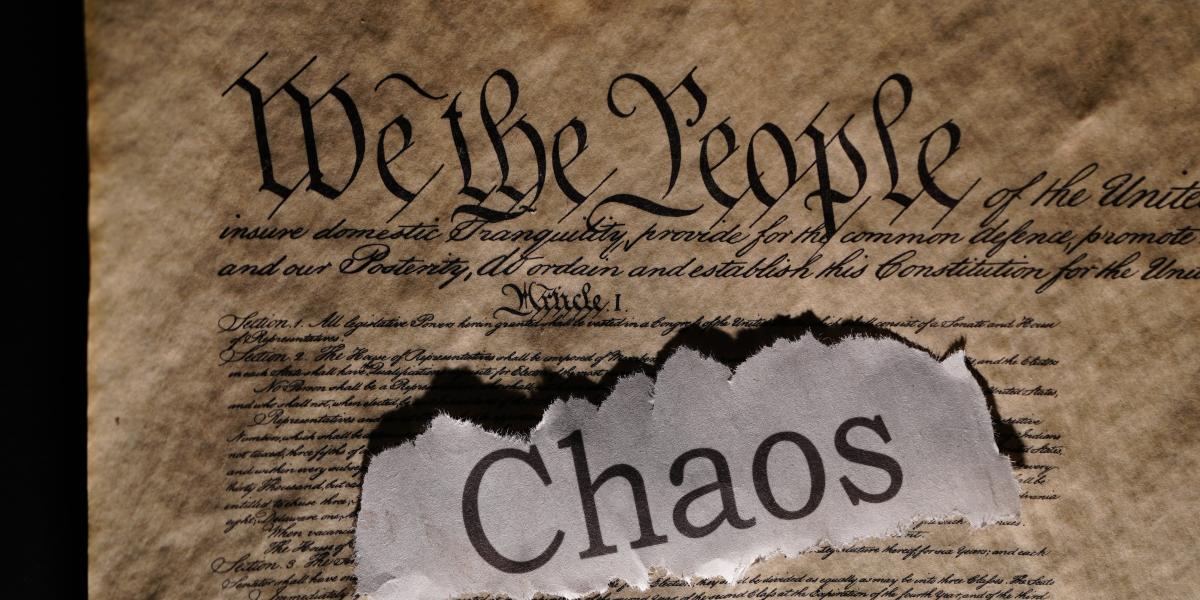
Constitutions and Chaos | Mises Institute

by FeeOnlyNews.com
5 months ago
in Economy
Reading Time: 4 mins read
A A
0
Constitutions and Chaos | Mises Institute
Share on FacebookShare on TwitterShare on LInkedIn


There is much to agree with in both Matt Walsh’s comments and Phil Duffy’s “Ken Burns Plays the “Founding Chaos” Card” criticisms of Ken Burns’s “The American Revolution,” flawed in the politically correct ways you would expect from PBS. Duffy focuses on Burns’s simplistic generalization “The Constitution saved the nation from chaos.”

There were a lot of problems in the aftermath of the Revolution that ended in 1783. The 13 states had suffered extensive destruction and financed an extremely expensive war with debt and paper money rather than taxes (as becomes a new confederation founded partly on resistance to taxation). But, in consequence of having built such an overhang of debt, the states were paying, on average, three to four times the taxes they paid as pre-Revolutionary colonies!

Shays’s Rebellion was prompted by Massachusetts attempting to raise taxes in order to pay their part of the Confederation debt. As Duffy emphasized, Massachusetts put down the Rebellion, but their electorate subsequently ejected much of the legislature that had raised taxes.

This sort of electoral response—very democratic yet perverse in terms of solving the debt problem—motivated those gathering for that 1787 conspiracy (sworn to secrecy and behind locked doors) which produced the Constitution. In other words, the American states had become excessively democratic. After 1775, legislatures were expanded so that each member represented rather small constituencies, and more representatives were middle class rather than aristocratic. (The proportion of legislators who were wealthy before the Revolution was 46 percent; it declined to 22 percent after the Revolution. This is detailed in The Founding Fortunes: How the Wealthy Paid for and Profited from the American Revolution by Tom Shachtman). Also, they were elected annually, so they were infinitely more responsive to the electorate than anything we can imagine today.

This led naturally to paying for the war with debt and paper money, rather than directly with taxes. It also led, as debts grew, to laws making it difficult for anyone to collect genuine debts. Foreigners and Americans grew very leery of lending to Americans by 1787.

So, both “Federalists” (nationalists in sheep’s clothing) and “Anti-Federalists” (the true federalists) were motivated by what they saw as the irresponsibility of excessive democracy. There was general agreement on creating a federation that was republican, as far from “mobocracy” as possible. In the words of Pennsylvania delegate Robert Morris, it was necessary to “restrain the democratic spirit.”

In this vein, there was consensus about one of the best things the Constitution did: It outlawed paper money, or at least they all thought it did. They explicitly forbade the states from using paper money. Article I, Section 10 forbade the states to “emit Bills of Credit; make any Thing but gold and silver Coin a Tender in Payment of Debts” and also forbade laws impairing the obligation of contracts, solving the debt collection problem. They also rejected in their deliberations giving the federal government the power to create paper money. And, since they argued at the time that the federal government could do nothing not explicitly authorized by the Constitution, they thought they “had gotten rid of paper money.”

Among other problems in post-Revolution America were the loss of trading opportunities that had previously existed within the British empire and the tendency of the individual states to impose tariffs and restrictions on interstate commerce. Virginia and South Carolina charged North Carolina such high tariffs that James Madison referred to North Carolina “as a patient bleeding from both arms.”

Thus, while I disagree with Burns that the Constitution was the only way to prevent a descent into chaos, there were some serious problems that the Constitution successfully addressed. Another important improvement it brought about was the uniform national import tariff as the chief method of taxation. It was initially set low to merely fund the government and the debt, but it was set higher than the competing states with ports (who were in competition) could set theirs, so it proved very efficient and crucial in addressing the large debt.

Alas, how much better would it have been had the delegates followed their legal instructions from the Congress to revise the Articles of Confederation with the improvements we’ve touched upon? For the Confederation’s looser, more voluntarist structure was much more protective of individual liberty over time in many ways.

For instance, because of geography and the wealth liberty created, the US has never been vulnerable to foreign attack before the nuclear era. Every US war has been a war of choice—the War of 1812, the Mexican War, Lincoln’s War, the Spanish-American War, WWI, WWII (FDR purposefully manipulated the US into it), the Korean War, the Vietnam War, Kosovo, Iraq (twice), Afghanistan, Libya, etc.—all wars engaged in by a US ruling class with the levers of national power. It is unimaginable that any of those wars would have been initiated by the US under the Articles of Confederation.

So just which constitution resulted in more chaos? The US-initiated War of 1812 caused tremendous death and destruction and nearly caused the New England states to secede. Absolutely no gain but plenty of chaos. Such an offensive war would have been impossible to initiate under the Articles of Confederation.

More than 85 million died in WWII because of US entry and its ruthless methods of prosecuting the war, with the consequent sequelae of the enslavement of Eastern Europe and China by Communism and on the order of 100 million murdered under Communism. That’s chaos.

Governments are inherently corrupt. The degree of corruption increases with the size of the government and its distance from the governed. The best you can do is have lots of smaller states (among which the citizens may vote with their feet) in confederations for mutual defense and free trade. That describes what was within reach with an improved Articles of Confederation.



Source link

Tags: ChaosConstitutionsInstituteMises
ShareTweetShare
Previous Post

With Global Attention on Venezuela, Israel Intensifies Assault on Gaza, Lebanon

Next Post

How “Easy Money” Turned Into A $50 Million Loss

Related Posts

Market Talk – May 29, 2026

Market Talk – May 29, 2026

by FeeOnlyNews.com
May 29, 2026
0

ASIA: The major Asian stock markets had a mixed day today: • NIKKEI 225 increased 1,636,38 points or 2.53% to...

Iran war cost: Average U.S. household paying 0 more on gas and energy

Iran war cost: Average U.S. household paying $450 more on gas and energy

by FeeOnlyNews.com
May 29, 2026
0

Americans have spent nearly $450 extra per household on rising energy costs during the Iran war, according to an analysis...

Coffee Break: Ancient Art, the Return of Analog, Science in Distress, and Death Is for Losers

Coffee Break: Ancient Art, the Return of Analog, Science in Distress, and Death Is for Losers

by FeeOnlyNews.com
May 29, 2026
0

Part the First: Functional Art from the Enigmatic Daunians.  William Morris famously wrote, “Have nothing in your houses that you...

“Creating a Nation”: The Declaration of Independence and the Nation Anachronism

“Creating a Nation”: The Declaration of Independence and the Nation Anachronism

by FeeOnlyNews.com
May 29, 2026
0

“Four score and seven years ago our fathers brought forth on this continent, a new nation,. . .”—Abraham Lincoln, “The...

Patents: The Damage of Coerced Intellectual Monopoly

Patents: The Damage of Coerced Intellectual Monopoly

by FeeOnlyNews.com
May 29, 2026
0

One of the reasons why we fall for the erroneous idea that patents are good for society is because we...

How the ‘double scar’ of past inflation, geopolitical shocks is hitting consumers

How the ‘double scar’ of past inflation, geopolitical shocks is hitting consumers

by FeeOnlyNews.com
May 29, 2026
0

A "double scar" of past inflation woes and geopolitical trauma is warping how consumers view the economy and threatening a...

Next Post
How “Easy Money” Turned Into A  Million Loss

How “Easy Money” Turned Into A $50 Million Loss

AngioDynamics raises 2026 revenue guidance to 4M while advancing Med Tech growth (NASDAQ:ANGO)

AngioDynamics raises 2026 revenue guidance to $314M while advancing Med Tech growth (NASDAQ:ANGO)

  • Trending
  • Comments
  • Latest
10 States Offering Free or Low‑Cost College Courses for Residents Over 60

10 States Offering Free or Low‑Cost College Courses for Residents Over 60

May 13, 2026
The New Medicare Coding Change Confusing Pharmacies Across Multiple States

The New Medicare Coding Change Confusing Pharmacies Across Multiple States

May 11, 2026
Epstein Class All-In on Massie Primary But Do Midterms Matter?

Epstein Class All-In on Massie Primary But Do Midterms Matter?

May 13, 2026
Memorial Day 2026: Take Advantage of Food Freebies, Deals

Memorial Day 2026: Take Advantage of Food Freebies, Deals

May 23, 2026
Latam Insights: Coinbase Co-Founder Eyes Venezuela as Grupo Salinas Embraces Stablecoins

Latam Insights: Coinbase Co-Founder Eyes Venezuela as Grupo Salinas Embraces Stablecoins

May 17, 2026
The 18 Largest US Funding Rounds of April 2026 – AlleyWatch

The 18 Largest US Funding Rounds of April 2026 – AlleyWatch

May 15, 2026
Wall Street ends higher, crude prices ease on potential US-Iran truce extension

Wall Street ends higher, crude prices ease on potential US-Iran truce extension

0
What’s a ‘G’-Shaped Economy and Are We in One?

What’s a ‘G’-Shaped Economy and Are We in One?

0
Grayscale Files Updated S-1 For Hyperliquid Staking ETF, What Do Experts Say?

Grayscale Files Updated S-1 For Hyperliquid Staking ETF, What Do Experts Say?

0
Most Employers Are Using AI for Hiring and Firing Decisions. How Reliable Is It?

Most Employers Are Using AI for Hiring and Firing Decisions. How Reliable Is It?

0
Zara’s India FY26 profit falls 32% to Rs 204 crore; revenue slips

Zara’s India FY26 profit falls 32% to Rs 204 crore; revenue slips

0
How the ‘double scar’ of past inflation, geopolitical shocks is hitting consumers

How the ‘double scar’ of past inflation, geopolitical shocks is hitting consumers

0
Zara’s India FY26 profit falls 32% to Rs 204 crore; revenue slips

Zara’s India FY26 profit falls 32% to Rs 204 crore; revenue slips

May 30, 2026
Grayscale Files Updated S-1 For Hyperliquid Staking ETF, What Do Experts Say?

Grayscale Files Updated S-1 For Hyperliquid Staking ETF, What Do Experts Say?

May 30, 2026
What’s a ‘G’-Shaped Economy and Are We in One?

What’s a ‘G’-Shaped Economy and Are We in One?

May 30, 2026
Top earners who stay in their jobs get much larger pay increases than those who switch

Top earners who stay in their jobs get much larger pay increases than those who switch

May 30, 2026
Beyond Equities: Why HNIs are increasingly turning to premium real estate for wealth preservation

Beyond Equities: Why HNIs are increasingly turning to premium real estate for wealth preservation

May 30, 2026
Buy Side Explodes: XRP Liquidity 7x Heavier Than Sells On Coinbase

Buy Side Explodes: XRP Liquidity 7x Heavier Than Sells On Coinbase

May 30, 2026
FeeOnlyNews.com

Get the latest news and follow the coverage of Business & Financial News, Stock Market Updates, Analysis, and more from the trusted sources.

CATEGORIES

  • Business
  • Cryptocurrency
  • Economy
  • Financial Planning
  • Investing
  • Market Analysis
  • Markets
  • Money
  • Personal Finance
  • Startups
  • Stock Market
  • Trading

LATEST UPDATES

  • Zara’s India FY26 profit falls 32% to Rs 204 crore; revenue slips
  • Grayscale Files Updated S-1 For Hyperliquid Staking ETF, What Do Experts Say?
  • What’s a ‘G’-Shaped Economy and Are We in One?
  • Our Great Privacy Policy
  • Terms of Use, Legal Notices & Disclaimers
  • About Us
  • Contact Us

Copyright © 2022-2024 All Rights Reserved
See articles for original source and related links to external sites.

Welcome Back!

Sign In with Facebook
Sign In with Google
Sign In with Linked In
OR

Login to your account below

Forgotten Password?

Retrieve your password

Please enter your username or email address to reset your password.

Log In
No Result
View All Result
  • Home
  • Business
  • Financial Planning
  • Personal Finance
  • Investing
  • Money
  • Economy
  • Markets
  • Stocks
  • Trading

Copyright © 2022-2024 All Rights Reserved
See articles for original source and related links to external sites.