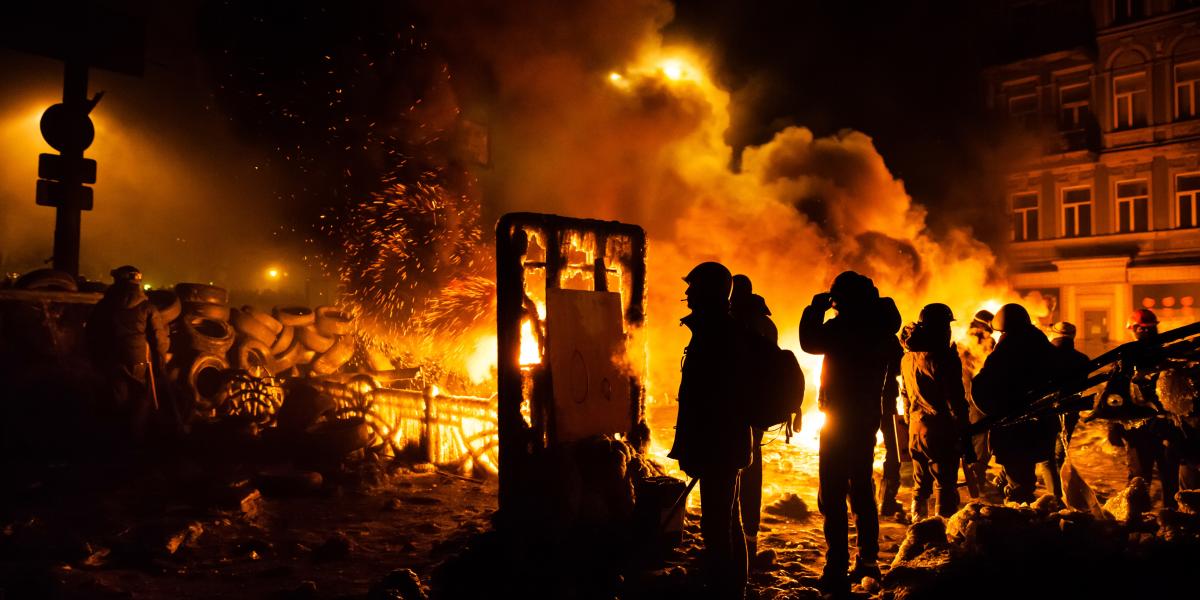
Ivan Katchanovski’s The Maidan Massacre in Ukraine: The Mass Killing That Changed the World offers the most detailed and empirically-grounded reconstruction of the events of February 2014 available in any language. The book’s central argument is that the killings of protesters and police on February 20—the pivotal moment that led to the overthrow of President Viktor Yanukovych were not the result of government-ordered repression, as the dominant Western narrative holds, but rather a coordinated false-flag operation carried out by elements within the Maidan opposition. Far from being speculative, this conclusion is built on an extraordinary body of evidence that includes ballistic studies, synchronized video analysis, unsealed court testimony from the 2023 Maidan massacre trial, forensic reports, and confessions by self-admitted Maidan snipers. The book’s significance lies not only in its controversial thesis but in its meticulous assembly of sources, many of which had been publicly available but ignored for a decade.
To understand the book’s contribution, it is necessary to revisit the context in which the Maidan massacre unfolded. The Euromaidan protests began as demonstrations against Yanukovych’s decision to postpone the signing of the EU Association Agreement. Over time, the protest movement increasingly fell under the influence of far-right nationalist groups and oligarchic political forces aligned with the opposition. Clashes gradually intensified, and several dramatic incidents, such as the beating of activist Tetiana Chornovol and the kidnapping of Dmytro Bulatov, were widely presented in the media as evidence of government brutality. Katchanovski shows that many of these earlier incidents were either staged or manipulated by opposition actors to inflame public sentiment, a pattern that foreshadowed the events of February 20.
By the time the massacre began, the Maidan Self-Defense units had stormed police lines, attacked the Party of Regions headquarters, and engaged in escalating violence that produced the first deaths in mid-February. The dominant Western framing, however, was that peaceful pro-democracy demonstrators were being slaughtered by a dictatorial regime. This narrative ossified with astonishing speed. Western media outlets—from The New York Times to the BBC and CNN—immediately attributed the gunfire to government forces without conducting any meaningful investigative reporting. Journalists on the ground observed snipers firing from buildings controlled by the Maidan opposition, including the Hotel Ukraina, yet nearly all news accounts assumed these shooters were government operatives, despite the absence of evidence and despite the fact that key buildings were under opposition control. This unquestioning acceptance of opposition claims helped solidify a moral narrative in which the government was solely responsible for the bloodshed.
One of the book’s most damning findings is that the official Ukrainian and Western government narrative that Yanukovych ordered security forces to massacre protesters was contradicted by the 2023 court verdict, which found no evidence of any such order. This factual determination directly undermines the foundational claim used to delegitimize the Yanukovych government in real time and to justify international sanctions. Katchanovski contrasts this with Russia’s narrative, which attributes the killings to far-right extremists in what it describes as a fascist coup. He argues that both narratives are partial and politically motivated. The reality—supported by forensic, testimonial, and video evidence—is far more complex, involving a coalition of far-right militants, opposition political figures, and paramilitary groups operating from buildings their forces controlled.
Quite intensely, the book examines the role of Wikipedia in shaping global understanding of the massacre. Wikipedia’s articles about Euromaidan and the killings have consistently reinforced the Western government narrative while marginalizing peer-reviewed studies, including Katchanovski’s own academic publications. The encyclopedia’s editorial process allowed activists, including individuals associated with far-right Ukrainian organizations, to dominate content and remove references to evidence contradicting the government version of events. A striking example involves the death of Ihor Kostenko—a well-known Maidan activist and also a prominent Ukrainian Wikipedia editor. Forensic evidence and the trial’s findings indicate he was shot from a direction consistent with Maidan-controlled sniper positions. Nevertheless, Wikipedia articles omit or obscure this fact, presenting his killing as an example of government brutality. The book demonstrates how digital epistemology was shaped by political activism and, in some cases, deliberate narrative control.
Perhaps the most explosive material in the book involves testimonies and confessions from self-admitted Maidan snipers. Katchanovski documents detailed statements from several individuals, many of them former Georgian military personnel, who confessed in interviews with Italian, Israeli, and US media outlets that they were recruited by Maidan leaders, armed with rifles, and instructed to fire on both police and protesters. These accounts include descriptions of receiving orders from Georgian officials aligned with the Maidan opposition and being stationed in strategic locations such as the Hotel Ukraina and the Music Conservatory. Their testimonies are supported by synchronized video evidence, witness statements from Ukrainian law enforcement, and ballistic analyses showing that many of the shots came from angles consistent with positions controlled by the opposition. What is remarkable is not that these confessions exist but that they have been almost entirely ignored by Western governments and media organizations.
The book also compiles testimonies from Maidan activists and protesters who witnessed snipers inside opposition-controlled buildings. Wounded activists repeatedly reported seeing muzzle flashes from upper floors of the Hotel Ukraina and hearing gunfire from behind their positions. Some testified during the 2023 trial that they saw armed individuals moving through hotel corridors or that protesters were hit from unexpected angles that contradicted the official version. Even prominent Ukrainian political figures, such as Arsenii Yatseniuk and Petro Poroshenko, earlier acknowledged that, during the massacre, snipers were firing from the hotel.
However, the latter claimed in February 2015 that Vladislav Surkov—an aide to Russian President Vladimir Putin—was personally coordinating foreign “snipers” on the Maidan, though no supporting evidence was presented. Moreover, Serhii Leshchenko—a member of Poroshenko’s parliamentary faction—revealed that Surkov had arrived in Kyiv by plane after the conclusion of the event. Similarly, the Prosecutor General of Ukraine—along with the head of the department responsible for investigating the Maidan massacre—later asserted that there was no evidence of Surkov’s or any Russian snipers’ involvement in the killings.
Interestingly, the physical and forensic evidence presented in the book further strengthens the argument that Maidan snipers, not government forces, were responsible for much of the killing. Bullet trajectories matched wounds on journalists and protesters that could only have been inflicted from elevated angles in Maidan-controlled buildings. Government forensic experts concluded that BBC and ARD journalists were shot at not by the Berkut police but by snipers posted at Maidan locations, including the Music Conservatory and the Post Office building, which at the time housed the headquarters of the Right Sector. Ballistic analysis showed that identical types of ammunition killed both police and protesters, suggesting coordinated fire rather than a chaotic exchange between two opposing groups. Members of the Berkut special police and SBU Alfa snipers testified that they observed gunfire coming from the Hotel Ukraina, while the Omega internal troops reported seeing shots specifically from the fifth to seventh floors. Moreover the Alfa Unit of the Security Service of Ukraine along with his Omega team of the Internal Troops reported being prevented by Maidan commanders from neutralizing these shooters. Such interference only makes sense if those commanders were protecting their own operatives.
The book concludes by examining the extensive cover-up that followed the massacre. Ukrainian prosecutors denied the presence of snipers in opposition-controlled buildings, despite overwhelming evidence, including their own trial exhibits. The European Union declined to conduct a formal investigation. Western governments refused to release intelligence assessments, including FBI analyses of massacre footage that remain classified even though officials admit they possess them. Key video evidence disappeared, and forensic data that contradicted the government narrative were downplayed or omitted from official reports. The legal proceedings themselves were marred by manipulation, stonewalling, and political pressure. The 2023 trial verdict revealed deep inconsistencies in the prosecution’s case, including fabricated claims, missing evidence, and a failure to prove that Berkut officers fired the fatal shots attributed to them.
Katchanovski’s book is ultimately a study of how political violence can reshape a nation and how narratives of such violence can be constructed, weaponized, and insulated from scrutiny. His argument is not that the Yanukovych government was innocent of wrongdoing, nor that Russia’s later invasion is justified. Instead, he emphasizes that the truth of the massacre has been subordinated to geopolitical interests, ideological commitments, and media dynamics that reward simplified moral narratives over complex forensic realities. The Maidan massacre became the founding myth of the post-2014 Ukrainian state and a cornerstone of Western policy in Eastern Europe. As a result, challenges to the orthodox narrative were suppressed not only by Ukrainian authorities but also by Western journalists, academics, and digital platforms.
The implications of this book are profound. If the massacre was indeed a false-flag operation, then the political order built upon it rests on deception. Moreover, misunderstanding the origins of the conflict contributed to a chain of events that led to war in the Donbas, the annexation of Crimea, and ultimately the far larger and more devastating Russia-Ukraine war that began in 2022. Katchanovski’s work urges scholars, policymakers, and citizens to confront the uncomfortable reality that widely-accepted narratives may be false, and that real accountability requires facing evidence even when it undermines cherished assumptions.
The Maidan Massacre in Ukraine stands as a landmark of forensic political research. It challenges the dominant historical understanding of one of the most consequential events of the twenty-first century and offers a deeply-documented alternative that demands serious engagement. Whether one accepts Katchanovski’s conclusions or not, the book makes clear that the standard narrative is unsustainable in light of the available evidence. The truth remains politically inconvenient, yet the book insists that acknowledging it is essential for Ukraine’s future and for a meaningful international understanding of the conflict that reshaped Europe.











-1024x683.jpg "Strait Outta Hormuz: Getting the Iran Oil Story Straight")