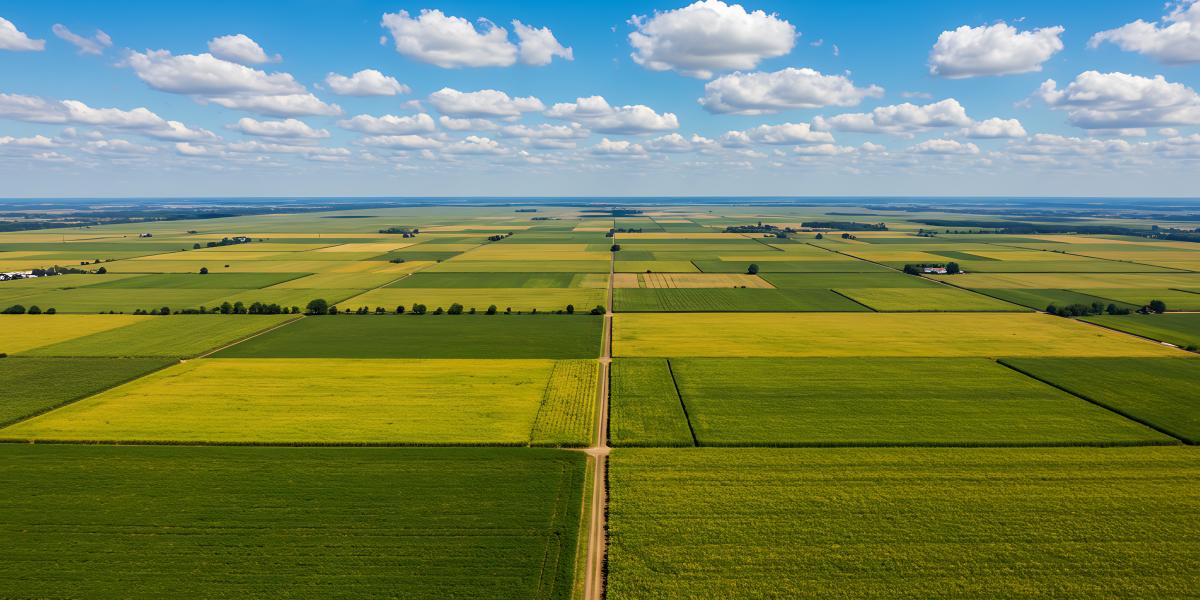
When Congress enacted the Farmland Protection Policy Act (FPPA) in 1981, it declared that a “continued decrease in the Nation’s farmland base may threaten the ability of the United States to produce food and fiber.” The statute—together with later summaries—announced a national policy to “minimize” the “unnecessary and irreversible” conversion of farmland to non-agricultural uses and required federal agencies to factor farmland into project decisions.
Four decades later, we know that the “vanishing farmland” crisis that birthed this law was largely a statistical mirage. Yet the FPPA has helped entrench the notion that the federal government has a collective claim on how land may be used and has quietly reinforced exclusionary, anti-housing land-use politics in metropolitan America. From a libertarian perspective, the problem is not just that the act’s empirical premise was weak. The deeper issue is that it presumes a quasi-national ownership of privately-held land, converting what ought to be private decisions into objects of bureaucratic supervision and political bargaining.
A Crisis Manufactured in Washington
The FPPA followed the US Department of Agriculture’s National Agricultural Lands Study (NALS), which warned that the United States was paving over three million acres of farmland per year and that irreplaceable “prime” soils were being permanently lost. NALS publications circulated with alarmist titles like, “Where Have the Farmlands Gone?” and their “three million acres per year” figure quickly became what one critic called a “magic number” in policy debates.
By the mid-1980s, agricultural economists and legal scholars were dismantling this narrative. Philip Raup’s “agricultural critique” of NALS argued that the study had exaggerated “farmland loss” by conflating cropland with other rural open space and by counting shifts in statistical definitions as physical disappearance of land rather than changes on paper. William Fischel’s review, “The Urbanization of Agricultural Land,” reached similar conclusions, noting “counterintuitive” estimates—such as Connecticut supposedly doubling its urban land area despite slow population growth—and emphasizing that functioning land markets already allocate agricultural land to its highest-valued use.
Journalist Gregg Easterbrook later chronicled the story in “Conservation: Vanishing Land Reappears.” He showed how the USDA’s Soil Conservation Service quietly retracted NALS’s most dramatic claims, acknowledging that earlier figures for land being “paved over” had been “markedly overstated” and that urbanization rates had not exploded. By the time the data had been corrected, however, the FPPA was law and a new federal farmland-protection apparatus was in place.
Legal scholar Jim Chen noted that the FPPA’s findings section enshrined the fear that shrinking farmland threatened national food security, only to be contradicted by later USDA technical work and by Easterbrook’s statistical autopsy. The “crisis” rationale for the FPPA was dubious even at enactment and has grown weaker with every decade of better data.
Farmland Preservation as Metropolitan Exclusion
Defenders of the FPPA sometimes argue that the law is harmless because it is “primarily procedural.” As USDA’s Natural Resources Conservation Service emphasizes, the FPPA does not formally prohibit development; instead, federal agencies must identify farmland affected by their projects, apply USDA scoring criteria, and “minimize” unnecessary conversion where practicable, following regulations. American Farmland Trust’s Farmland Information Center likewise presents the law as a neutral coordination tool.
But there is no such thing as a neutral procedure in land use. The FPPA inserts federal scoring, forms, and bureaucratic consultation into any federally assisted project that might convert farmland—from highways and airports to water infrastructure and housing. It also encourages federal “compatibility” with state and local farmland-protection policies, creating an incentive for activist state and local governments to legislate aggressive restrictions and then point to those as constraints the federal government must respect.
The economic consequences of this framework are not distributed evenly. As Fischel later warned, and as subsequent empirical work has confirmed, constraining the supply of developable land on the urban fringe tends to raise land and housing prices for those who do not yet own property, while conferring capital gains on existing landowners inside the protected boundary. Studies of farmland-preservation programs frequently find that preservation increases nearby housing prices and land values.
To a libertarian, this is precisely the problem. The FPPA—and the array of easement and preservation programs built atop its logic—transfer wealth from future residents and renters to incumbent landowners and existing communities. Harvey Jacobs’s work on “social equity in agricultural land protection” and Lori Lynch’s review of the economic effects of farmland preservation both stress that rising land values may please local governments and homeowners but come at the expense of lower-income households and would-be newcomers.
Corwin Johnson and Valerie Fogleman, in “The Farmland Protection Policy Act: Stillbirth of a Policy?”, warned that NALS-inspired farmland-retention policies risked empowering “parochial interests” to block new housing under the banner of protecting the countryside. Restrictions justified as environmental or agricultural measures routinely become tools for exclusionary politics, helping incumbents cartelize the supply of developable land and price out less wealthy entrants.
From the perspective of libertarian property theory, such arrangements amount to a partial socialization of land. The owner’s formal title remains, but critical sticks in the bundle of rights—to subdivide, to sell for development, to change use—are expropriated and redeployed according to political criteria. The result is a politicized hybrid in which bureaucrats and organized local interests decide who may live where and on what terms.
Rothbard, Simon, and the Myth of National Ownership
In For a New Liberty, Murray Rothbard devoted a chapter to “Conservation, Ecology, and Growth,” criticizing the habit of treating natural resources as if they were collectively owned by “society” and managed by the state. He emphasized that conservation emerges from secure private property rights and market prices, not from bureaucratic land-use plans. Julian Simon’s The Ultimate Resource applied similar reasoning to resource pessimism, showing that fears of “running out” of land, minerals, or food have repeatedly failed in the face of human ingenuity and substitution.
The FPPA embodies precisely the collectivist fallacy Rothbard and Simon warned against. Its findings section speaks of “the Nation’s farmland base” as if there were a single entity whose acreage must be preserved in the aggregate. There is no such thing; there are only individual parcels, each owned (or homesteaded) by particular persons or firms, each subject to changing patterns of demand and opportunity. When land near a growing city is converted into housing, warehouses, or factories, this is not a loss to “the nation”; it is a reallocation of scarce resources to higher-valued uses as revealed by voluntary exchange. If agricultural output ever genuinely became constrained, rising food prices would incentivize intensification, technological improvement, or conversion of marginal land elsewhere into cropping—the very process Simon documented.
Toward a Libertarian Farmland Policy
Some analysts sympathetic to preservation, such as Michael Bunce in “Thirty years of farmland preservation in North America,” concede that crisis rhetoric about “disappearing” farmland was simplistic and alarmist, even as they call for better-designed preservation tools. Johnson and Fogleman likewise describe the FPPA as a “stillbirth,” crippled by poor implementation and vulnerable to empirical and distributional criticism, yet they stop short of rejecting federal involvement altogether.
From an Austro-libertarian perspective, the appropriate response is not to “fix” the FPPA’s procedures or tweak its scoring systems. It is to repeal the act and unwind the federal role in farmland protection. There is no moral or economic justification for treating the pattern of land use as a public good to be engineered from Washington. If a landowner voluntarily sells or converts farmland to housing, so long as he does not invade the person or property of others, there is no legitimate basis for state interference.
A more just and effective approach would rely on voluntary conservation and market mechanisms:
Private land trusts and conservation organizations that purchase development rights or easements with willing donors’ funds, rather than with tax expenditures and subsidies that transfer wealth to selected landowners;Contractual covenants and homeowners’ associations that internalize amenity preferences among consenting owners;The rollback of zoning, growth controls, and FPPA-style overlays that, as Rothbard and later Austrians argue, cartelize land and systematically raise housing costs;Market-based environmental remedies that protect neighbors from genuine harms without dictating land use wholesale
Forty years of experience have not vindicated the FPPA’s alarmist premises or its quiet socialization of land. If Americans value open space and pastoral landscapes, they can and should express that preference through voluntary institutions and price signals, not through crisis-driven statutes that treat private farmland as a national asset to be managed from above. A genuinely libertarian land policy would put decision-making back where it belongs: in the hands of owners and entrepreneurs, guided by prices, not panic.














-1024x683.jpg "Strait Outta Hormuz: Getting the Iran Oil Story Straight")