Published on December 1st, 2025 by Bob Ciura
High-yield stocks pay out dividends that are significantly higher than the market average. For example, the S&P 500’s current yield is only ~1.2%.
High-yield stocks can be particularly beneficial in supplementing income after retirement. A $120,000 investment in stocks with an average dividend yield of 5% creates an average of $500 a month in dividends.
Horizon Technology Finance (HRZN) is part of our ‘High Dividend 50’ series, which covers the 50 highest-yielding stocks in the Sure Analysis Research Database.
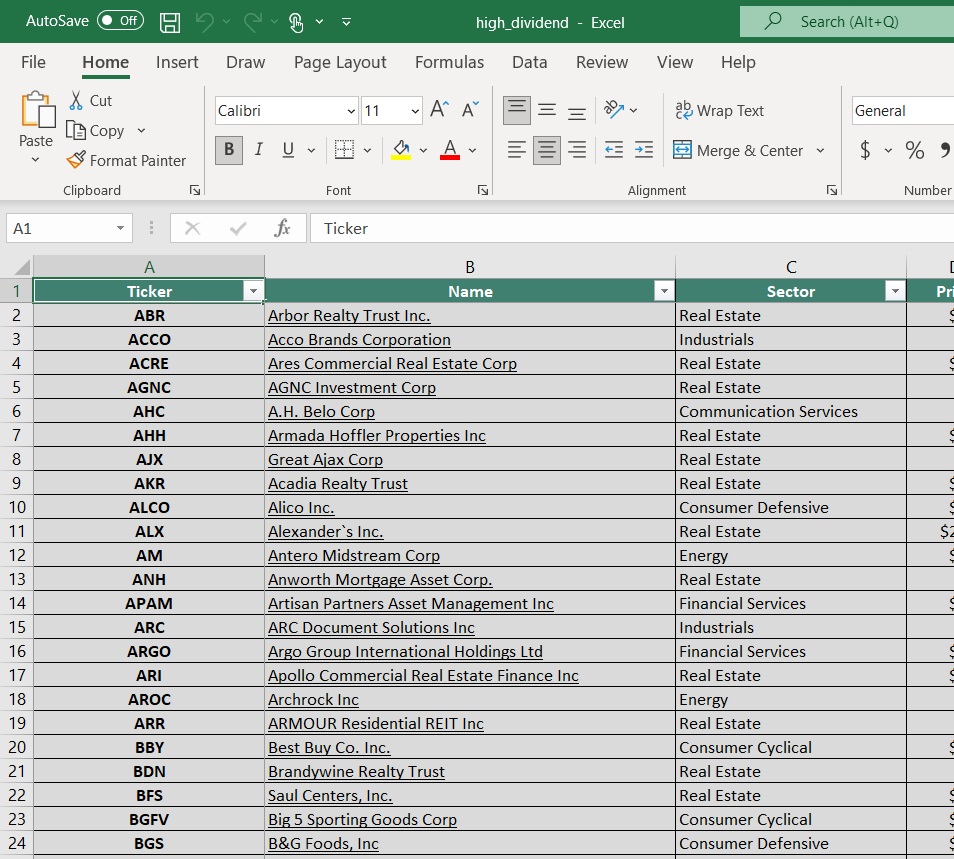
We have created a spreadsheet of stocks (and closely related REITs, MLPs, etc.) with dividend yields of 5% or more.
You can download your free full list of all securities with 5%+ yields (along with important financial metrics such as dividend yield and payout ratio) by clicking on the link below:
Next on our list of high-dividend stocks to review is Horizon Technology Finance.
Business Overview
Horizon Technology Finance is a BDC (Business Development Company) seeking to provide venture capital to small and medium-sized companies, mainly in the life sciences, technology, healthcare-IT sectors, and sustainability, which account for around 42%, 33%, 15%, and 10% of its portfolio, respectively.
The company has been able to generate attractive risk-adjusted returns through directly originated senior secured loans and additional capital appreciation through warrants, featuring a last-quarter portfolio yield of 15.8%.
The company has topped the typical industry average IRR of around 10% from its loan coupons by engaging in commitment fees, guidance fees, and potential equity rights, maximizing its total yield. Horizon Technology has gross investment income of around $60 million annually.
On October 28th, 2025, Horizon announced its Q3 results for the period ending September 30th, 2025. For the quarter, total investment income rose 6.9% year-over-year to $26.3 million, driven primarily by higher fee and interest income on investments from the debt portfolio.
The company’s dollar-weighted annualized yield on average debt investments in Q3 of 2025 and Q3 of 2024 was 18.6% and 15.9%, respectively.
Net investment income per share (IIS) remained flat year-over-year at $0.32. Net asset value (NAV) per share improved to $7.12, up from $6.75 in the prior quarter, but this was down from $9.12 in the prior year.
Horizon’s undistributed spillover income stood at $0.93 per share at quarter-end, maintaining a strong income cushion to support future dividends. Our assumptions for FY2025’s IIS/share stand at $1.12.
Growth Prospects
Horizon’s investment results have been quite stable over the years, despite many of its peers in the sector suffering due to the oversupply of cheap financing.
Lower market rates caused BDCs to keep refinancing their loan assets at gradually lower rates up until recently, damaging their investment results.
However, Horizon’s niche operations that require more unusual expertise in industries like biotech have maintained their higher ROIs amid a lack of cheap loans for such risky sectors, including early-stage tech companies.
As its successful due diligence record has made possible, the company has maintained quite stable dividends, paid out monthly, providing smooth capital returns to its investors. Horizon’s sectors of interest are likely to remain quite high-risk and capital-hungry.
That said, we expect a stable IIS/share through 2030, as the direction of rates several years ahead is uncertain.
Competitive Advantages & Recession Performance
Horizon’s dividend remained well-covered in recent years, including during the COVID-19 pandemic. Still, we estimate that a dividend cut could occur based on its ongoing performance.
Regardless, the BDC’s competitive advantage lies in its team’s expertise to identify the most promising companies in risky sectors, which requires professional knowledge and experience beyond finance.
Horizon’s stable results over the years are also visible in its stock price, which is typically less volatile than its BDC peers.
With $130.9 million in cash and $329.0 million of credit facility capacity available, the company’s liquidity remains robust.
Additionally, Horizon reported a net debt-to-equity ratio of approximately 1.34, slightly above its targeted leverage range of 1.20, while its asset coverage ratio remained healthy at roughly 167%.
Dividend Analysis
After providing its most recent quarterly results, management reinforced its confidence in the dividend’s stability by declaring three forward monthly distributions at a rate of $0.11 per share, payable through March 2026.
HRZN pays monthly dividends which cumulatively result in an annualized payout of $1.32 per share. This results in a very high yield of nearly 20% at the current share price.
The company also paid special dividends of $0.05 in each of the past two years.
However, with expected 2025 investment income per share of $1.12, Horizon has an expected dividend payout ratio of 118% for the year.
A payout ratio above 100% means the company is distributing more to shareholders in dividends than it is earning, which makes for an unsustainable situation.
Therefore, we view the dividend as highly risky, with potential for a future dividend cut, particularly in a recession.
Final Thoughts
Horizon should be able to keep leveraging its niche expertise in tech and life sciences, demanding a higher return on its investments, which should continue to result in very high investment yields.
We view Horizon as one of the highest-quality BDCs amongst its competitors. Stemming from the potential for a valuation multiple expansion and the very high tailwind and the 19.7% yield, we forecast high potential returns.
However, we rate shares as a sell at current prices due to the lack of consistent dividend increases. Also, we think that a distribution cut is possible.
High-Yield Individual Security Research
Other Sure Dividend Resources
Thanks for reading this article. Please send any feedback, corrections, or questions to [email protected].












-1024x683.jpg "Strait Outta Hormuz: Getting the Iran Oil Story Straight")