A group of Separatists, whom we call the Pilgrims, originally abandoned England for Holland but they found life there too routine, too easy. Life should be a challenge, and they weren’t being tested enough. According to William Bradford, their leader, a few preferred the prisons of England to the liberties of Holland, which they considered an affliction.
They left Holland, passed through England, and sailed on the Mayflower for America. When they arrived on the Massachusetts coast they found an abandoned Indian village decimated by a three-year plague that began in 1617. As John M. Barry, author of Roger Williams and the Creation of the American Soul, writes,
The English did not fear this plague. They believed God had used it to clear the land for them. They called it Plymouth Plantation. Ninety-nine passengers disembarked from the ship. In less than a year only fifty were still alive.
Unlike the Separatists—who had no backing in England—a ship of financed Puritans arrived in 1624 on the northern tip of Massachusetts Bay with ambitions to build a new world. Their investors—known as the Massachusetts Bay Company, or simply, the Bay Company—hoped the Puritans would establish a flourishing economy, convert the Indians, and establish the right kind of Protestant religion, as they defined it.
The arrivals established a settlement in Salem (Hebrew for “peace”) forty miles by sea north of Plymouth. The settlers were families with livestock and supplies, most of them Puritans. Five years later, in 1629, the Bay Company sent five ships of families, 350 people total, to Salem. They consisted of “governors, able Ministers, Physicians, Soldiers, Schoolmaster, Mariners, and Mechanics of all sorts. . .”
Later in 1629, the Bay Company sent another ship to Salem, with John Winthrop chosen as governor, that included combat veterans. Winthrop told the passengers they were establishing a “City upon a Hill” and that the “eyes of all people are upon us.” When they arrived in Salem on June 12, 1630, they found more than 80 of the previous fleet dead and many others weak and sick.
Roger Williams Looks for a Home
Back in England, William Laud intensified his campaign to rid the English church of “unworthy” ministers, one of which was Roger Williams.
Williams knew his convictions made him more than eligible for imprisonment and torture. Sailing on the ship the Lyon, Williams and his wife, along with John Winthrop Jr., left Bristol December 1, 1630 and anchored in Boston harbor on February 5, 1631.
The Boston church offered Williams the position of teacher. For Williams, 28, it would’ve been a great opportunity, but he declined, telling them, “I dare not officiate an unseparated people.” The church took offense at his reply. According to Williams, the state had no authority to govern an individual’s relationship with God—none whatsoever.
Williams then joined the settlement in Plymouth—home of the Mayflower Pilgrims—to become a farmer. He was received with open arms by everyone, including the two governors, Bradford and Winslow. He became active in the church and soon became an unpaid assistant pastor.
Williams Uprooted
Williams began his proselytizing, not by preaching, but by learning the Indians’ language. He developed friendships with them, began trading with them, and traveled among several tribes. He entertained them in his home. He reached the unpopular conclusion that the Indians owned the land they occupied, and that the English had no title to it unless granted by the Indians. He charged King Charles for telling “a solemn public lie” for claiming it belonged to the settlers.
Later, in early fall of 1633, with Governor Bradford’s encouragement, Williams and a few supporters left Plymouth and returned to Salem. He settled into a spacious home and lived an active social life.
Conformity was central to Salem; it spread even to the stabilizing of profits and wages. It especially applied to childrearing. If possible, children should not know they possess a will of their own. Education lay in humility and tractableness.
Any offenders were subject to excommunication or banishment from the settlement. Any banished person who returned to Massachusetts was subject to punishments ranging from fines to death.
Even so, Williams remained in Salem, planting and harvesting crops, and continuing his relationships with the Indians. He acquired fluency in their language and wrote a book about it. The Salem church made him its teacher, further irritating the Boston magistrates. Williams was ordered to appear in Boston to defend himself, but he failed to show.
Governor John Winthrop ordered a party of soldiers to capture Williams and put him on a boat to England, but a fierce blizzard delayed them for days. While they waited, Williams was tipped off by a secret messenger sent by Winthrop that he was targeted for arrest and deportation:
For himself, dressing against the winter, stuffing his clothes with the dried corn paste which Indians lived on for weeks at a time, with no time for sentimental goodbyes to friends, he fled his home, a burgher’s cottage built to last and which would stand for two hundred and fifty more years (!), until it was torn down to make way for progress. Williams would never see it again.
Williams entered the forest and blizzard on foot. With the snow already deep, it was an exhausting trek that lasted for miles. He survived only because Indians took him in.
In early spring of 1637, he scouted out land owned by the Narragansett Tribe, with whom he had a close relationship. Canonicus—the tribe’s sachem—and his nephew Miantonomi, gave him permission to settle there.
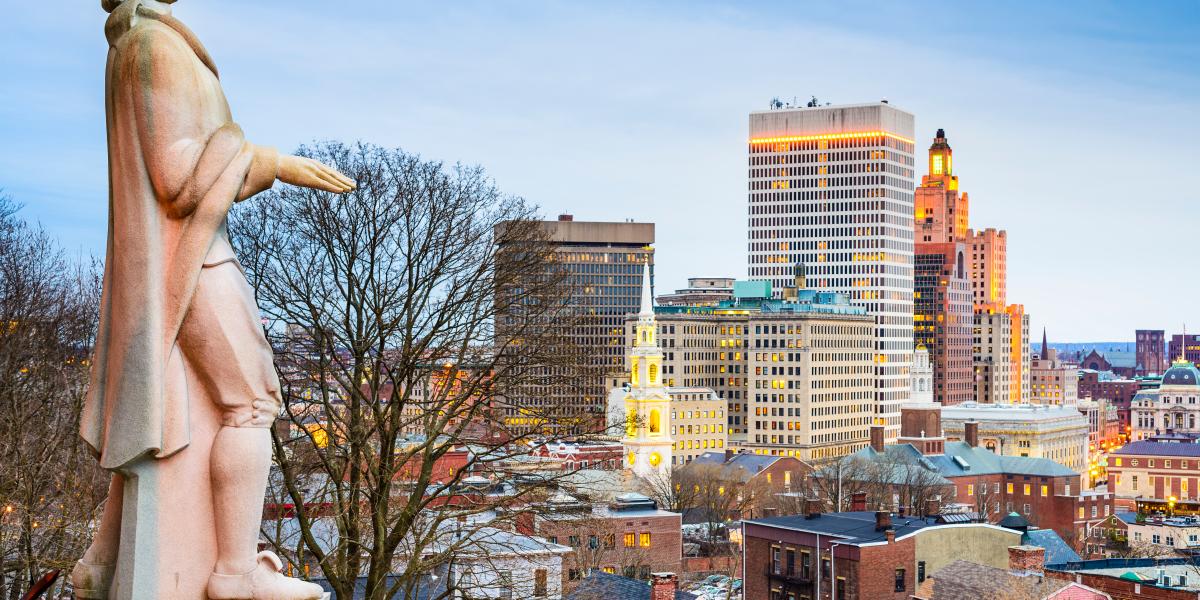
Providence
Williams was fully free in the wilderness. He attributed God’s merciful providence for leading him there during his darkest hours. He called the place Providence, so that “it might be for a shelter for persons distressed for conscience.”
As others straggled in, they realized they had no agreement about how to govern themselves. Williams—the owner of the land—drew upon his experience as an understudy with English jurist Sir Edward Coke (pronounced “cook”), who said every Englishman’s home was his castle, and from Queen Elizabeth, who sought “no window into men’s souls.”
He maintained that governments governed only with the consent of the governed, rejecting both the divine right of kings and the Puritan view that governors were accountable only to God, not the people. He could never forget that savages had saved his life, not his friends and fellow Christians. In Providence, people worshiped in their homes, not a church, and their homes were arranged in a straight line, not around a town common, as found in the Massachusetts settlements. A meeting place would not be built in Providence for another half century. In Conceived in Liberty, Rothbard has high praise for Williams:
The enormous significance of Roger Williams’ successful flight and settlement of Providence. . .was now becoming evident. For Williams’ example held out a beacon light of liberty to all the free spirits caught in the vast prisonhouse that was Massachusetts Bay.
Conclusion
Rhode Island’s legacy as a staunch defender of freedom has not been completely lost with the passage of time. On May 4, 1776, it became the first colony to repudiate its allegiance to England, the fourth among the newly-independent states to ratify the Articles of Confederation on February 9, 1778, and it became the last state to ratify the Constitution on May 29, 1790, but only after assurances that a Bill of Rights was forthcoming and under threats of crushing tariffs from other states. It was also the only state to boycott the Constitutional Convention. (For those who think the boycott was a blight on Rhode Island’s record, I invite them to consider the research of Leonard L. Richards in his Shays’s Rebellion: The American Revolution’s Final Battle).
Like all US states, Rhode Island today suffers from politics, debt, and taxes; more so than most states. Taking money out of the hands of those who have earned it and putting it in a political pot to redistribute is still regarded as sound policy and morally respectable. Yet there is hope for its future. One might think the state’s full name would be regarded by most as obsolete in the 21st century’s free lunches, political correctness, identity politics, and war. But residents don’t think so. In 2010 they voted 78 percent to 22 percent to retain the full name—the State of Rhode Island and Providence Plantations. Retaining the original name keeps current Rhode Islanders connected to the tough, libertarian thinker who founded their state.