The New Landscape of War
The battlefields of Ukraine have revealed a transformation unprecedented since the mechanized wars of the twentieth century. As Baluyevsky and Pukhov note in “Digital War – A New Reality” (Russia in Global Affairs, 2025), “the fog of war has almost entirely lifted.” Swarms of drones, networked sensors, and reconnaissance satellites have turned the front into an arena of persistent visibility. Every emission, heat signature, and vehicle movement risks instant detection and destruction. The authors call this a “zone of total annihilation,” extending dozens of kilometers behind the line of contact.
This new transparency upends the logic of mass. The “era of large battalions is over,” they write, and survivability now depends on dispersion, concealment, and electronic adaptation rather than numbers. The decisive contests are not between armies, but between networks: whose data flows faster, whose autonomous systems coordinate better, whose decision loops are more resilient under attack.
For elite infantry forces, this means a fundamental change in mission. Once used to break through enemy lines, elites are now required to survive, sense, and integrate. They act as low-signature human nodes that connect sensors, drones, and precision fires, exercising judgment when automation falters. The lesson of Ukraine is not that humans are obsolete, but that only the best-trained, most adaptive humans can endure in a battlespace dominated by machines. This article describes the nature of this military transformation.
More coordinated drone swarms. This is what 1000 hive mind drones looks like.
Now imagine them even smaller, faster, and completely controlled by AI.
Conventional warfare is over. pic.twitter.com/UbJd1pCWqM
— Green Beret Nap Time (@GBNT1952) February 13, 2025
From the Physical to the Cognitive Elite
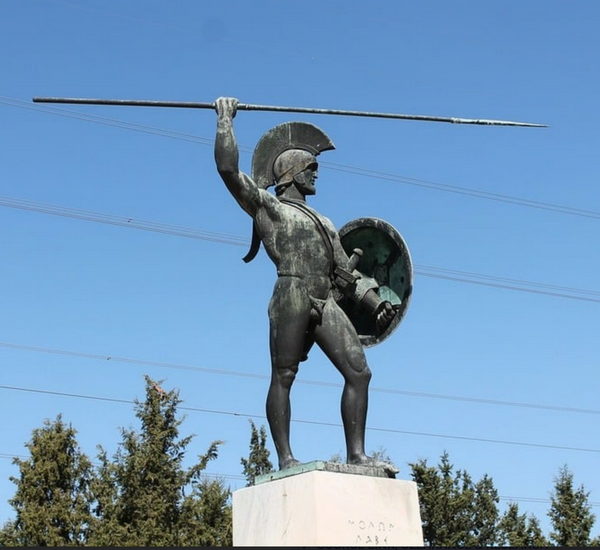
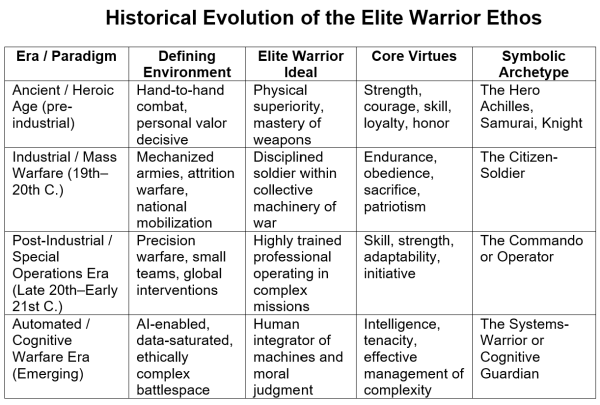
For centuries, military elites were defined by their bodies. The hoplite, the knight, the ranger, and the commando were those who could fight and win when facing every hardship of the battlefield. They embodied endurance and physical courage. Intensive training strengthened the body and fortified the will to prevail in physical combat.
Spartan warrior
But the frontier of excellence has shifted. The modern battlefield’s limiting factor is not muscle but cognitive bandwidth: the ability to perceive patterns amid digital noise, integrate contradictory data streams, and decide faster than the enemy. Elite soldiers must navigate a continuous flood of sensor feeds, AI recommendations, and adversarial misinformation. In this environment, the mental discipline to remain calm, analytic, and responsible becomes the true mark of superiority.
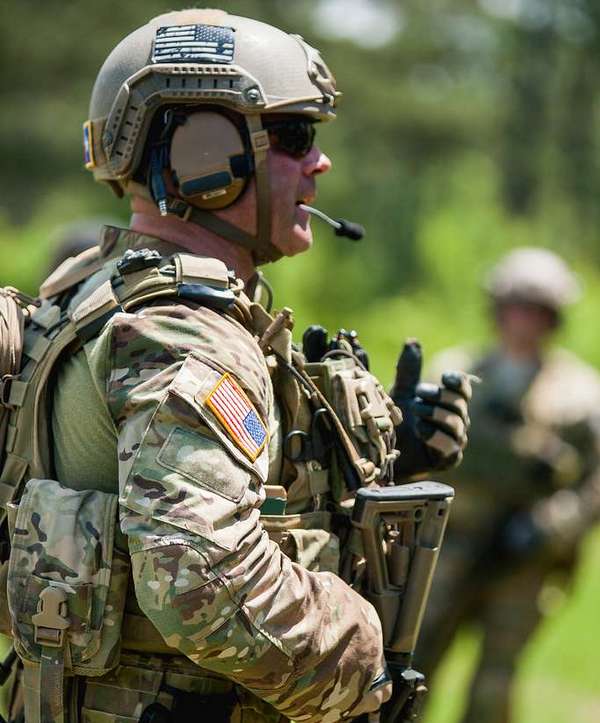
Modern special Forces soldier
This does not diminish the physical dimension; it reframes it. The body becomes the support system for the mind: strong enough to endure stress and deprivation, yet trained above all to maintain clarity under overload. The future elite is the soldier who can think precisely in an information-saturated environment.
Automation and the Narrowing of the Human Military Domain
As autonomous and semi-autonomous systems proliferate, human combatants occupy an ever-narrower slice of the battlespace. Drones clear trenches; robotic mules carry supplies; machine-vision systems identify targets. Humans remain indispensable only where disambiguation, ethics, or improvisation are required. These are precisely the areas where elites will concentrate.
In this sense, the role of the elite becomes paradoxical: they operate in the smallest physical space but carry the heaviest moral and strategic weight. They are the last circuit breakers in a chain of machine decision-making. Their courage is not only physical but epistemic—the readiness to assume responsibility in uncertainty, to override automation when it conflicts with judgment. In digital war, courage means discernment.
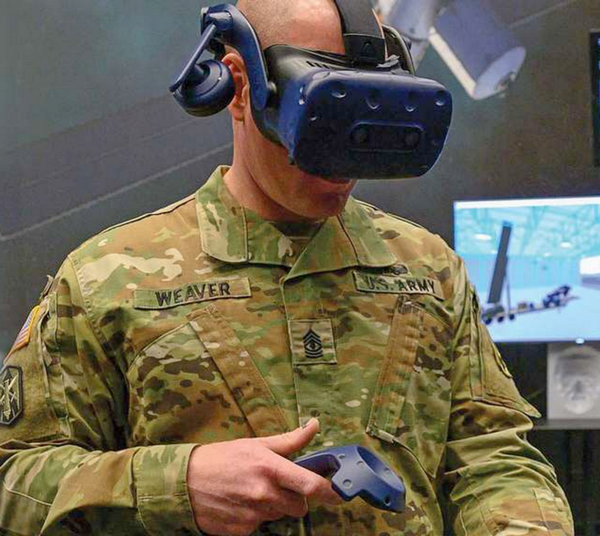
Soldier with VR headset
The New Warrior Ethos
The traditional warrior ethos—valor, endurance, sacrifice—was born in a world where the decisive virtue was willingness to risk hardship and death. That remains, but it is joined by a new set of traits: broad intelligence, disciplined restraint, tenacity of purpose, and steadiness under “informational fire.” The modern elite must live with constant operational complexity and exposure to multiple data streams whose reliability is uncertain.
The definition of battlefield prowess is expanded to include the capacity to think clearly when complex decisions must be made in seconds; honor becomes fidelity to truth when algorithms tempt with false precision. The battlefield hero of the twenty-first century is not the warrior who charges the hill, but the one who knows when, where, and if to trigger automated fire.
Selection and Training in the New Paradigm
Selection for elite units once meant physical ordeal: long marches, sleep deprivation, resistance to pain. Those will remain, but they will be joined by cognitive stress tests: information overload simulations, decision-making under electronic denial, and moral reasoning under pressure.
Neuroscience and behavioral analytics are likely to supplement traditional training. Brain-state monitoring, adaptive simulation, and virtual-reality stress inoculation will help identify those who can maintain focus under chaotic feedback. Language, coding, and system-management skills will rank alongside marksmanship. Elite soldiers will be expected to operate mini-UAVs, analyze electronic spectra, and exploit battlefield AI, all while executing conventional small-unit tactics.
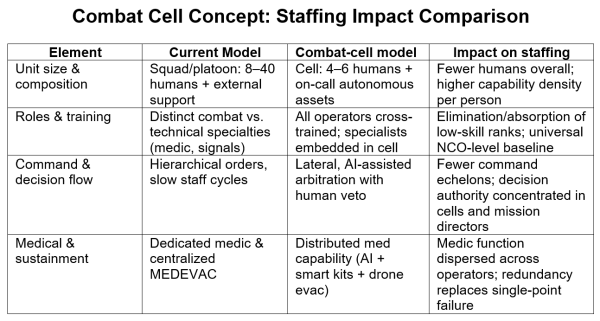
Leadership training will evolve as well. Commanders must orchestrate teams that function as micro-networks: self-healing, decentralized, and data-competent. The elite platoon of the future will look less like a squad of riflemen and more like an armed sensor-fusion cell.
A New Organizational Model for the Digital Infantry Force
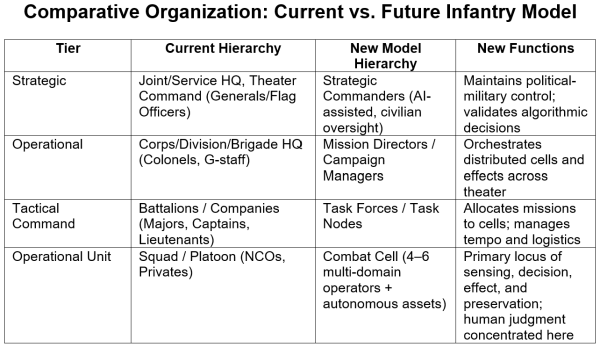
If future elite training centers on cognitive mastery of digital resources, military organization would evolve accordingly. The basic building block of the future infantry force would likely be the “combat cell,” a small, highly cross-trained unit heavily augmented by AI and robotic assets. Most functions of a traditional infantry platoon or squad would be compressed into this cell, and it would have greater operational discretion enabled by superior reconnaissance, communications, and firepower resources. Groups of these cells would be assembled and coordinated by higher echelons of command, all with the benefit of AI support.
Erosion of the Conscription Model
The rise of automation accelerates the end of conscription. In a world where every movement can be tracked and destroyed, untrained soldiers are liabilities, not assets. Large mobilized armies suited the industrial age; digital war rewards skill over scale.
Conscripts cannot be trained fast enough to manage complex systems or to exercise sound judgment under machine supervision. The future belongs to smaller, professionalized forces where every member is a career technician, analyst, or integrator. Even states that retain conscription will likely shift it toward technical or cyber service rather than front-line combat.
This concentration of expertise will widen the gap between elite and non-elite units. The elites will resemble special operations and cyber forces blended into one: humans selected for their ability to operate in both kinetic and informational dimensions.
Social and Cultural Consequences
As the elite warrior evolves, so too does society’s image of the soldier. The old archetype, the strong, stoic defender, reflected an industrial society that valued strength, mass, and endurance. The new archetype, the analytical, self-aware professional, reflects an information society that prizes intelligence, adaptability, and judgment.
This shift carries risks. The further the elite diverges from public experience, the greater the potential alienation between military and society. When the mechanisms of warfare becomes invisible, conducted by remote specialists and semi-autonomous systems, the traditional link of shared sacrifice weakens. Civilian admiration may turn into detached respect, or even suspicion, of a class of “technocratic warriors.”
To preserve legitimacy, militaries will need to cultivate new moral narratives emphasizing stewardship and accountability. The elite warrior must be understood not as an agent of destruction but as a guardian of thresholds—a human conscience embedded within automated violence.
A New Hierarchy of Judgment
Automation creates efficiency but also opacity. AI systems can identify patterns no human sees, but may reach erroneous or unsound conclusions. The elite soldier’s new role is to interpret—to decide when to trust the algorithm and when to reject it. This requires both technical fluency and philosophical grounding.
In this sense, the elite become specialists of judgment. They wield not massed firepower but interpretive authority. They are entrusted with the discretion to translate machine output into moral action. The old officer corps claimed legitimacy through birth or command; the new elite earns it through competence and credibility in a domain where errors propagate at machine speed.
Their burden will be psychological as well as ethical. The modern elite will fight in isolation, controlling distant systems whose consequences are immediate but unseen. Maintaining emotional balance and moral clarity in such conditions will demand a new kind of resilience—an internal code as rigorous as any physical discipline.
The Shrinking Circle of the Human Elite
All these transformations converge in a general trend: as automation deepens, the circle of human participants grows smaller. The next stage in the evolution of military elites will not be expansion, but contraction. As artificial intelligence assumes more tactical and strategic functions, the number of human decision-makers at the center of combat will narrow to an unprecedented degree.
Already, prototype systems in the United States, China, and Israel can plan strikes, prioritize targets, and allocate munitions faster than any staff officer. Future “AI battle managers” will not merely advise but act, integrating sensor data and effectors across multiple domains. In such an environment, even the most capable human operators will be curators of automated decisions rather than continuous participants in them.
The elite soldier’s role will thus bifurcate. A few will remain in the field, acting as human conscience and contingency managers within autonomous formations. A smaller number still, strategic elites, will supervise at the theater or national level, validating or vetoing algorithmic choices. The rest of the military hierarchy may flatten around machine intelligence that performs staff work, logistics optimization, and even deception planning.
This will have profound ethical and organizational consequences. The circle of human agency will shrink, concentrating both power and accountability in an ever-tighter cadre. Elite status will depend less on physical or cognitive prowess and more on trustworthiness, interpretive judgment, and moral literacy—qualities that justify the continued presence of humans inside lethal decision loops.
As automation of warfare advances, the true elite may become fewer but weightier: each human decision will carry more strategic consequence, because each will stand against the momentum of machine logic. Their authority will derive not from superior calculation, but from the capacity to question the algorithm itself: to perceive when an AI-generated answer is not the right one.
Continuity and Renewal
Despite all this change, the essence of the elite remains superiority through mastery. Whether wielding spear, rifle, or terminal, the elite has always stood at the leading edge of armed conflict. What changes are the enabling elements: steel to silicon, muscle to data, but not the calling. The same martial virtues, discipline, skill, judgment, courage, are transposed into a new key. The algorithmic elite carries forward the lineage of warriors who accepted the challenges and responsibility of combat. Their bravery lies in comprehension, their strength in restraint. In this way, automation of warfare does not end the warrior tradition; it purifies it. It strips away ritualized violence and leaves the essential task: securing victory by those capable of bearing the stress of combat and the weight of decision.
Yet there is danger in overestimating the potential of this new military elite paradigm. Advanced militaries may present their professional, high-technology cadres as instruments of precision and restraint, but rival states will continue to seek competitive military advantage. The diffusion of AI-enabled command systems and cognitively trained small units will not necessarily reduce the frequency or intensity of conflict. On the contrary, as decision cycles shorten and modernized elite formations multiply across competing nations, the threshold for escalation could narrow. Each state’s pursuit of “warfighting precision” could become another form of arms race, one measured not in firepower, but in speed, autonomy, and informational dominance.
Conclusion
The transformation of military elites marks the passage from heroic warfare to cognitive warfare. The decisive factor in battle is shifting from physical dominance to informational adaptation. Wars of the future will be fought not by masses of conscripts, but by small, professional cadres operating within webs of machines and data. In that environment, the highest virtue will be clarity of judgment: the ability to discern relevant truth, act decisively, and attain objectives amid algorithmic and informational overload. The elite warrior of tomorrow will not be the strongest or most ruthless, but the one who can integrate intelligence, technology, and ethics into effective action. Future warriors will fight less to destroy and more to navigate toward victory, winning battles in a world where understanding has become the most powerful weapon.