The federal government shutdown in recent weeks has highlighted the full cost of many government programs, including the food stamp program. Many people—especially the kind who don’t spend their time tracking federal spending—have been shocked by the fact that one in eight Americans—12 percent of the population—receives food stamps. That’s about 42 million people. Moreover, most food stamp recipients receive other forms of government “welfare” as well.
For many, these statistics flying around social media and among podcasters have served to highlight the sheer size of the American population that receives government money as a substantial portion of their income.
This raises an important question: if a sizable portion of a person’s income comes from tax dollars, should that person be eligible to vote himself access to even more tax dollars?
Some think not. This woman, for instance, received 64K likes when she stated: “I don’t think these people should vote. Honestly, how can you vote freely, when you’re being bought?”
She’s right.
This is a controversial take, to say the least. Yet, many people who act aghast at the idea would also surely regard it as a bad thing if a politician voted “yes” to awarding a government contract to his own company. This is because many people understand that being in a position to vote to send yourself more taxpayer money involves a conflict of interest. Historically, a member of a city council or legislature has often been expected to refrain from voting when he can personally benefit financially from his own vote. It is understood that anyone voting in this situation is not voting “freely” but is biased in favor of enriching himself at the expense of others.
Yet, few people think twice when a voter casts his ballot for a politician who has promised to give that voter more taxpayer money. Sometimes, at the state level, voters will cast their ballot to directly enrich themselves through ballot initiatives and referenda. This, we are told is all perfectly fine because voting is allegedly some kind of sacred right.
How Many People Live off Taxpayer Funds?
How many voters—or at least potential voters—are using the taxpayers as their personal piggy banks?
Although recent controversies over food stamps have highlighted that particular program, food stamps are just the tip of the iceberg. The number of Americans who receive monthly taxpayer-funded income goes far beyond the 41 million on food stamps. For example, 72 million Americans receive Social Security, and 65 million of those also receive tax-funded health services through Medicare. Yes, recipients of Social Security like to claim that they “paid in” to the system and now receive their payments out of some kind of imagined trust fund. The reality, of course, is that Social Security and Medicare are 100% funded by current workers. That is, the programs are nothing more than a wealth transfer from workers to retirees. In every way except the rhetoric, Social Security and Medicare are just welfare programs, and every politician knows that his elderly voters expect him to keep ripping off current taxpayers to keep the elderly voters happy.
There are also 70 million Americans on Medicaid. In many cases, Medicaid services amount to the equivalent of thousands of dollars per month for recipients.
We can’t just add these numbers up, however, as there is a lot of overlap in the programs. For example, 78 percent of food stamp recipients are also eligible for Medicaid. Moreover, since we’re talking about all of this in the context of voting, we should remove children—who cannot vote—from the counts.
Medicare recipients are nearly all on Social Security, so the “Social Security and/or Medicare” group totals about 72 million adults. To this we can add the adult Medicaid recipients who total about 60 percent of total recipients. That’s about 42 million adults. But we must also remove the 12 million Medicaid recipients who are also on Medicare and so are already counted in the Medicare category. That means we can add 30 million adult Medicaid recipients to the 72 million on Social Security. Then, we can add the adult food-stamp recipients who are not already counted under the Medicaid category. That’s another 5.4 million adults. That brings us to a total of about 107 million adult US residents on some form or welfare—and we’re not even counting TANF, rental assistance (Section 8), or other smaller programs here.
Don’t Forget Taxpayer Funded Government Employees and Contractors
Of course, people receiving so-called “social benefits” are not the only people who life off the largesse of the taxpayers. There are at least 10 million others whose paychecks come from the taxpayers. For example, there are 2.2 million federal civilian workers, 1.3 million military “service” members, 400,000 postal workers, 1.8 million workers funded by federal grants, and more than 5 million federal contractors. That latter category, of course, includes those well-paid engineers and white collar workers who make weapons for the Pentagon or “consult” for the departments of Agriculture, State, and other agencies.
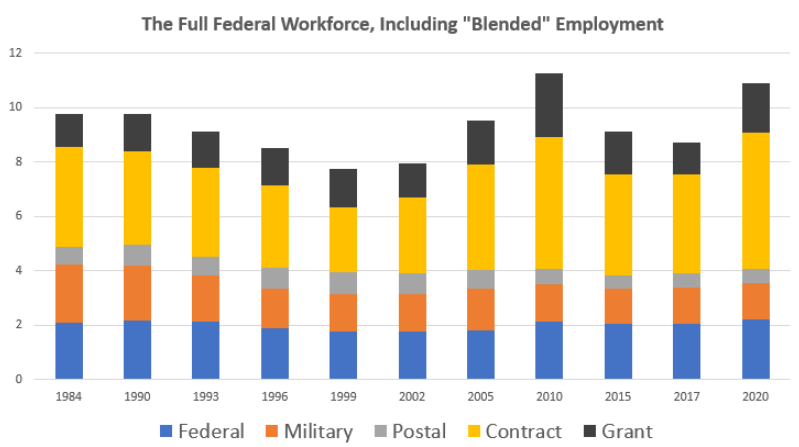
Source: Brookings Institution, (in millions of employees).
Sure, many contractors and federal employees will tell you that they aren’t in the same category as welfare recipients because they “work.” But from the point of view of tax transfers and fiscal policy, there is no difference at all. The issue here isn’t morality or virtue or whether or not someone “deserves” his tax-funded check. We’re simply pointing out the millions of Americans whose income is based on a forcible transfer of wealth from the taxpayers to the recipients’ pocket.
In this, federal contractors and other federal workers are often similar to all recipients of taxpayer money: they all have reasons as to why they have some sort of right to the taxpayer’s dime. Trying to convince these people otherwise is often a lost cause for the reasons that Upton Sinclair suggested long ago: “It is difficult to get a man to understand something when his salary depends upon his not understanding it.”
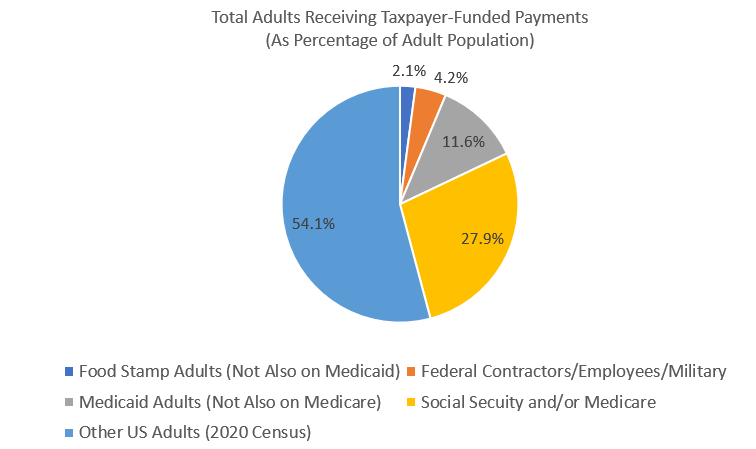
But whatever justification is given by the 117 million or so Americans living off the taxpayer’s “generosity,” the fact remains that at least a third of the population in the United States—nearly 45 percent of the adult population—receives a lot of money from the taxpayers. What’s worse, I’m not even including here all the local-government workers funded by federal dollars, students and faculty at federally funded colleges, or the users of smaller federal programs like LIHEAP. And yet we still find nearly half the US population is receiving taxpayer-funded salaries or “benefits.”
When the Bureaucrats/Welfare Recipients/Government Contractors Outnumber the Taxpayers
So, are we to seriously believe that these people would ever vote to substantially cut government spending? Every politician knows the answer to this. He knows that those millions of government contractors and military employees are simply not going to support a candidate who prioritizes any substantial cuts to military spending. Politicians know that opposing Social Security is political suicide. Nowadays, even opposing Medicaid has become a politically dangerous endeavor because so many millions of voters depend on the program’s taxpayer-funded services.
Even if only half of these 116 million taxpayer-funded adults actually vote, that’s a pretty big chunk of the 150 million who voted in the 2024 election. The entire US adult population, after all, is only about 258 million.
This all illustrates why the United States government will never rein in spending or seriously engage the problem of mounting debt and deficits short of an acute sovereign debt crisis or a (probably violent) coup-like event. The hundred-million or so Americans who rely on federal spending for their incomes won’t allow any real reform to ever occur. Runaway debt and spending is now baked into the system. These is no orderly or legal way out of this.
The political dynamic at work was explained by Ludwig von Mises long ago. In his short book Bureaucracy, Ludwig von Mises examined this problem in the context of government employees. In a section titled “The Bureaucrat as a Voter” Mises explains:
The bureaucrat is not only a government employee. He is, under a democratic constitution, at the same time a voter and as such a part of the sovereign, his employer. He is in a peculiar position: he is both employer and employee. And his pecuniary interest as employee towers above his interest as employer, as he gets much more from the public funds than he contributes to them.
This double relationship becomes more important as the people on the government’s pay roll increase. The bureaucrat as voter is more eager to get a raise than to keep the budget balanced. His main concern is to swell the pay roll.
Mises went on to examine the rise of powerful interest groups in France and Germany in the years before “the fall of their democratic constitutions.” He explained:
There were not only the hosts of public employees, and those employed in the nationalized branches of business (e.g., railroad, post, telegraph, and telephone), there were the receivers of the unemployment dole and of social security benefits, as well as the farmers and some other groups which the government directly or indirectly subsidized. Their main concern was to get more out of the public funds. They did not care for “ideal” issues like liberty, justice, the supremacy of the law, and good government. They asked for more money, that was all. No candidate for parliament, provincial diets, or town councils could risk opposing the appetite of the public employees for a raise. The various political parties were eager to outdo one another in munificence.
Mises concluded:
Representative democracy cannot subsist if a great part of the voters are on the government pay roll. If the members of parliament no longer consider themselves mandatories of the taxpayers but deputies of those receiving salaries, wages, subsidies, doles, and other benefits from the treasury, democracy is done for.
The logic of this position is simple. If the voting taxpayers (specifically, those who actually pay the bills) are outnumbered or outcompeted by the tax receivers, then, inevitably, the economic system will tend more and more toward economic profligacy, leading eventually to bankruptcy.
America is already a long way down this road.